

When a Partner Will Not Commit: Questions Worth Asking
When a partner will not commit, asking a reader to predict their answer usually keeps you waiting. A more useful reading turns the question around: what commitment means to you, whether you have asked for it plainly, what their words and actions show, and how long you are willing to wait. Those answers lead to a decision.
Key takeaways
- Asking "will they commit?" puts your next step on hold until someone else acts.
- People often argue about "commitment" for months before realizing they meant different things.
- Choose a calm evening, not the end of a wedding reception or the middle of a fight.
- No reader can tell you which of these applies to your partner.
- In a love and relationship reading , Astrologer and Psychic Vijayram may look at your own seventh house and its lord, Venus, Saturn's influence and your current dasha period.
It is late. The phone is lit up in a dark room, and the search bar holds the same few words people type every night: he wont commit, she will not talk about the future, why won't they move in. What most people want, underneath the search, is someone to tell them how it ends. Will they come around, or should I go?
A reader can be tempted to answer that question. An honest one will not, because the answer is not in anyone's chart but the other person's mind. What a reading can do is help you turn a prediction you cannot get into a decision you can make.
Why the prediction question keeps you stuck
Asking "will they commit?" puts your next step on hold until someone else acts. If a reader says yes, you wait. If a reader says no, you may still wait, hoping they were wrong. Either way, months pass and nothing changes. The question feels active but works like a pause button.
The alternative is to ask questions whose answers belong to you.
Five questions worth asking yourself first
1. What does commitment mean to me?
Exclusivity? Moving in? Meeting each other's parents? Engagement, marriage, children? A timeline? People often argue about "commitment" for months before realizing they meant different things. Write down specifically what you want, and roughly by when.
2. Have I asked for it clearly?
Hints, jokes and pointed remarks about friends' weddings are not the same as a direct request. Many partners who seem to avoid commitment have never actually been asked a plain question in a calm moment.
3. What have they said, and what have they done?
Listen to both. "I am not ready yet, but I want this" is different from "I do not see myself getting married." Notice whether actions match the words: do they include you in plans months ahead, introduce you to family, talk about a shared future without being prompted?
4. How long am I willing to wait, and for what sign?
Waiting can be reasonable. A partner finishing a residency, recovering from a divorce or saving for a down payment may need time. But open-ended waiting erodes people. Decide what change you need to see, and by roughly when, so waiting becomes a choice rather than a drift.
5. What will I do if the answer is no?
This is the hardest one, and the one most people avoid. Imagining it does not make it happen. It simply means you will not be making the biggest decision of the year in the worst moment of it.
Opening the conversation
Choose a calm evening, not the end of a wedding reception or the middle of a fight. Then keep it short and specific. Something like: "I love being with you, and I want us to live together within the next year. I would like to know honestly where you are with that." Then stop talking and listen. You may not get a full answer that night. Agree to come back to it within a few weeks, and notice whether they do.
Common reasons people hesitate
No reader can tell you which of these applies to your partner. Only a conversation can. But knowing the range helps you ask better questions:
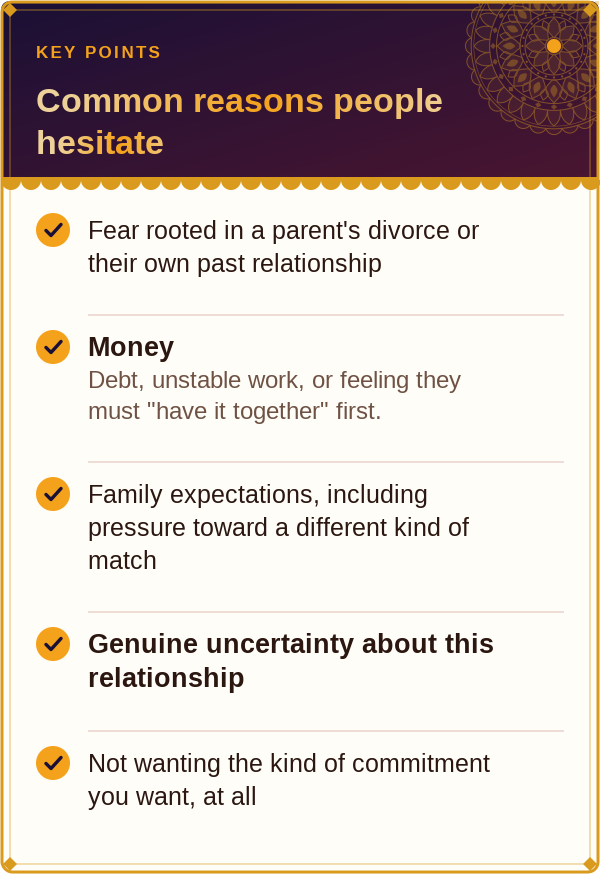
- Fear rooted in a parent's divorce or their own past relationship.
- Money: debt, unstable work, or feeling they must "have it together" first.
- Family expectations, including pressure toward a different kind of match.
- Genuine uncertainty about this relationship.
- Not wanting the kind of commitment you want, at all.
Some of these can be worked through together. The last two usually cannot be talked away.
What tradition looks at
In a love and relationship reading, Astrologer and Psychic Vijayram may look at your own seventh house and its lord, Venus, Saturn's influence and your current dasha period. These describe your patterns: whether you tend toward partners who keep distance, whether this is a period tradition associates with partnership or with solitary work. They are background for your decision, never a forecast of someone else's.
If timing is your real question, a love timing reading focuses on that alone.
What healthy hesitation and unhealthy control look like
Hesitating to commit is not abuse. But some patterns go further: a partner who keeps you uncertain on purpose, punishes you for raising the subject, or controls your money, time or friendships. The National Domestic Violence Hotline's page on healthy relationships describes the difference, and its advocates answer. Couples research summarized by the Gottman Institute also points to respect and responsiveness as the ground any commitment stands on.
The limit
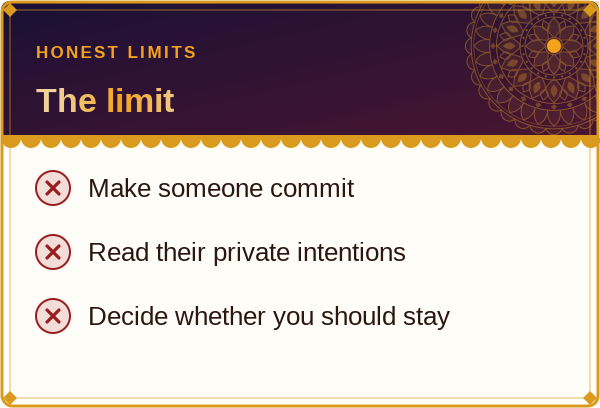
A reading cannot make someone commit, read their private intentions or decide whether you should stay. It can give you a clearer view of what you want and the steadiness to ask for it. The answer you get after that is information, and it belongs to you.
Some people find the Saturn and late love post a useful companion when commitment questions keep returning year after year.
Common questions
Can a reading tell me whether my partner will ever commit?
No. Their choice belongs to them. A reading can describe your own patterns and periods, and help you decide what you will do with the uncertainty.
Is giving an ultimatum wrong?
An ultimatum used as a threat usually backfires. A clear statement of what you need, and what you will do if it is not possible, is different. It is honest information about your own limits, not an attempt to control the other person.
Does Saturn in the seventh house mean my partner will never commit?
No. Tradition links Saturn with slowness and seriousness, not refusal. Many people with Saturn there commit deeply, just later or more cautiously. The post on Saturn and love that arrives late explains the difference between slow and never.
What if they say they want to commit, but nothing changes?
Then the words and the actions are telling you different things, and actions usually carry more weight. It is fair to ask what specific steps they are ready to take, and by roughly when.
Should we do a compatibility reading together?
Only if you both want it. A two-chart compatibility reading can open a conversation about the future, but it should not be used to pressure a reluctant partner.
Related service

Keep reading

Staying or Leaving After Infidelity: A Reading as One Voice, Not the Verdict
An infidelity reading will not name guilt or deliver a verdict. How it can help you sort your own next step, alongside counseling and the friends you trust.
Read article →
Rahu and Intense Attachment
Rahu in love and relationships: how Vedic tradition describes fixation and longing, what Rahu in the seventh is said to show, and grounding practices that help.
Read article →
Saturn and Love That Arrives Late
Saturn and late love in astrology: the placements tradition links with relationships that arrive later, what Shani tends to give, and why slow is not never.
Read article →Quick answers
Can I ask about someone else's feelings in a love reading?
Questions to ask in a love reading when you want to know someone else's feelings: why readings stay with your side, and how to reframe the question.
Read answer →Should I keep waiting for my ex while I get readings?
Can a psychic bring your ex back? Get-your-ex-back work is offered as prayer, mantra and puja for reconciliation, with no result promised. Waiting versus healing.
Read answer →Talk to Astrologer and Psychic Vijayram
Tell us what you are facing. If a reading is unlikely to help, you will be told that plainly.