
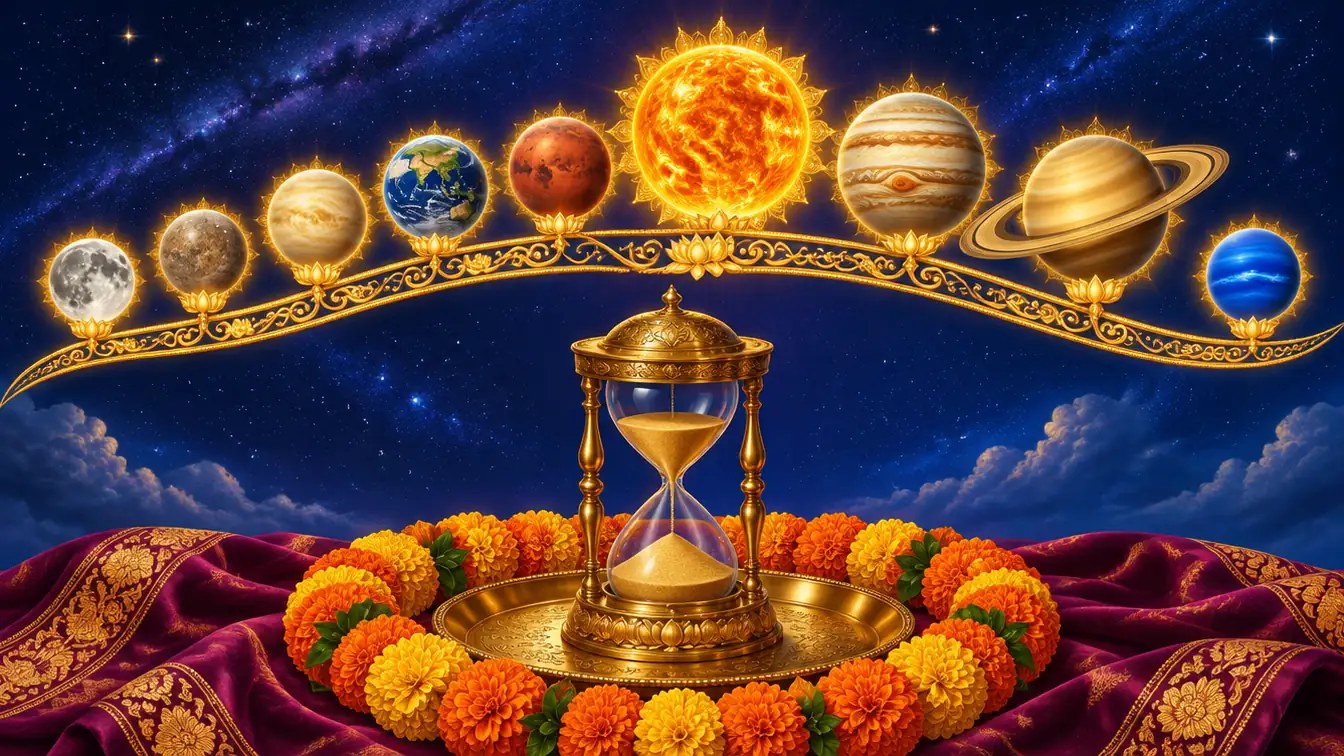
Planetary Period (Dasha) and Transit Reading
Which planetary period you are in, what it tends to bring, how long it lasts, and how the slow transits sit on top of it.
A dasha reading tells you which planetary period you are in under the Vimshottari system, what that planet traditionally emphasizes, when the period and its sub-periods change, and how current transits such as Sade Sati interact with it. Astrologer and Psychic Vijayram offers dasha readings to Chicago clients by phone, WhatsApp or video, as guidance only.
Key takeaways
- The Vimshottari dasha system divides an ideal life of 120 years among nine grahas in a fixed order.
- A Saturn mahadasha, for instance, begins with a Saturn-Saturn stretch of a little over three years, then moves to Saturn-Mercury, Saturn-Ketu and so on.
- Gochara, the movement of planets through the signs today, is read against your natal Moon.
- Some hypothetical cases make this clearer.
- People in a long Saturn period often want to know when it eases; the post on a Saturn mahadasha at work answers the questions that come up most.
A 120-year clock that starts at your birth

The Vimshottari dasha system divides an ideal life of 120 years among nine grahas in a fixed order. Where your Moon stood at birth decides which period you began in and how much of it was left: the Moon's nakshatra names the planet, and how far the Moon had traveled through that nakshatra sets the balance. From there the periods follow one another in sequence. The overview of dasha systems gives the background.
| Period (mahadasha) | Length |
|---|---|
| Ketu | 7 years |
| Venus | 20 years |
| Sun | 6 years |
| Moon | 10 years |
| Mars | 7 years |
| Rahu | 18 years |
| Jupiter | 16 years |
| Saturn | 19 years |
| Mercury | 17 years |
Because the starting point depends on the Moon, and the Moon moves about half a degree an hour, an error of one hour in the birth time can move every later date by several months. That is why this reading asks for the most reliable time you have.
Sub-periods are where the detail lives
Each mahadasha is split into nine antardashas, one for each planet, in the same order and in proportion to their lengths. A Saturn mahadasha, for instance, begins with a Saturn-Saturn stretch of a little over three years, then moves to Saturn-Mercury, Saturn-Ketu and so on. Most of what people actually notice, such as a change of job, a move or a new relationship, is usually discussed at the level of the antardasha rather than the 19-year whole. The post on plotting your own Vimshottari timeline shows how to sketch this on paper.
Transits sit on top of the periods
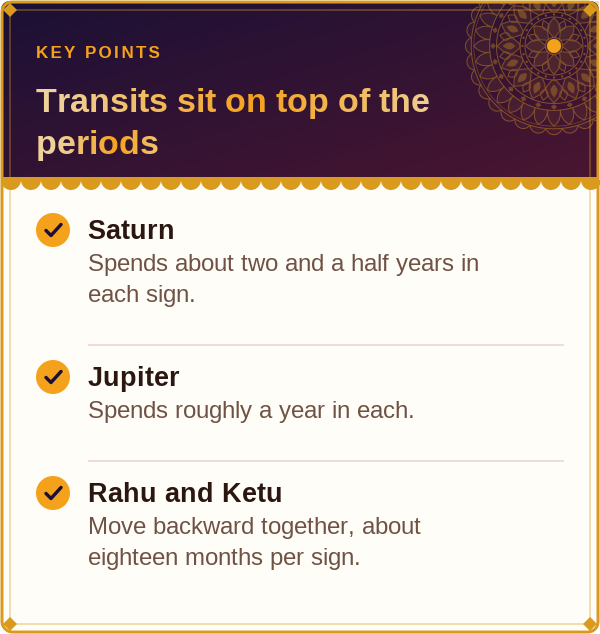
Gochara, the movement of planets through the signs today, is read against your natal Moon. Mantreswara's classical rules on this are collected in the Phaladeepika chapter on transits. The slow movers matter most:
- Saturn spends about two and a half years in each sign.
- Jupiter spends roughly a year in each.
- Rahu and Ketu move backward together, about eighteen months per sign.
Sade Sati is the seven-and-a-half-year stretch when Saturn passes through the sign before your Moon, your Moon sign itself and the sign after. It is the transit people ask about most, often with more fear than it deserves. The short answer on how to tell whether Sade Sati has started explains the arithmetic, and the post on steady routines for each phase of Sade Sati offers practical habits for each stage.
How a period shows up in ordinary life
Some hypothetical cases make this clearer. Suppose someone in a Rahu-Jupiter sub-period is weighing a job that would take the family from Evanston to the West Coast. Tradition links Rahu with ambition and distance and Jupiter with counsel, so the conversation turns to what the person is really seeking and whose advice they trust. Suppose a recent retiree in Downers Grove has just entered a Ketu period and feels drawn to prayer and away from a busy social calendar; Ketu is traditionally associated with withdrawal and spiritual interest, and that pull can be talked through rather than worried about. Or suppose a student begins a Sun period and is offered a leadership role. None of them would leave with a prediction. Each would leave with a way of understanding the season they are in, and with ideas for using it well.
What the reading gives you
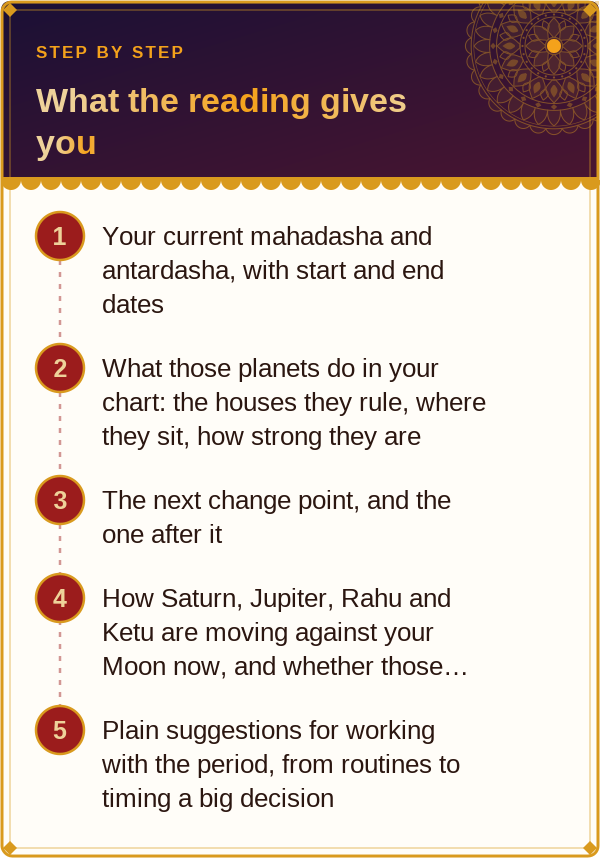
- Your current mahadasha and antardasha, with start and end dates.
- What those planets do in your chart: the houses they rule, where they sit, how strong they are.
- The next change point, and the one after it.
- How Saturn, Jupiter, Rahu and Ketu are moving against your Moon now, and whether those transits reinforce or soften the period.
- Plain suggestions for working with the period, from routines to timing a big decision.
People in a long Saturn period often want to know when it eases; the post on a Saturn mahadasha at work answers the questions that come up most. To find your own period before booking, see how to find which mahadasha you are in.
Preparing for the session
Send your birth details through the contact page, along with dates of five or six turning points in your life: a move, a marriage, a job change, a loss. Matching those against the periods is the best check on the birth time. The session is held by phone, WhatsApp or video at a time agreed in Central Time, and the timeline is talked through period by period. If you have never had your chart read as a whole, start with the full kundli reading and come back to timing later. For the coming twelve months in particular, the year-ahead varshaphal reading adds a birthday-to-birthday view.
What timing cannot tell you
A dasha describes a season, not an event. It cannot say that something specific will happen on a given date, and a hard period is not a punishment or a sign that anything is wrong with you. Astrologer and Psychic Vijayram reads periods as tendencies to prepare for and work with, offered as faith-based guidance, never as a reason for fear.
Common questions
Is Sade Sati always a hard time?
No. Tradition treats it as a period of pressure and maturing, and many people finish a career milestone or settle a household during it. How it feels depends on Saturn's role in your own chart and the dasha running at the same time.
Which dasha system is used?
Vimshottari, the system most Vedic astrologers rely on. If a family astrologer once used Yogini or another system, bring the notes and the two can be compared.
Can a dasha change overnight?
The change point is a date, but people rarely feel a sudden switch. The final months of one period often blend into the first months of the next, which is why sub-periods are read on both sides of a change.
Do I need a remedy during a difficult period?
No remedy is required. Some people find comfort in prayer or discipline during a heavy stretch, and the Graha Shanti consultation explains those options without pressure.
What if my birth time is uncertain?
Dasha dates can shift by months with an uncertain time. The reader will say how much, and may ask for dates of past life events to narrow it down.
Related services

Year-Ahead Varshaphal Reading
A yearly astrology forecast for Chicago clients, read as a Vedic varshaphal: your solar return chart month by month, with good windows and pressure points.
View service →
Muhurta: Choosing Auspicious Dates
A muhurta consultation in Chicago: auspicious dates and times for moves, openings and ceremonies, calculated for Chicago sunrise and Central Time.
View service →Read more

Staying Steady Through Sade Sati: Routines for Each of the Three Phases
Sade Sati remedies without fear: what each of Saturn's three phases is said to emphasize, who is in it now, and steady routines for long Chicago winters.
Read article →
Visible or Not? Deciding on Grahan Customs When an Eclipse Crosses Chicago's Sky
Grahan rules in the USA start with one question: can the eclipse be seen from Chicago? How visibility decides sutak, meals and temple closures.
Read article →
Plotting Your Own Vimshottari Timeline on Paper
Work out your Vimshottari dasha by hand: from the Moon's nakshatra to a drawn timeline of mahadashas in their 120-year order, so you can see where you are now.
Read article →
Saturn Mahadasha at Work: Promotions, Delays and Long Projects
Saturn mahadasha and your career: how Shani's nineteen years are read for promotions, delays and long projects, why placement matters, and habits that suit it.
Read article →
Rahu Mahadasha for Immigrants: Ambition, Distance and Reinvention in Chicago
Rahu mahadasha for people who moved countries: Rahu's link with foreign places and new paths, why many in Chicago notice it, and how to read it calmly.
Read article →Quick answers
How do I find which mahadasha I am in now?
What is mahadasha, and which one are you in now? Trace the Vimshottari sequence from the Moon's nakshatra at birth to today's period in a few plain steps.
Read answer →How do I know if Sade Sati has started for me?
What is Sade Sati, and has it started for you? Compare transiting Saturn with your Vedic Moon sign, then read the three phases without the scare stories.
Read answer →Talk to Astrologer and Psychic Vijayram
Tell us what you are facing. If a reading is unlikely to help, you will be told that plainly.