

Plotting Your Own Vimshottari Timeline on Paper
To plot your Vimshottari dasha by hand, find your Moon's sidereal degree, identify its nakshatra and ruling planet, and work out how much of that planet's period remained at birth. Then lay the nine mahadashas end to end in their fixed order, Ketu, Venus, Sun, Moon, Mars, Rahu, Jupiter, Saturn, Mercury, on a dated line.
Key takeaways
- The order never varies, and after Mercury it returns to Ketu.
- Look up the one containing your Moon, and its ruler, in the guide to the nakshatras grouped by ruling planet .
- Subtract the Moon's position from the nakshatra's end point.
- Mark your birth year at the left end of the paper and a point roughly a hundred years on at the right.
- The length of each is the mahadasha years times the sub-period planet's years, divided by 120.
Most people meet their dashas through an app that lists dates in a long column. That works, but it hides how simple the system really is. With a printed chart, a pencil and a sheet of paper, you can work out your own planetary periods in about twenty minutes and see your whole life laid out as a single line. Doing it once by hand makes every later reading easier to follow.
What you need
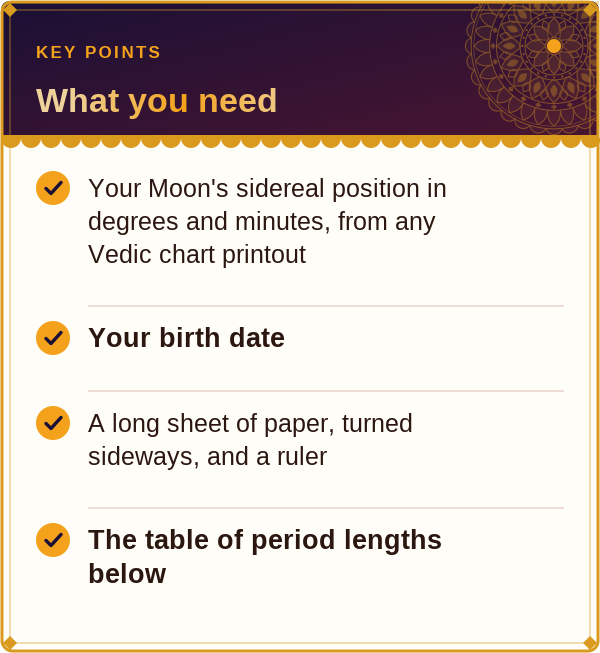
- Your Moon's sidereal position in degrees and minutes, from any Vedic chart printout.
- Your birth date.
- A long sheet of paper, turned sideways, and a ruler.
- The table of period lengths below.
The nine periods and their years
| Order | Planet | Years |
|---|---|---|
| 1 | Ketu | 7 |
| 2 | Venus | 20 |
| 3 | Sun | 6 |
| 4 | Moon | 10 |
| 5 | Mars | 7 |
| 6 | Rahu | 18 |
| 7 | Jupiter | 16 |
| 8 | Saturn | 19 |
| 9 | Mercury | 17 |
They add to 120 years, which is where the name comes from: vimshottari means "one hundred and twenty". The order never varies, and after Mercury it returns to Ketu. The overview of the dasha system describes Vimshottari alongside the other period systems astrologers use.
Step 1: Find your Moon's nakshatra
Each nakshatra spans 13 degrees 20 minutes. Look up the one containing your Moon, and its ruler, in the guide to the nakshatras grouped by ruling planet. Write down the nakshatra's start and end points.
Step 2: Work out how much of the first period was left
Subtract the Moon's position from the nakshatra's end point. Divide by 13 degrees 20 minutes. Multiply by the ruling planet's years. The answer is the balance of the first period at birth.
A worked example
Say the Moon sits at 8 degrees 0 minutes of Libra, and the person was born in mid-June 1990.
- Swati runs from 6°40' to 20°00' Libra, so the Moon is in Swati, ruled by Rahu.
- The Moon has traveled 1°20' into it, leaving 12°00' of the 13°20'.
- 12 divided by 13.33 is 0.9, and 0.9 times Rahu's 18 years is 16.2 years.
- 0.2 of a year is about two and a half months, so Rahu's period ends around late August 2006.
Step 3: Draw the line
Mark your birth year at the left end of the paper and a point roughly a hundred years on at the right. Then lay the periods end to end:
| Mahadasha | Runs from | To about |
|---|---|---|
| Rahu (balance) | June 1990 | August 2006 |
| Jupiter | August 2006 | August 2022 |
| Saturn | August 2022 | August 2041 |
| Mercury | August 2041 | August 2058 |
| Ketu | August 2058 | August 2065 |
| Venus | August 2065 | August 2085 |
Shade the period you are in now. For this example, that is the Saturn period, which began in 2022. The post on Saturn's long period at work would be the natural next read for this person.
Step 4: Add the sub-periods for the current chapter
Each mahadasha splits into nine antardashas, starting with its own planet and following the same order. The length of each is the mahadasha years times the sub-period planet's years, divided by 120.
Continuing the example: Saturn's own sub-period is 19 times 19 divided by 120, about 3 years, running to around August 2025. Next comes Mercury: 19 times 17 divided by 120, about 2.7 years, running to around spring 2028. So in late 2026 this person would be in Saturn mahadasha, Mercury antardasha. Draw these as small ticks under the shaded section.
Step 5: Sanity checks
- The periods should run in the fixed order with no planet skipped.
- The first period should always be shorter than its full length, unless the Moon sat at the very start of its nakshatra.
- Rahu and Ketu periods are never adjacent: Ketu follows Mercury and is followed by Venus, while Rahu falls between Mars and Jupiter.
How sensitive the dates are
The Moon is the fastest-moving body in the chart. It circles the sky in about 27 days, according to NASA's Moon facts, which works out to roughly half a degree an hour. In the example, an hour's error in birth time would move every boundary by about eight months. That is why astrologers check birth times carefully, and why the post on rectifying a birth time from life events leans so heavily on dashas.
If you just want to know where you are without the arithmetic, the short answer on finding which mahadasha you are in gives the quick route.
What the line can and cannot show
Your timeline shows which planet tradition puts in the foreground for each stretch of years. It does not show what will happen in them. That depends on the houses each planet rules and occupies, its strength, and the transits laid over it. A dasha and transit reading with Astrologer and Psychic Vijayram interprets your current period and the next change in Central Time, as reflection and guidance rather than a forecast of events.
Common questions
Why does my app give slightly different dates from my hand calculation?
Usually because of the year length or the ayanamsa. Some software uses a 365.25-day year and some a 360-day year, and the ayanamsa shifts the Moon by a fraction of a degree. Over a long period those small differences add up to weeks or months.
How accurate does my birth time need to be?
The Moon moves about half a degree an hour, so an hour's error can shift every period boundary by several months. For broad chapters, a time within half an hour is workable.
Do I start a new mahadasha on my birthday?
No. Periods begin on calculated dates that have nothing to do with your birthday, except by coincidence.
Can I do the same for antardashas?
Yes. Multiply the mahadasha's years by the sub-period planet's years and divide by 120. The sub-periods start with the mahadasha's own planet and follow the same order.
Related service
Keep reading

Saturn Mahadasha at Work: Promotions, Delays and Long Projects
Saturn mahadasha and your career: how Shani's nineteen years are read for promotions, delays and long projects, why placement matters, and habits that suit it.
Read article →
Rahu Mahadasha for Immigrants: Ambition, Distance and Reinvention in Chicago
Rahu mahadasha for people who moved countries: Rahu's link with foreign places and new paths, why many in Chicago notice it, and how to read it calmly.
Read article →
When Jupiter Is Weak: Reading a Jupiter Mahadasha Realistically
Jupiter mahadasha is often sold as a golden era. How sign, house, combustion and the houses Guru rules change that, and modest expectations that hold up.
Read article →Quick answers
How do I find which mahadasha I am in now?
What is mahadasha, and which one are you in now? Trace the Vimshottari sequence from the Moon's nakshatra at birth to today's period in a few plain steps.
Read answer →How do I know if Sade Sati has started for me?
What is Sade Sati, and has it started for you? Compare transiting Saturn with your Vedic Moon sign, then read the three phases without the scare stories.
Read answer →Talk to Astrologer and Psychic Vijayram
Tell us what you are facing. If a reading is unlikely to help, you will be told that plainly.