

Rectifying a Birth Time From Life Events: Which Dates to Gather First
Birth time rectification tests several candidate birth times against dated events in your life, such as marriage, children's births, international moves and job changes, to see which time puts those events in fitting planetary periods and transits. Gather the best-documented dates first. The method can narrow a window, but it rarely proves a single exact minute.
Key takeaways
- Before any rectification, search properly for a written time:
- The best are clearly dated, clearly yours, and tied to a specific house in the chart.
- The astrologer starts from your rough window and lists candidate times.
- Suppose a family remembers a birth "between 5:30 and 7:00 in the morning." That ninety-minute window might span two ascendant signs and seven or eight navamsa ascendants.
- Rectification is careful reasoning, not proof.
Many people know their birth date but only roughly when in the day they were born. "Around sunrise." "Just after lunch." "During the night, your father was asleep." For a Vedic chart, that is a problem, because the ascendant moves through all twelve signs in a day and the divisional charts move faster still. Rectification is the method astrologers use to estimate a working time from the events of a life. Its quality depends almost entirely on the dates you bring.
First, look for the recorded time
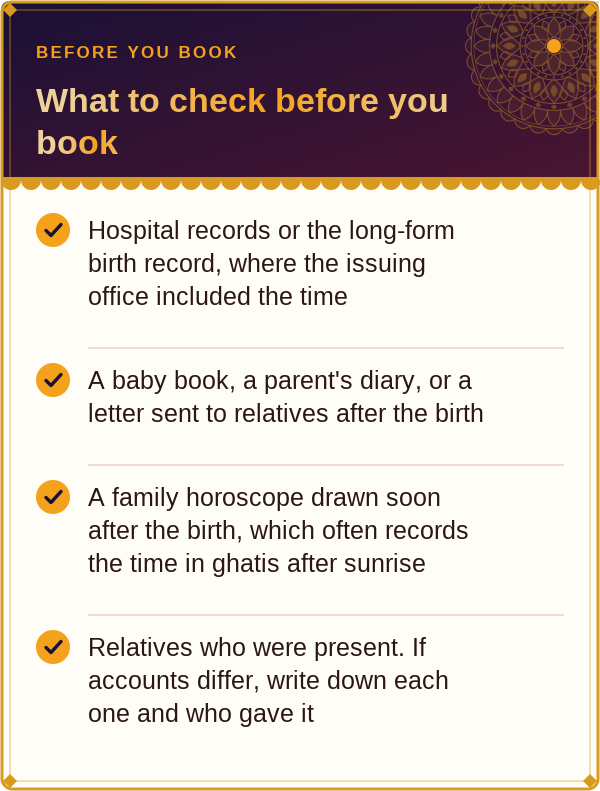
Before any rectification, search properly for a written time:
- Hospital records or the long-form birth record, where the issuing office included the time.
- A baby book, a parent's diary, or a letter sent to relatives after the birth.
- A family horoscope drawn soon after the birth, which often records the time in ghatis after sunrise.
- Relatives who were present. If accounts differ, write down each one and who gave it.
The short answer on what to do when family members remember different times covers that situation, and for older Chicago births the post on daylight saving and birth times before 1967 explains a common clock error.
Which dates to gather first
Not all events are equally useful. The best are clearly dated, clearly yours, and tied to a specific house in the chart. A sensible order:
| Priority | Event | What to note |
|---|---|---|
| 1 | Marriage | Exact date; engagement date too if known |
| 1 | Births of your children | Each child's date, in order |
| 2 | International or long-distance moves | Date of arrival, from and to |
| 2 | Starting or losing a job | Start and end dates, and whether the change was chosen |
| 3 | Major promotions or career turns | Month and year at least |
| 3 | Graduation or major exam results | Date or month |
| 3 | Buying a home | Closing date |
| 4 | Start or end of a serious relationship | Approximate month |
| 4 | Deaths of parents or grandparents | Only if you are comfortable sharing |
| 4 | Accidents or surgeries | Optional; date only, no medical details needed |
Mark each date with how sure you are: exact day, month only, or year only. An honest "year only" is far more useful than a guessed day.
How the dates are used
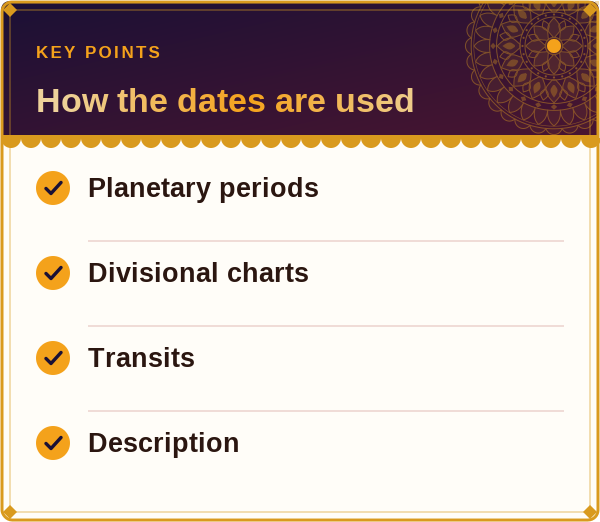
The astrologer starts from your rough window and lists candidate times. Each candidate gives a slightly different chart: perhaps a different ascendant, certainly a different navamsa ascendant and different dasha dates. Then each event is tested against each candidate:
- Planetary periods. Because the Moon's exact position sets the Vimshottari dasha dates, a change of a few minutes shifts every period boundary. Tradition expects a marriage to fall in a period linked with the 7th house or Venus, a move abroad in one linked with the 12th or 9th, a child's birth in one linked with the 5th. The candidate that fits more events wins credibility. The post on plotting a Vimshottari timeline shows how sensitive those dates are.
- Divisional charts. The D9 ascendant changes every thirteen minutes or so, the D10 every twelve. Marriage dates test the D9, career dates the D10. See the navamsa and planet strength.
- Transits. Slow transits of Saturn and Jupiter over key houses at the time of each event are checked as a second layer.
- Description. Some astrologers also compare the candidate ascendants with physical build and temperament. This is the weakest test and is used only as a tiebreaker.
A sketch of the process
Suppose a family remembers a birth "between 5:30 and 7:00 in the morning." That ninety-minute window might span two ascendant signs and seven or eight navamsa ascendants. The astrologer drafts each candidate, runs the dashas, and checks the marriage date, two children's births and an international move against each. Perhaps three candidates fail clearly, two fit some events, and one fits all four. That one becomes the working time, with the second-best noted.
The method's limits
Rectification is careful reasoning, not proof. Its main weaknesses are well known:
- Several candidates can fit. Life events are many and chart factors are flexible.
- Confirmation bias. Once a time looks promising, it is human to notice matches and explain away misses. The psychology of confirmation bias applies to astrologers as much as anyone, which is why testing every candidate the same way matters.
- Memory errors. A misremembered date can push the result toward the wrong time.
- Different methods give different answers. Astrologers using different techniques can rectify the same chart differently.
A good rectified time should be labeled as a working estimate, with the reasoning shown.

When rectification is not the right tool
If you need guidance on one specific question and have no reliable birth time, a Prashna question chart uses the moment you ask instead of the moment you were born. It avoids the birth-time problem entirely.
Sending your list
Write the events in date order with your confidence beside each, and add your rough birth window and birthplace. A birth chart reading with Astrologer and Psychic Vijayram can include a rectification review, explained step by step, so you can see how the working time was chosen and how firm it is.
Common questions
How many events do I need?
Eight to twelve well-dated events of different kinds is a good working set. A few exact dates are worth more than many vague ones.
Do I have to share painful events?
No. Losses, accidents and illnesses can help, but only share what you are comfortable sharing. Marriage, children, moves and job changes are usually enough to start.
Can rectification work with no idea at all of the time?
It can, but the work is harder and the result less certain, because every lagna must be tested. Even a rough window, such as 'before breakfast' or 'late evening', helps a great deal.
What if two candidate times fit equally well?
That happens. The astrologer will say so and may read the chart with both in mind, flagging which conclusions change between them.
Related service

Keep reading

Gemstones in Jyotish: Who Should Not Wear Them
Astrology gemstones are not for everyone. When Jyotish discourages a stone, how a trial period works, and the lower-cost remedies to weigh first.
Read article →
Rudraksha Basics: Faces, Use and Care
Rudraksha benefits explained as devotion, not medicine: what the faces mean, which bead people choose, how to spot fakes and how to care for a mala.
Read article →
Remedies Without a Price Tag: Seva, Fasting and Charity in Chicago
Simple Vedic remedies that ask for time, not money: charity, mantra, fasting and seva, with real ways to serve at Chicago temples, gurdwaras and food pantries.
Read article →Quick answers
Can a Western birth chart printout be turned into a kundli?
What is a kundli, and can a Western birth chart printout become one? Yes, from the same birth data. Here is what the sidereal shift and Indian layout change.
Read answer →How exact does my birth place need to be: city, hospital or village?
The birth chart reading details needed: date, clock time and town. Why the nearest city is usually close enough, and when a more exact birthplace helps.
Read answer →Talk to Astrologer and Psychic Vijayram
Tell us what you are facing. If a reading is unlikely to help, you will be told that plainly.