
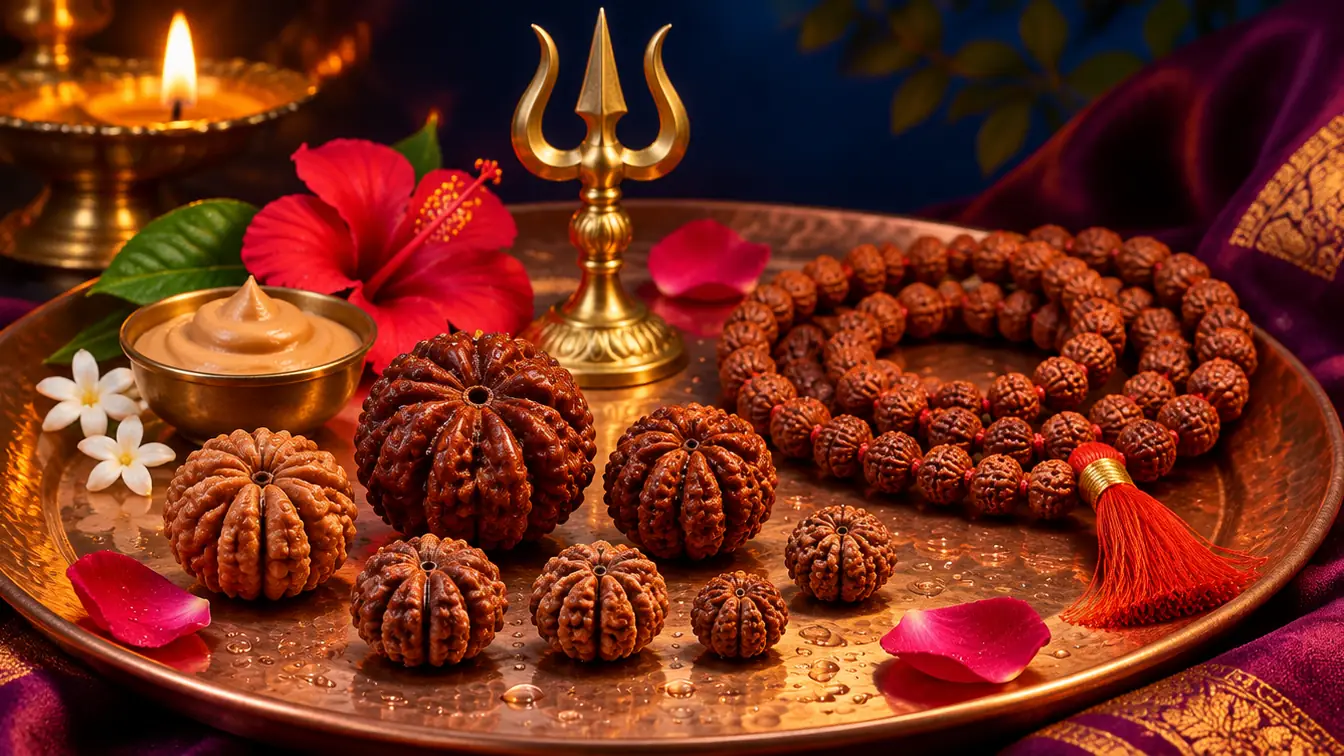
Rudraksha Basics: Faces, Use and Care
The benefits of rudraksha are devotional: the bead is a sacred seed tied to Shiva, used for counting mantras and as a daily reminder of prayer. Tradition links each face count to a deity or planet. It is not a medical treatment, and it should never replace a doctor, therapy or prescribed medication.
Key takeaways
- A rudraksha is the dried seed stone of trees in the genus Elaeocarpus , which grow from the Himalayan foothills of Nepal and India down to Indonesia.
- The lines running from top to bottom of the bead are called faces (mukhi).
- For most people the answer is simple: a five-faced bead, or a mala of five-faced beads.
- Because rare beads command high prices, imitations are common.
- Customs about when to remove the bead (at funerals, while sleeping, in the bathroom) differ by family.
A note before anything else. If you are reading about rudraksha because of a health worry, such as blood pressure, sleep, anxiety or a diagnosis, please start with your doctor. A bead is a devotional object. It does not treat any condition, and it is never a reason to stop or change prescribed medication. MedlinePlus, from the National Library of Medicine, is a reliable place to read about a condition before your appointment. With that said, here is what rudraksha is, and what the tradition actually claims for it.
What a rudraksha is
A rudraksha is the dried seed stone of trees in the genus Elaeocarpus, which grow from the Himalayan foothills of Nepal and India down to Indonesia. The name joins Rudra, a name of Shiva, with aksha, eye or tear; a well-known story says the trees grew from Shiva's tears. As the history of rudraksha shows, the beads have been strung into malas for Shaiva worship for centuries, and many Hindus outside the Shaiva tradition wear them too.
Nepalese beads tend to be larger and deeply grooved; Indonesian beads are smaller and smoother. Neither is "better" in a devotional sense. Size changes the price and how the mala sits on the neck, nothing more.
Faces, or mukhi
The lines running from top to bottom of the bead are called faces (mukhi). Most beads have between one and fourteen, and higher counts exist but are rare. Tradition links each count with a deity, and a more recent scheme links the first nine with the planets:
| Faces | Traditional association | Planet in one modern scheme |
|---|---|---|
| 1 | Shiva | Sun |
| 2 | Ardhanarishvara, Shiva and Parvati as one | Moon |
| 3 | Agni, the sacred fire | Mars |
| 4 | Brahma | Mercury |
| 5 | Kalagni Rudra, a form of Shiva | Jupiter |
| 6 | Kartikeya | Venus |
| 7 | Mahalakshmi | Saturn |
| 8 | Ganesha | Rahu |
| 9 | Durga | Ketu |
Texts and teachers differ on several rows, so treat the table as a guide to what you will hear, not as a rulebook.
Which rudraksha to wear
For most people the answer is simple: a five-faced bead, or a mala of five-faced beads. It is by far the most common type, which keeps genuine beads affordable, and it is associated with Shiva in general rather than with a narrow wish. Rarer faces are usually suggested only for a specific devotional reason, sometimes after an astrologer has looked at a planet in your chart. If someone tells you that only a rare and expensive bead will help you, that is a sales pitch, not a teaching. A remedy consultation can look at the question without any purchase attached, and the same caution applies as with stones, explained in our post on who should not wear astrological gemstones.
Real or fake?
Because rare beads command high prices, imitations are common. The magazine Hinduism Today has described how fake rudrakshas are made and sold: extra lines carved into ordinary beads, two beads glued into one, beads made of wood or resin, and the cashew-shaped "one-faced" seed that comes from a different plant. Home tricks such as floating a bead in water or spinning it between two coins are not reliable ways to tell. For an expensive bead, ask for a report from a laboratory that uses X-ray imaging to count the seed chambers inside, which should match the faces outside. For an ordinary five-faced mala, buy from a seller you can return to and pay a sensible price.
How people use it
- Japa. A mala of 108 beads plus one larger guru bead is used to count repetitions of a mantra. You turn the beads with the thumb and middle finger, and on reaching the guru bead you turn back rather than crossing it.
- Wearing. A single bead on a red or black thread, or capped in silver, worn at the neck or wrist.
- Starting. Many begin on a Monday, or on Maha Shivaratri, after a short prayer such as Om Namah Shivaya. Our post on keeping the Shivaratri night vigil in Chicago describes that observance.
Customs about when to remove the bead (at funerals, while sleeping, in the bathroom) differ by family. None of them is a rule you will be punished for missing.
Care, including through a Chicago winter
- Keep it away from soap, perfume and cleaning sprays.
- Indoor heat from November to March dries everything out. A seed that dries too far can crack, so once every few weeks some people rub in a drop of oil and wipe off the excess.
- Rinse dust off with plain water now and then, then let it dry naturally, not on a radiator.
- Restring a mala as soon as the thread looks thin. A snapped mala on the Red Line platform is a hard way to learn this.
- Store it in a cloth pouch, not loose in a bag with keys.
Putting it to work
The bead is a tool for the practice, not the practice itself. If you want help choosing a mantra to count on it, personal mantra and meditation guidance with Astrologer and Psychic Vijayram is held by phone, WhatsApp or video and starts from what you can keep up daily. Our plain guide to choosing a mantra is a good first read.
The honest limit: a rudraksha cannot change a diagnosis, settle a dispute or make anyone love you. What it can do is sit in your hand at the same hour each day and bring you back to prayer.
Common questions
Which rudraksha should a beginner wear?
The five-faced bead is the usual starting point. It is the most common, it is linked with Shiva himself rather than a narrow purpose, and it is easy to find in a genuine form at a fair price.
Can women wear rudraksha?
Many families and teachers say yes, and many women wear it. Some households keep older customs, such as removing the bead during menstruation. Follow your own family's practice or ask your temple priest.
Will a rudraksha lower my blood pressure or ease anxiety?
Do not rely on it for that. Blood pressure and anxiety need a doctor's care. Saying a mantra with a mala can feel calming, which is worth having, but it is not treatment and should never replace medication.
Can I wear my rudraksha in the shower?
Most people take it off. Soap and hot water dry the seed and weaken the thread. If it gets wet, let it dry naturally away from a radiator.
Related service
Keep reading
Remedies Without a Price Tag: Seva, Fasting and Charity in Chicago
Simple Vedic remedies that ask for time, not money: charity, mantra, fasting and seva, with real ways to serve at Chicago temples, gurdwaras and food pantries.
Read article →
Rahu Kalam and Daily Timing: How Much Should You Worry?
Rahu Kalam explained: how the daily window is worked out from local sunrise, why India-based apps get Chicago wrong, and a sensible way to use it.
Read article →
Choosing a Date for a Car or a Big Purchase
A muhurta for buying a car, step by step: the simple panchang checks families use for vehicles and big purchases, and which moment actually counts.
Read article →Quick answers
Should I wear a gemstone an astrologer suggests?
Should you wear an astrology gemstone an astrologer suggests? It is a traditional remedy, not a cure: questions to ask first, and when to wait or decline.
Read answer →Can a Western birth chart printout be turned into a kundli?
What is a kundli, and can a Western birth chart printout become one? Yes, from the same birth data. Here is what the sidereal shift and Indian layout change.
Read answer →Talk to Astrologer and Psychic Vijayram
Tell us what you are facing. If a reading is unlikely to help, you will be told that plainly.