
Vivekananda in Chicago, 1893: How Vedic Thought Reached the Midwest
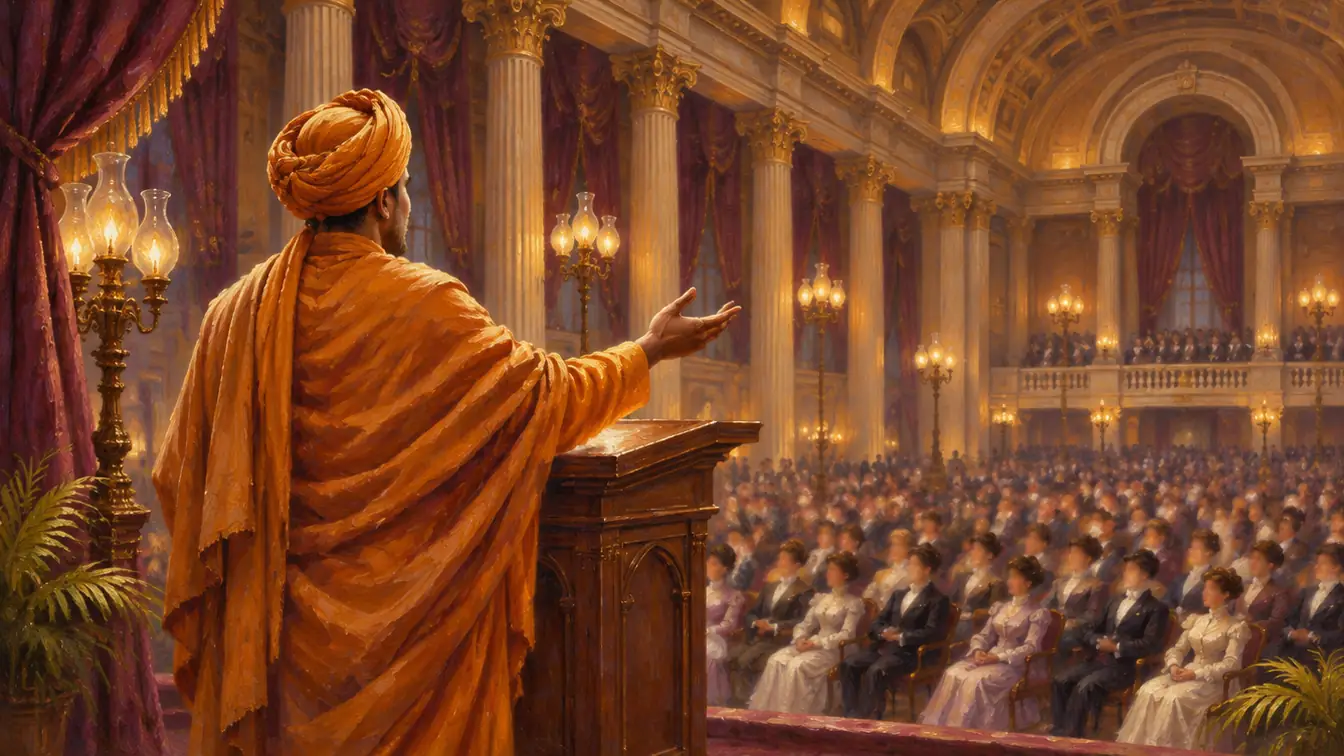
On September 11, 1893, Swami Vivekananda opened his address to the World's Parliament of Religions in the Loop, in the building that is now the Art Institute of Chicago, with the words Sisters and brothers of America. It was many Americans' first direct encounter with Vedanta, and Chicago's Hindu families still honor it.
Key takeaways
- The Parliament was part of the World's Columbian Exposition, the fair that brought the world to Chicago that year.
- After the Parliament, Vivekananda spent about two years lecturing across the eastern and central United States, with Chicago among his main bases alongside Detroit, Boston and New York.
- Chicagoland now has one of the largest Indian American communities in the country, and most families arrived generations after 1893.
- A post on an astrology site owes readers this: Vivekananda was not a friend of astrology.
- Jyotish has its own long tradition within Hindu thought, and many devout families use it for marriages, house moves and naming ceremonies.
Michigan Avenue, across from Grant Park, is mostly visited for the art. The stone building with the bronze lions also holds a quieter memory for Hindu families in Chicago. In September 1893 it hosted the World's Parliament of Religions, and on its opening day a 30-year-old monk from Calcutta stood up and began, "Sisters and brothers of America."
What happened in the Loop in September 1893
The Parliament was part of the World's Columbian Exposition, the fair that brought the world to Chicago that year. According to the history of the Parliament of the World's Religions, it opened on September 11, 1893, in the World's Congress Auxiliary Building, which is now the Art Institute of Chicago, and ran until September 27. It is widely described as the first organized gathering of the world's faiths in one hall.
Swami Vivekananda had come without a formal invitation and with very little money. His opening words drew a long ovation before he had said anything else. Over the following days he spoke about Vedanta: that truth can be reached by many paths, that the divine is present in every person, and that tolerance means accepting other faiths as true, not simply putting up with them. For many Americans in the hall, it was the first time they had heard Hindu thought presented by a Hindu teacher, in English, on his own terms.
How the ideas spread from Chicago
After the Parliament, Vivekananda spent about two years lecturing across the eastern and central United States, with Chicago among his main bases alongside Detroit, Boston and New York. Vedanta Societies took root on both coasts. The Midwest, which had no Hindu temples and very few Indian residents at the time, became the place where the conversation started rather than where it settled.
That conversation came back to the Loop twice. The Parliament's centennial gathering met at the Palmer House hotel in 1993, and the Parliament returned to Chicago again in August 2023. Each time, Vivekananda's 1893 address was the reference point.
Why it still matters to Hindu families here
Chicagoland now has one of the largest Indian American communities in the country, and most families arrived generations after 1893. Yet the speech gives them something few immigrant groups have: a founding moment for their faith in America that happened in their own city, in a building they can walk into.
The clearest sign is in Lemont. The Hindu Temple of Greater Chicago includes a Swami Vivekananda Spiritual Center for yoga, meditation and talks, and a bronze statue of him modeled on a photograph taken in Chicago after the Parliament. A family visiting the Rama shrine can walk over to the statue afterward, and it makes an easy place to tell children the story of the speech. If you are planning such a visit, the guide to visiting temples in Lemont, Aurora and Bartlett covers practical points.
An awkward truth for an astrologer to write
A post on an astrology site owes readers this: Vivekananda was not a friend of astrology. In notes of his class talks collected in Volume 8 of his Complete Works, under the heading "Man the Maker of His Destiny," his students recorded him calling astrology and similar mystical things signs of a weak mind when people lean on them, and advising a physician, good food and rest instead. His whole teaching pushed toward strength and self-effort, away from waiting on the stars.
That warning is worth taking seriously rather than explaining away. It describes a real misuse: the person who stops acting because a chart says the time is wrong, or who spends money chasing remedies out of fear. A practice that ignores the warning becomes exactly what he criticized.
How this practice reads that warning
Jyotish has its own long tradition within Hindu thought, and many devout families use it for marriages, house moves and naming ceremonies. It can sit alongside Vivekananda's teaching if it keeps a few rules:
- The chart describes tendencies; the person decides. A difficult period is a reason to prepare, not a reason to stop trying.
- Practical help comes first. Health worries go to a doctor, money worries to a qualified adviser, safety worries to the police.
- Remedies are optional and modest. Prayer, mantra, discipline and service before anything bought.
- No fear. A reading that leaves you frightened has failed, whatever it says.
That is how Astrologer and Psychic Vijayram approaches a Vedic astrology consultation in Chicago: as one source of reflection among many, held by phone, WhatsApp or video. For those who want a daily practice rather than a reading, guidance on personal mantra and meditation is closer to what Vivekananda himself taught.
Seeing the places for yourself
The Art Institute's Michigan Avenue building stands in the Loop, a short walk from the Adams/Wabash 'L' station; the lobby and grand staircase give a sense of the scale of 1893. More on the neighborhood around it is on the page for readings for people in the Loop, and the wider district is described under downtown and the South Side. Lemont is a drive to the southwest; check the temple's own website for current visiting arrangements before you go. And for a lighter look at the city's own founding date, there is a playful chart of Chicago from 1837.
The limit worth keeping in mind
History cannot tell you how to live, and neither can a horoscope. What the 1893 speech offers is an example of conviction and openness; what a reading offers is a structured moment of reflection. Neither replaces your own judgment, and Vivekananda would have been the first to say so.
Common questions
Where exactly did Vivekananda speak in Chicago?
The Parliament met in the World's Congress Auxiliary Building on Michigan Avenue, put up for the 1893 World's Columbian Exposition and now part of the Art Institute of Chicago, in the Loop.
Did Vivekananda believe in astrology?
He was wary of it. Class notes recorded by his students show him warning against leaning on astrology and similar practices, and urging strength, good food, rest and a doctor when such worries take hold. He put self-effort first.
Is there a memorial to Vivekananda in the Chicago area?
Yes. The Hindu Temple of Greater Chicago in Lemont has a Swami Vivekananda Spiritual Center and a bronze statue of him, modeled on a photograph taken in Chicago after the 1893 Parliament.
Why do some families mark September 11 as a Vivekananda day?
Because that was the opening day of the 1893 Parliament and of his first address. For many Hindu Americans the date carries that memory alongside the later events that share it.
Related service
Keep reading
Devon Avenue Questions: What Chicago Families Ask an Astrologer
What families around Devon Avenue ask an Indian astrologer: marriage matches, visa waits, shop openings and children's charts, and where a chart's answer stops.
Read article →
Lakshmi Puja on a Chicago Weeknight: Fitting Pradosh Kaal Around Work
Diwali puja time in Chicago follows local sunset, not India's clock. How families fit Pradosh Kaal and the Taurus window around commutes and school nights.
Read article →
Navadurga and the Nine Planets: A Navratri Guide for Chicagoland
A Navratri guide for Chicagoland: Durga's nine forms paired with the nine planets, fasting basics, and garba nights in Schaumburg, Naperville and Aurora.
Read article →More from Downtown, West and South Sides
What the Adler Planetarium Sky Shows: Sidereal vs Tropical Zodiac
Sidereal vs tropical zodiac, explained with the real sky over Chicago's Museum Campus: why your Vedic sign sits about 24 degrees from your Western one.
Read article →
Day of the Dead in Pilsen and Pitru Paksha: Two Ways of Remembering
Day of the Dead in Chicago's Pilsen and the Hindu Pitru Paksha side by side: ofrendas and tarpan, marigolds and sesame, and how to honor both with respect.
Read article →
Lunch-Hour Readings for Loop Office Workers
A psychic reading downtown in Chicago without leaving the Loop: how to fit a focused 30-minute phone session into a workday and still get something useful.
Read article →Local pages
Astrologer in The Loop
An astrologer in the Loop, Chicago, for office workers and downtown residents: career, timing and Vedic chart readings by phone, WhatsApp or video.
View location →
Psychic Reading and Astrology in River North
Psychic reading in River North, Chicago, for gallery, design and nightlife workers: tarot, intuitive and Vedic chart sessions by phone, WhatsApp or video.
View location →
Astrologer in South Loop
An astrologer in South Loop, Chicago, near the Museum Campus and Adler Planetarium: Vedic birth chart and timing readings by phone, WhatsApp or video.
View location →Quick answers
Which is better for timing questions, Vedic or Western astrology?
Vedic vs Western astrology for timing questions: dasha periods against transits and progressions, plus the sidereal zodiac and the Moon-sign emphasis.
Read answer →What fits into a short reading versus a full astrology session?
How long is an astrology reading? What fits into a short single-question session versus a full chart review, and how to pick the format for your question.
Read answer →Talk to Astrologer and Psychic Vijayram
Tell us what you are facing. If a reading is unlikely to help, you will be told that plainly.