
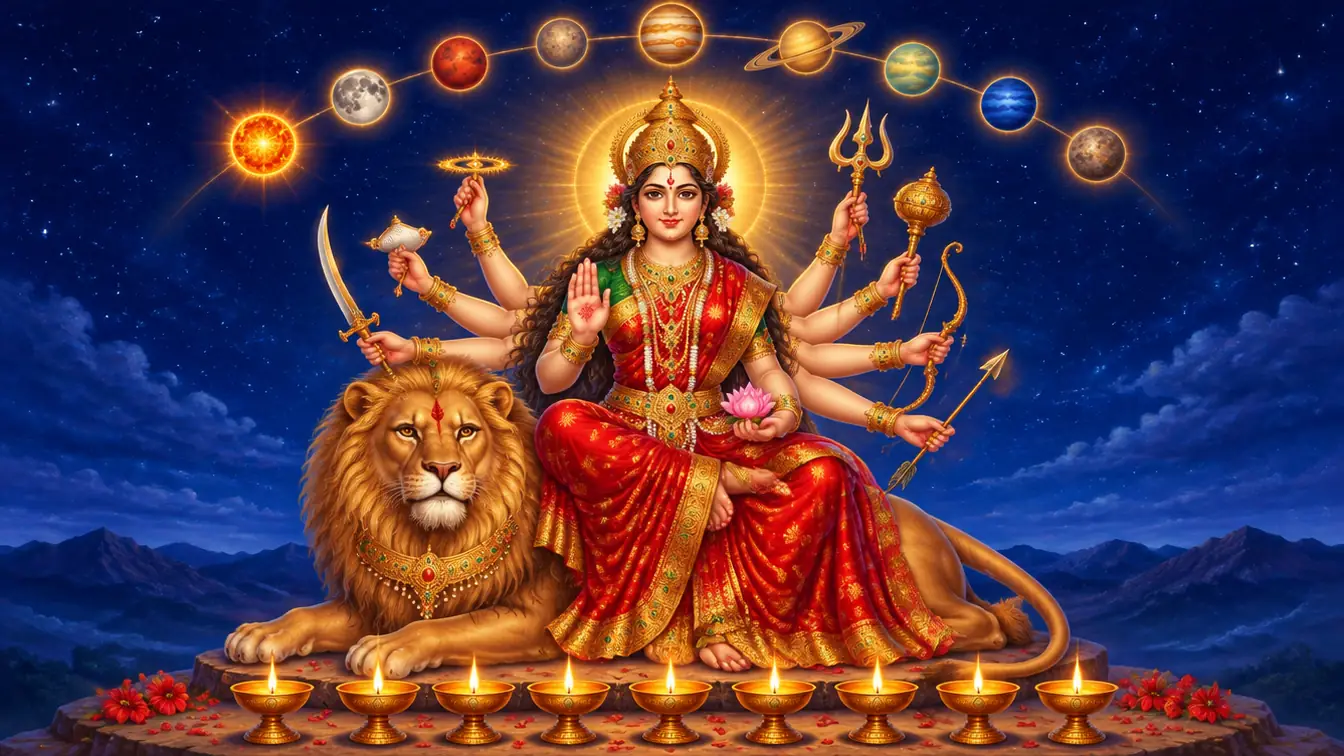
Navadurga and the Nine Planets: A Navratri Guide for Chicagoland
In a popular devotional tradition, each of Durga's nine forms worshipped during Navratri is linked to one of the nine grahas, from Shailaputri and the Moon to Siddhidatri and Ketu. Across Chicagoland, families combine those nine days of prayer and fasting with garba and dandiya evenings in the suburbs.
Key takeaways
- During Navratri, Durga is worshipped in nine forms, one each night, known together as the Navadurga .
- Vedic astrology works with nine grahas, the Navagraha : Sun, Moon, Mars, Mercury, Jupiter, Venus, Saturn, and the lunar nodes Rahu and Ketu.
- In practice the pairing shows up in small ways.
- Fasting customs vary by region and family.
- The social heart of Sharad Navratri here is garba, the Gujarati circle dance, and dandiya raas with its paired sticks.
By the first week of Navratri, banquet halls and school gyms from Schaumburg to Aurora are booked for garba, and chaniya cholis are being pressed in suburban living rooms. Behind the dancing sits a nine-night cycle of worship, and in many households one devotional idea gives each night a second layer: every form of the goddess is paired with one of the nine planets.
Nine forms of one goddess
During Navratri, Durga is worshipped in nine forms, one each night, known together as the Navadurga. The order below is the one most families follow, from the mountain's daughter on the first night to the giver of spiritual powers on the ninth.
The popular pairing with the grahas
Vedic astrology works with nine grahas, the Navagraha: Sun, Moon, Mars, Mercury, Jupiter, Venus, Saturn, and the lunar nodes Rahu and Ketu. Nine forms and nine planets invite matching, and a widely repeated list does exactly that:
| Night | Form of Durga | Graha in the popular list | What devotees usually focus on |
|---|---|---|---|
| 1 | Shailaputri | Moon | Steadiness of mind, a calm beginning |
| 2 | Brahmacharini | Mars | Discipline and patient effort |
| 3 | Chandraghanta | Venus | Courage with grace |
| 4 | Kushmanda | Sun | Energy, health and warmth |
| 5 | Skandamata | Mercury | Learning, speech, care for children |
| 6 | Katyayani | Jupiter | Right judgment, marriage prayers |
| 7 | Kalaratri | Saturn | Facing fear, ending darkness |
| 8 | Mahagauri | Rahu | Purity, clearing confusion |
| 9 | Siddhidatri | Ketu | Completion and inner insight |
Two honest notes. First, this pairing is a devotional tradition, not something set out in the classical astrology texts, and some lists differ in places. Second, it is meant as a focus for prayer. A person going through a hard Saturn period might give the seventh night a little extra attention; that is a choice, not a requirement.
How families here use it
In practice the pairing shows up in small ways. A parent whose child has exams might pray with particular care on the fifth night. Someone in a long Saturn transit might light a sesame-oil lamp on the seventh. A family planning a wedding may say the Katyayani mantra on the sixth. None of this needs a priest or a purchase.
When the concern is heavier, some families arrange a formal graha shanti, a set of prayers for planetary peace. The post on what graha shanti involves explains the ritual, and the service page for Graha Shanti planetary peace prayers describes how it is arranged remotely, always as an optional step explained in advance.
Fasting during the nine days
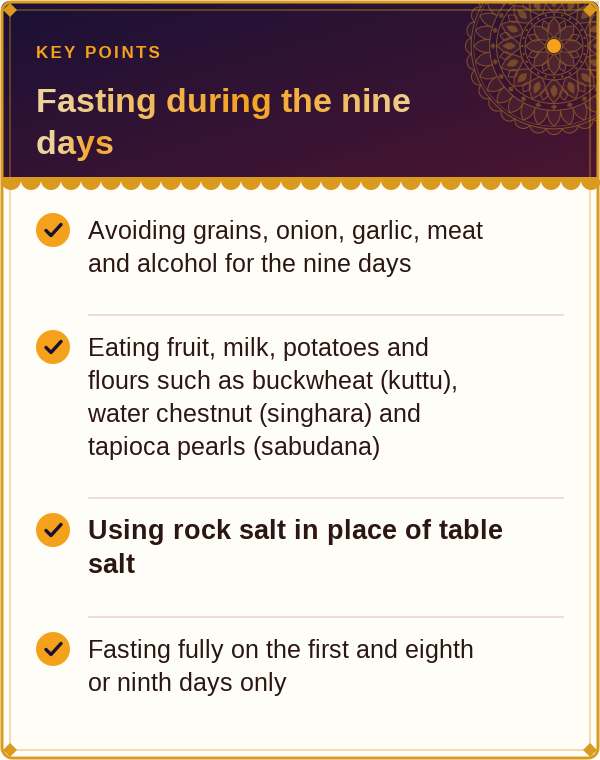
Fasting customs vary by region and family. Common patterns include:
- Avoiding grains, onion, garlic, meat and alcohol for the nine days.
- Eating fruit, milk, potatoes and flours such as buckwheat (kuttu), water chestnut (singhara) and tapioca pearls (sabudana).
- Using rock salt in place of table salt.
- Fasting fully on the first and eighth or ninth days only.
Most Indian groceries in the suburbs and on Devon stock fasting flours ahead of the festival. If you have diabetes, are pregnant, take regular medication or have a history of disordered eating, speak to your doctor first. A gentler fast, or none, is a perfectly faithful choice.
Garba and dandiya across Chicagoland
The social heart of Sharad Navratri here is garba, the Gujarati circle dance, and dandiya raas with its paired sticks. As the 2026 Chicago Navratri roundup shows, events run each autumn in Schaumburg, Naperville, Aurora and other suburbs, organized by community associations, temples and cultural groups. October evenings here can be cold, so most events are indoors and run late.
For families in those suburbs, the pages for Schaumburg, Naperville and Aurora describe how readings by phone or video fit local life. Check each event's own page for dates and tickets; listings change every year.
Prayer at home on a work night
Not everyone can attend a temple each evening. A simple home practice works: a lamp at the altar, the night's form named, a short mantra or the Durga Saptashati verses your family uses, and a moment of silence. Ten minutes after dinner is enough. If you would like a personal mantra for the nine nights, mantra and meditation guidance can help you choose one suited to your practice. Astrologer and Psychic Vijayram offers such sessions by phone, WhatsApp or video.
The tenth day, and the spring Navratri
The nine nights end with Vijayadashami, or Dussehra, the day of victory. In North Indian families it marks Rama's defeat of Ravana; in Bengali homes it closes Durga Puja with the goddess's farewell; in parts of South India it is a favored day to begin learning, when small children write their first letters. Astrologically, many families regard it as a good day to start something new without needing a separate muhurta.
There is also a second, quieter Navratri in spring, in the lunar month of Chaitra, which ends on Rama Navami. It arrives in Chicago in March or April, often in cold rain, and is kept mostly at home and in temples rather than in dance halls. The same nine forms and the same planetary pairing apply, so a family that found the autumn cycle helpful can repeat it six months later.
What this tradition cannot do
Praying on the night linked to a difficult planet does not switch that planet off. Navratri is a time of devotion, discipline and community, and its value lies there. Practical problems still need practical answers, and no ritual should be sold to you as a fix.
Common questions
Is the goddess-planet pairing found in the classical astrology texts?
Not in the main ones. It is a devotional association found in popular guides and family practice, and different lists exist. Treat it as a way to pray, not as a technical rule.
Do I have to fast all nine days?
No. Families choose anything from a full nine-day fast to the first and last days only, or a simple change of diet. Anyone with diabetes, a pregnancy or regular medication should talk to a doctor before fasting.
Should I worship the goddess linked to a planet that troubles my chart?
Some people do, and it can be a meaningful focus for prayer. It is optional, it asks only for your attention, and it does not replace practical steps in your life.
When is Navratri in Chicago?
Sharad Navratri usually falls in September or October and Chaitra Navratri in March or April. Exact dates come from a panchang calculated for local sunrise, so check a Chicago listing each year.
Related service
Keep reading

Kites, Til-Gud and Snow: Keeping Makar Sankranti in Chicago
Keeping Makar Sankranti in Chicago: the Sun's move into sidereal Capricorn, til-gud, Pongal and Lohri indoors, and why kite flying here waits for a milder day.
Read article →
Staying Steady Through Sade Sati: Routines for Each of the Three Phases
Sade Sati remedies without fear: what each of Saturn's three phases is said to emphasize, who is in it now, and steady routines for long Chicago winters.
Read article →
What the Adler Planetarium Sky Shows: Sidereal vs Tropical Zodiac
Sidereal vs tropical zodiac, explained with the real sky over Chicago's Museum Campus: why your Vedic sign sits about 24 degrees from your Western one.
Read article →Quick answers
Can a Western birth chart printout be turned into a kundli?
What is a kundli, and can a Western birth chart printout become one? Yes, from the same birth data. Here is what the sidereal shift and Indian layout change.
Read answer →How exact does my birth place need to be: city, hospital or village?
The birth chart reading details needed: date, clock time and town. Why the nearest city is usually close enough, and when a more exact birthplace helps.
Read answer →Talk to Astrologer and Psychic Vijayram
Tell us what you are facing. If a reading is unlikely to help, you will be told that plainly.