
Single-Card Answers: Why Yes-or-No Tarot Struggles With 'Should' Questions
Yes or no tarot draws one card and reads it as a yes, no or maybe, often by whether it lands upright. It struggles with 'should I' questions because those hide values, trade-offs and conditions that one card cannot weigh. Reframing the question into 'what would help me decide' gives the card something useful to say.
Key takeaways
- A "should" question looks simple, but it carries a lot underneath.
- The fix is to turn a request for a verdict into a request for insight.
- A single card is a good fit for low-stakes reflection: "What should I keep in mind today?" or "What would make this weekend restful?" It is also a reasonable way to check your own reaction.
- For a single real decision, a short one-question decision reading starts by getting the wording right and then lays a small spread rather than one card.
"Should I take the job?" "Should I text him?" "Should I move back home?" These are the questions people most often bring to a single card, hoping for a quick yes or no. The appeal is obvious. A decision is heavy, and a card that simply answered it would lift the weight.
The trouble is that one card is badly suited to a "should" question. This post explains why, how yes-or-no tarot is usually done, and how to turn a "should I" into a question the cards can actually help with.
How single-card answers are usually drawn
There is no single standard, which is the first clue that the method is improvised. Common approaches include:
- Upright means yes, reversed means no. The simplest, and the most like flipping a coin.
- A list of yes, no and maybe cards. The Sun or the Star for yes, the Tower or the Ten of Swords for no, and many in between. Lists vary from book to book.
- Three cards, majority wins. Two uprights out of three makes a yes.
- Deal until an ace appears. An older method borrowed from playing-card fortune telling, where the ace's suit or position decides.
Readers in the wider tradition of cartomancy have used methods like these for a long time, mostly for light questions. Modern tarot reading grew around spreads with several positions precisely because one card says so little.
Why "should" questions trip up a single card
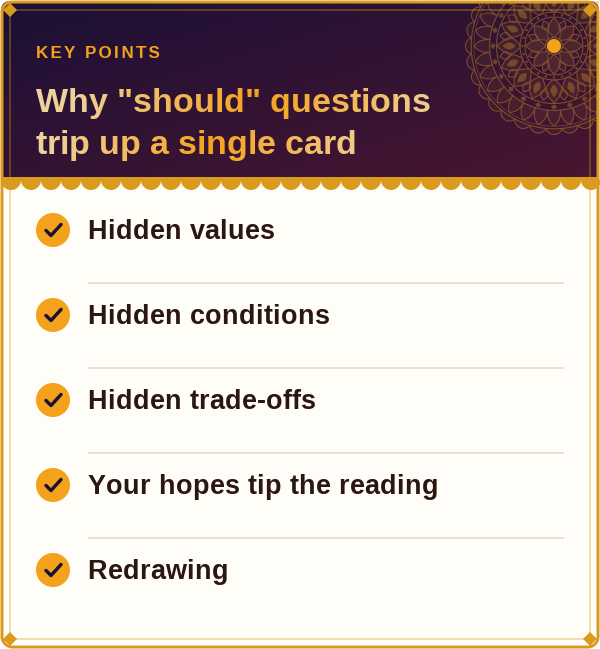
A "should" question looks simple, but it carries a lot underneath.
- Hidden values. "Should I take the job?" really asks: do I value the pay more than the commute, the title more than my current team, growth more than stability? A card cannot rank your values for you.
- Hidden conditions. The answer might be "yes, if the salary is right" or "no, unless they allow remote days." A single yes or no erases those conditions.
- Hidden trade-offs. Most real choices have costs on both sides. A one-word answer pretends one side has none.
- Your hopes tip the reading. If you badly want a yes, an ambiguous card will look like one. If you fear a no, the same card will look like a no.
- Redrawing. A disappointing card invites a second draw, then a third. At that point the deck has become a coin you keep flipping until it agrees with you.
Reframing: from "should I" to something the cards can work with
The fix is to turn a request for a verdict into a request for insight. Some useful patterns:
- "Should I…?" becomes "What would help me decide whether to…?"
- "Should I…?" becomes "What do I gain and what do I risk if I…?"
- "Should I…?" becomes "What am I not seeing about…?"
- "Is this the right choice?" becomes "What matters most to me in this choice?"
Some examples:
- "Should I text my ex?" becomes "What am I hoping a message would give me?" The card might show loneliness, curiosity or a need for closure, each of which suggests a different next step.
- "Should I take the job in Schaumburg?" becomes a two-option layout: one card for taking it, one for staying, one for what I am overlooking.
- "Should I move back to India?" becomes "What draws me back, and what keeps me here?" Two cards, then a long think.
The guide to turning prediction questions into better tarot questions works through more rewrites, and the post on five ways to lay out a three-card spread gives layouts that suit reframed questions.
When a single card is fine
Not every question needs a spread. A single card is a good fit for low-stakes reflection: "What should I keep in mind today?" or "What would make this weekend restful?" It is also a reasonable way to check your own reaction. Some people draw one card, notice whether they feel relief or disappointment, and treat that feeling as the real answer. The card was a mirror for a preference they already had.
What a single card should not decide: anything involving health, money you cannot afford to lose, legal matters, your safety or someone else's.
A two-minute exercise before any yes-or-no draw
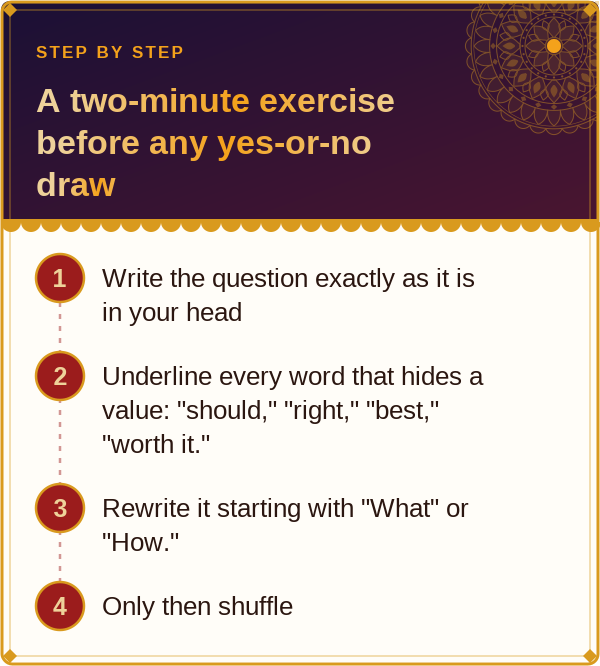
- Write the question exactly as it is in your head.
- Underline every word that hides a value: "should," "right," "best," "worth it."
- Rewrite it starting with "What" or "How."
- Only then shuffle.
If the rewritten question still feels like it needs a firm answer, it probably needs facts, not cards: a conversation, a number, an expert.
Bringing a decision to a reading
For a single real decision, a short one-question decision reading starts by getting the wording right and then lays a small spread rather than one card. For larger choices with two clear paths, such as housing, a fuller layout like the two-path spread for renting or buying gives each option its own space. If you prefer an astrological approach to a single question, a Prashna question-chart consultation casts a chart for the moment you ask. Astrologer and Psychic Vijayram offers each of these by phone, WhatsApp or video.
The plain limit: no card, single or in a spread, can make a decision for you or foretell how it will turn out. As the short answer on whether tarot is a forecast or a mirror explains, the cards reflect. The choosing is yours.
Common questions
Is yes-or-no tarot accurate?
There is no evidence that any card reliably answers a factual yes-or-no question, and no honest reader claims otherwise. A single card works better as a prompt that shows how you feel about an option.
What if I keep drawing until I get a yes?
Then you already know the answer you want. That is useful information, but it came from you, not the cards. Put the deck away and think about why that answer matters so much.
Which cards mean yes?
Different systems give different lists, which says a lot. Some count every upright card as yes; others treat cards like the Sun and the Star as yes and the Tower or Ten of Swords as no. No list is standard.
Will a reader give me a straight yes or no in a session?
A careful reader will usually help you reword the question first. If the question is low-stakes, a simple single-card reading is fine. For anything serious, expect a short spread and a conversation instead of a one-word verdict.
Related service
Keep reading

Turning 'Will He Call?' Into a Better Tarot Question
How to ask tarot questions that help: worked rewrites that turn 'will he call?' and other prediction questions into ones centered on what you can do next.
Read article →
Love Tarot Spreads for Singles, Couples and the Undecided
Love tarot questions and spreads for three situations: single, in a couple, or undecided about a relationship, each keeping the reading on your own choices.
Read article →
Tarot After a Breakup
A breakup tarot spread for closure, with care for how you are doing first: when to see a doctor or contact the Suicide and Crisis Lifeline, a five-card layout, and what cards cannot change.
Read article →Quick answers
Does it matter who shuffles the tarot deck?
How does a tarot reading work, and does it matter who shuffles the deck? Shuffling customs in person and at a distance, and what matters more than hands.
Read answer →Is a tarot reading a forecast or a mirror?
Can tarot predict the future? Why readers use tarot to reflect on a situation and its likely direction rather than to fix events, and how to use it well.
Read answer →Talk to Astrologer and Psychic Vijayram
Tell us what you are facing. If a reading is unlikely to help, you will be told that plainly.