

Turning 'Will He Call?' Into a Better Tarot Question
To ask tarot questions that help, move from predicting to understanding. Instead of 'Will he call?', ask 'What do I need to feel steady while I wait to hear from him?' Good questions are open, about you rather than someone else, focused on one topic, and built around a verb you control, like 'how can I'.
Key takeaways
- A tarot reading interprets symbolic pictures in light of a question.
- In each case the new question puts you at the center and asks for something you can act on.
- You ask, "What do I need to feel steady while I wait to hear from him?" and draw the Four of Swords: a figure lying at rest in a quiet chapel.
- Some questions cannot be fixed by rewording, because the cards are the wrong tool entirely.
- Relationship questions are where rewording matters most, because they are where people most want to know another person's feelings.
"Will he call?" may be the most common question ever asked of a tarot deck. It is also one of the least useful. It asks the cards to predict another person's choice, it can only be answered yes or no, and whatever card turns up, you are still sitting by the phone afterward.
The good news is that almost any question can be rewritten into one that helps. This post shows how, with worked examples, so you can bring a better question to your own cards or to a session.
What makes a question work
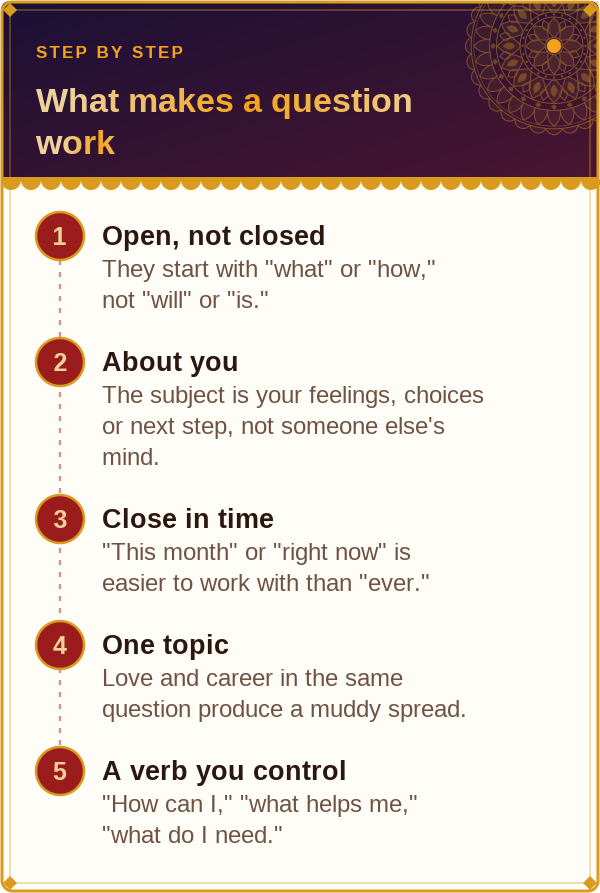
A tarot reading interprets symbolic pictures in light of a question. When the question is a request for a forecast, the pictures have nothing to hold on to. When it is a request for understanding, every card has something to say. Strong questions tend to share five features:
- Open, not closed. They start with "what" or "how," not "will" or "is."
- About you. The subject is your feelings, choices or next step, not someone else's mind.
- Close in time. "This month" or "right now" is easier to work with than "ever."
- One topic. Love and career in the same question produce a muddy spread.
- A verb you control. "How can I," "what helps me," "what do I need."
Writing the question down helps more than people expect. The University of Rochester Medical Center's note on journaling for emotional wellness describes writing things down as a way to prioritize problems, fears and concerns, and to spot what is causing stress. The same applies here: seeing your question written out often shows you what you are really asking.
Worked rewrites
| Original question | The problem | A better version |
|---|---|---|
| Will he call? | Predicts someone else's choice | What do I need to feel steady while I wait to hear from him? |
| Does she love me? | Asks the cards to read her mind | What do I want from this relationship, and am I getting it? |
| Will I get the job? | A yes-or-no forecast | What can I do to present myself well in the final interview? |
| Will my boss approve the transfer? | Someone else's decision | How can I make my case for the transfer clearly? |
| Is this person the one? | Too big and too final | What is this relationship teaching me about what I need? |
| Will I ever be happy? | Vague and without a time frame | What is one change that would make this month feel better? |
| Should I move to Seattle? | Hides values and trade-offs | What draws me to the move, and what would I miss? |
| Why does my mother-in-law dislike me? | Asks for her motives | How can I protect my peace during family visits? |
Notice the pattern. In each case the new question puts you at the center and asks for something you can act on. The card that comes up might be the same, but now it has a job to do.
Back to "Will he call?"
Here is one way the rewrite plays out. You ask, "What do I need to feel steady while I wait to hear from him?" and draw the Four of Swords: a figure lying at rest in a quiet chapel. The card suggests stepping back, sleeping properly and not checking your phone every ten minutes. It cannot say whether he will call, and it does not pretend to. It gives you something useful to do in the meantime.
You could go further with a three-card version: "What am I feeling? What do I want? What can I do?" That small spread often reveals that the real question was never about the call at all. It was about wanting to feel chosen, or wanting an answer either way so you can move on.
Questions that belong somewhere else
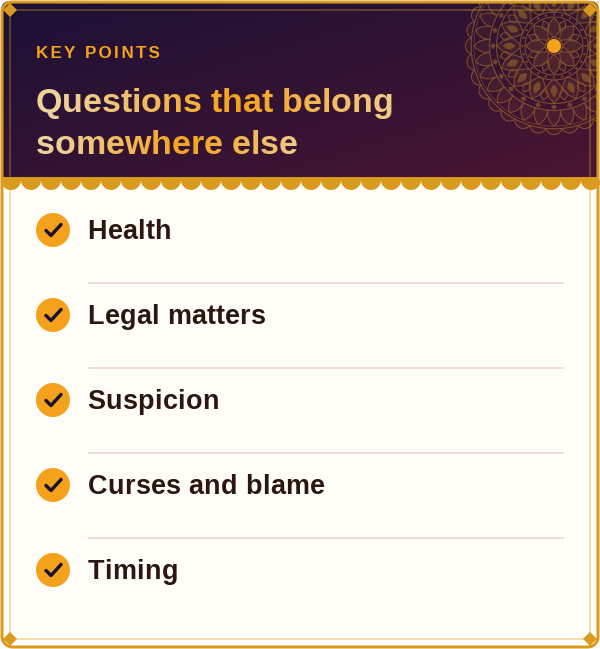
Some questions cannot be fixed by rewording, because the cards are the wrong tool entirely.
- Health: "Will my father's surgery go well?" belongs with his doctors. A card can help with "How can I support him and look after myself this week?"
- Legal matters: "Will I win custody?" belongs with a lawyer.
- Suspicion: "Is my partner cheating?" needs a conversation, or a counselor, not a card.
- Curses and blame: "Who has put the evil eye on me?" No honest reading names a culprit. Ordinary explanations, such as stress, conflict or poor sleep, come first.
- Timing: "When will I get married?" suits astrology better; the marriage timing consultation works from the birth chart's periods rather than a single draw.
The post on requests a careful reader turns down explains the wider set of questions this practice declines.
Love questions in particular
Relationship questions are where rewording matters most, because they are where people most want to know another person's feelings. The short answer on asking about someone else's feelings in a love reading explains what can and cannot be read. The post on love tarot spreads for singles, couples and the undecided offers ready-made layouts that keep the focus on your own choices.
Bringing your question to a session
You do not have to arrive with a perfect question. In a one-question decision reading, the first few minutes are spent on the wording together, and many people find that conversation useful in itself. Astrologer and Psychic Vijayram reads by phone, WhatsApp or video, and you can send your rough question when you book.
The limit is worth repeating: even the best question cannot make a card predict what another person will do. A good question simply gives the reading a fair chance to help you see your own situation more clearly.
Common questions
Can I ask about another person at all?
Yes, as long as the question stays on your side of the relationship. 'How can I support my brother right now?' works. 'What is my brother hiding?' does not, because no card can see into someone else's mind.
What if I do not know what to ask?
Start with 'What do I most need to understand about my situation right now?' Then let the first card point you toward a sharper question, or talk it through with the reader at the start of a session.
Is it bad to ask the same question twice?
It is not bad, but it rarely helps on the same day. Ask again when something has changed. Repeating a question until the answer improves turns the deck into a coin toss.
Can I ask about timing, like when something will happen?
Tarot is weak on timing. If when is the real question, such as when marriage might come, a Vedic astrology reading that works from your birth chart and planetary periods is the better tool.
Related service

Keep reading
Love Tarot Spreads for Singles, Couples and the Undecided
Love tarot questions and spreads for three situations: single, in a couple, or undecided about a relationship, each keeping the reading on your own choices.
Read article →
Tarot After a Breakup
A breakup tarot spread for closure, with care for how you are doing first: when to see a doctor or contact the Suicide and Crisis Lifeline, a five-card layout, and what cards cannot change.
Read article →
Tarot for Couples: Reading Together
A couples tarot reading works best with ground rules: both partners choose to be there, nobody is ambushed, and the cards never take sides. How to set them.
Read article →Quick answers
Does it matter who shuffles the tarot deck?
How does a tarot reading work, and does it matter who shuffles the deck? Shuffling customs in person and at a distance, and what matters more than hands.
Read answer →Is a tarot reading a forecast or a mirror?
Can tarot predict the future? Why readers use tarot to reflect on a situation and its likely direction rather than to fix events, and how to use it well.
Read answer →Talk to Astrologer and Psychic Vijayram
Tell us what you are facing. If a reading is unlikely to help, you will be told that plainly.