
Is a tarot reading a forecast or a mirror?
Tarot works best as a mirror. Readers use the cards to look at a situation, the forces in it and the direction it seems to be heading if nothing changes. That direction is not fixed; you can change it. There is no reliable evidence that tarot foretells specific events, and honest readers do not claim it does.
Key takeaways
- Tarot cards first appeared in fifteenth-century Italy as a card game, and a rare early tarocchi deck at Yale survives from that era.
- In a spread such as the Celtic Cross, the final position shows where things look headed on the present course.
- A tarot card reading or a one-question decision reading with Astrologer and Psychic Vijayram is offered in that spirit, as reflection rather than prediction.
Where tarot came from
Tarot cards first appeared in fifteenth-century Italy as a card game, and a rare early tarocchi deck at Yale survives from that era. Reading meaning into them came later, in late eighteenth-century France. The images were never designed as a forecasting instrument, which is partly why they work so well as prompts.
What an outcome card means
In a spread such as the Celtic Cross, the final position shows where things look headed on the present course. A difficult card there, such as the Ten of Swords, is a reason to look at what could change, not a sentence passed on you. Why yes-or-no tarot struggles with should questions looks at a related limit.
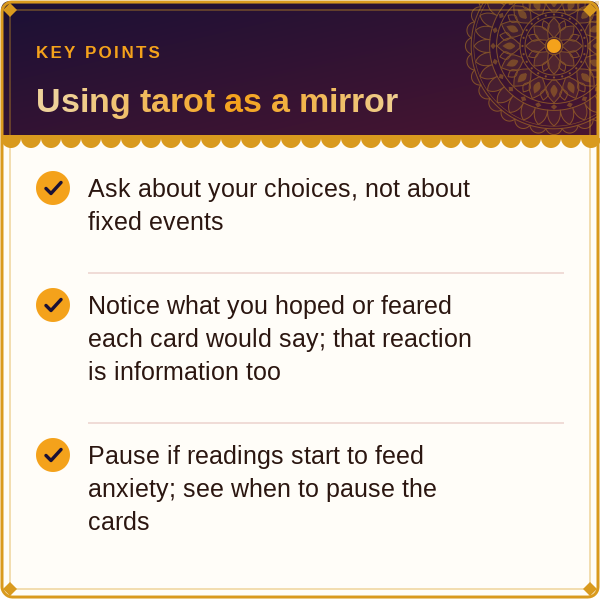
Using tarot as a mirror
- Ask about your choices, not about fixed events.
- Notice what you hoped or feared each card would say; that reaction is information too.
- Pause if readings start to feed anxiety; see when to pause the cards.
A tarot card reading or a one-question decision reading with Astrologer and Psychic Vijayram is offered in that spirit, as reflection rather than prediction.
Questions people ask
Related service
Read more

More quick answers
Talk to Astrologer and Psychic Vijayram
Tell us what you are facing. If a reading is unlikely to help, you will be told that plainly.