

Tarot and Anxiety: When to Pause the Cards
Tarot can ease anxiety for some people and feed it for others. Pause the cards if you draw repeatedly on the same worry, feel worse after reading, or cannot decide anything without a spread. Talk to a doctor or therapist about persistent anxiety, contact the Suicide and Crisis Lifeline in a crisis, and never change medication because of a reading.
Key takeaways
- Anxiety that sticks around and gets in the way of work, sleep, relationships or daily life is a health matter, not a card matter.
- None of these makes you a bad person or a failed reader.
- The post on a month without readings lays out a similar reset for people who feel hooked on psychic sessions.
- A tarot card is a picture that invites reflection.
- A responsible reader watches for these patterns too.
For some people, a tarot reading is a calm hour of reflection. For others, it becomes another place for worry to live. You draw a card about a test result, do not like it, draw again, then look up the meaning on three websites, then lie awake. If that sounds familiar, this post is for you.
First: if anxiety is affecting your life
Anxiety that sticks around and gets in the way of work, sleep, relationships or daily life is a health matter, not a card matter. The National Institute of Mental Health's page on anxiety disorders describes the common forms and explains that they are treatable, most often with psychotherapy, medication or both. A primary care doctor is a good first call. If you are already being treated, keep going, and never stop or change medication because of something in a reading.
If you are not sure where to start, the NAMI HelpLine can point you toward local support and information. If you are in crisis or having thoughts of harming yourself, contact the Suicide and Crisis Lifeline to reach the Suicide and Crisis Lifeline, any hour of the day. In an emergency, call emergency services.
Signs the cards are feeding the worry
None of these makes you a bad person or a failed reader. They are simply signals to step back.
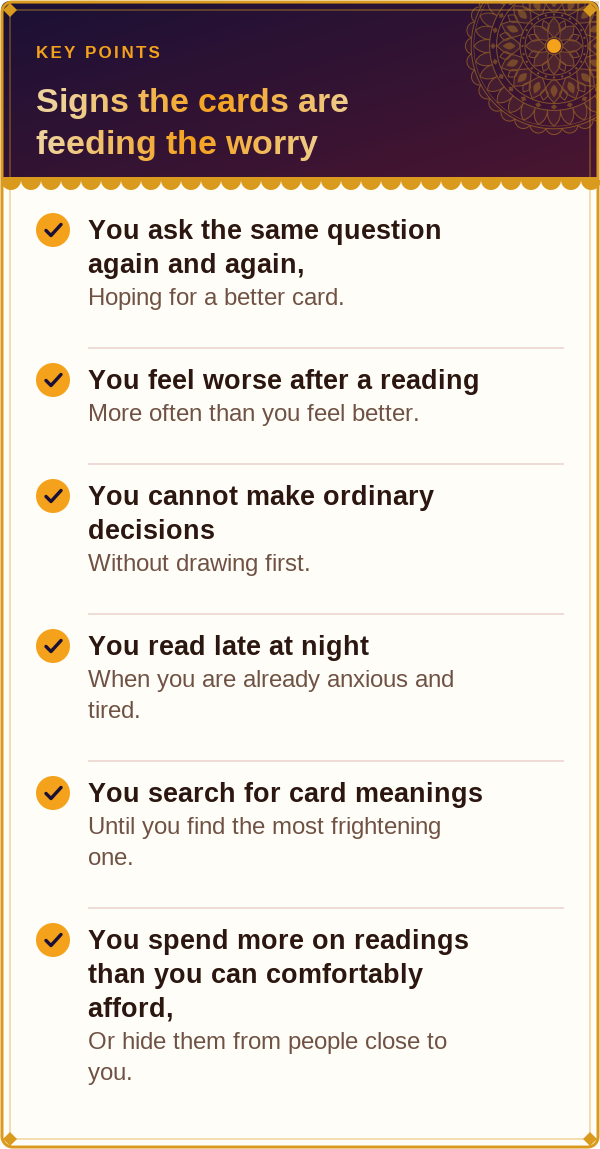
- You ask the same question again and again, hoping for a better card.
- You feel worse after a reading more often than you feel better.
- You cannot make ordinary decisions without drawing first.
- You read late at night when you are already anxious and tired.
- You search for card meanings until you find the most frightening one.
- You spend more on readings than you can comfortably afford, or hide them from people close to you.
- You book a reader to check what another reader said.
Therapists often describe a pattern called reassurance seeking: looking for certainty to calm a worry, getting brief relief, then needing to check again. Tarot can slip into that role easily, because a card never gives the certainty anxiety is looking for.
How to take a real break
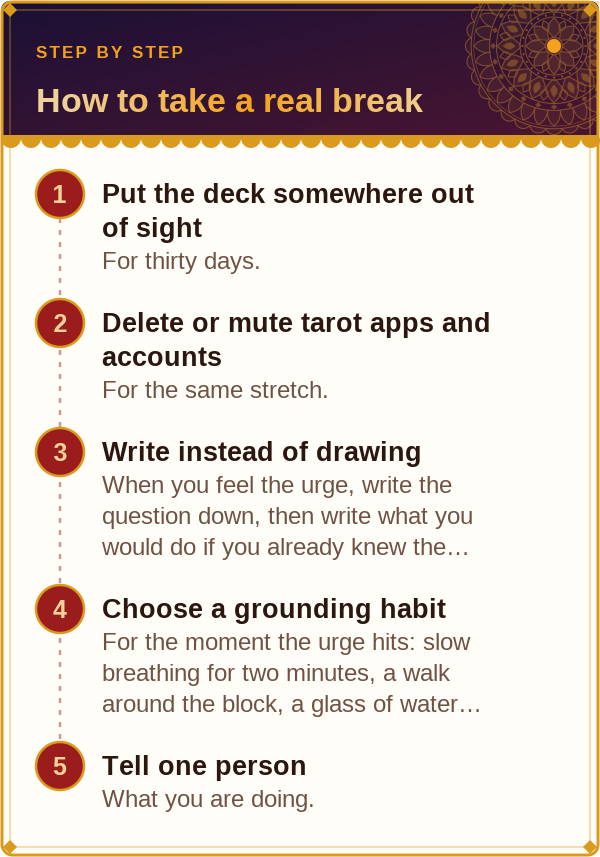
- Put the deck somewhere out of sight for thirty days. A high shelf, a friend's house, a drawer you do not open.
- Delete or mute tarot apps and accounts for the same stretch.
- Write instead of drawing. When you feel the urge, write the question down, then write what you would do if you already knew the answer.
- Choose a grounding habit for the moment the urge hits: slow breathing for two minutes, a walk around the block, a glass of water, a call to a friend. Breath and mantra practice can help some people, and the personal mantra and meditation guidance teaches simple methods, alongside medical care, never instead of it.
- Tell one person what you are doing. Saying it aloud makes it easier to keep.
The post on a month without readings lays out a similar reset for people who feel hooked on psychic sessions.
Why more readings rarely bring more peace
A tarot card is a picture that invites reflection. It cannot tell you that a feared event will not happen, because, as the short answer on whether tarot is a forecast or a mirror explains, it is not a forecast. When anxiety asks a deck for certainty, the deck can only offer ambiguity, and anxiety reads ambiguity as danger. That is why drawing again usually makes things worse.
What an ethical reader does when anxiety shows up
A responsible reader watches for these patterns too. In practice that means:
- Declining to repeat a reading on the same question within a short period.
- Not reading on health outcomes, test results or anyone's lifespan.
- Pausing the cards when a session turns into distress, and talking about support instead.
- Never using a frightening card to sell a remedy. The post on tarot without fear selling sets out those lines.
Coming back to the cards, if you choose to
After a break, some people find they no longer want readings. Others return with a lighter touch. If you come back, try a few rules:
- One reading on a question, then wait for something real to change.
- No readings after a set hour in the evening.
- Reflective questions only, never health, safety or "will it go wrong."
- Notice how you feel an hour later, and let that guide you.
A simple morning practice, like the one in a daily card for reflection, not prediction, can be gentler than full spreads.
When you are ready for a session
A tarot card reading with Astrologer and Psychic Vijayram is booked in advance, by phone, WhatsApp or video, with a clear question and a set length. If the conversation shows that anxiety is doing the asking, the reading will slow down or stop, and you will be encouraged toward the help that actually works for anxiety.
The limit is plain: a tarot reading is faith-based guidance for reflection. It does not treat anxiety, it cannot promise that a feared thing will not happen, and it never replaces a doctor, therapist or crisis line.
Common questions
Is it bad to use tarot if I have an anxiety disorder?
Not necessarily, but it is worth discussing with your therapist or doctor. For some people an occasional reflective card is calming. For others, any reading becomes a new thing to worry about. Notice which one you are, honestly.
How long should a break from the cards last?
A month is a good start: long enough to notice how you cope without them. If the urge to draw stays strong after that, it is worth exploring with a professional.
Will a reader tell me if I am booking too often?
A careful one will. This practice declines repeated readings on the same question in a short time and may suggest a break, because more readings rarely bring more peace.
Can a reading help with my anxiety?
A reading is not a treatment for anxiety. It can sometimes help you put a worry into words, but therapy, medical care and practices such as regular sleep and movement are what help anxiety itself.
Related service
Keep reading
No Card Requires a Paid Fix: Tarot Without Fear Selling
Tarot ethics in plain terms: why a frightening card is never a reason to buy a ritual, the lines an ethical reader keeps, and what to do if you are pressured.
Read article →
A Daily Card for Reflection, Not Prediction: Five Ways to Read It
A daily tarot card works best as a short reflection, not a forecast. Five prompts for your morning card, an evening check-in and a simple weekly journal habit.
Read article →
Angel Card Readings: Gentle Messages, Honest Limits
What an angel card reading is, how it differs from tarot, how a session runs by phone or video, and why its messages are encouragement, not prediction.
Read article →Quick answers
Does it matter who shuffles the tarot deck?
How does a tarot reading work, and does it matter who shuffles the deck? Shuffling customs in person and at a distance, and what matters more than hands.
Read answer →Is a tarot reading a forecast or a mirror?
Can tarot predict the future? Why readers use tarot to reflect on a situation and its likely direction rather than to fix events, and how to use it well.
Read answer →Talk to Astrologer and Psychic Vijayram
Tell us what you are facing. If a reading is unlikely to help, you will be told that plainly.