

Year-Ahead Varshaphal Reading
A twelve-month outlook drawn from the chart of your solar return, read month by month and kept to tendencies rather than events.
A varshaphal is a Vedic year-ahead reading built from a chart cast for the moment the Sun returns to its exact birth position each year. Astrologer and Psychic Vijayram reads it month by month for Chicago clients, by phone, WhatsApp or video, as an outlook of tendencies and good windows rather than a forecast of events.
Key takeaways
- Most people know their birth chart as a single, fixed map.
- The reading moves through the year in order, naming the months that look supportive for plans and the ones that suggest patience.
- A note for one month might say that the mudda dasha moves to Mercury, that Mercury rules the year's 10th house, and that the stretch suits paperwork, interviews and study.
- Send your birth details through the contact page , along with where you expect to be on your next birthday.
- A varshaphal describes the shape of a year as the tradition reads it: where effort is likely to flow easily and where it may meet resistance.
A new chart for every birthday

Most people know their birth chart as a single, fixed map. The varshaphal adds a fresh chart each year. It is cast for the exact moment the Sun returns to the sidereal degree it held when you were born, a moment that can fall on the day before or after your birthday by the calendar. This annual technique belongs to the Tajika school, which absorbed Persian methods into Indian astrology and is described in the overview of Tajika and the varshaphal chart.
Where you are matters. Most Tajika practitioners cast the chart for the place you are at the moment of the solar return, so someone living in Chicago gets a chart with a Chicago rising sign, even if their birth chart was drawn for Hyderabad or Lahore. That is one reason a year-ahead reading from a family astrologer abroad can differ from one done here.
What gets read
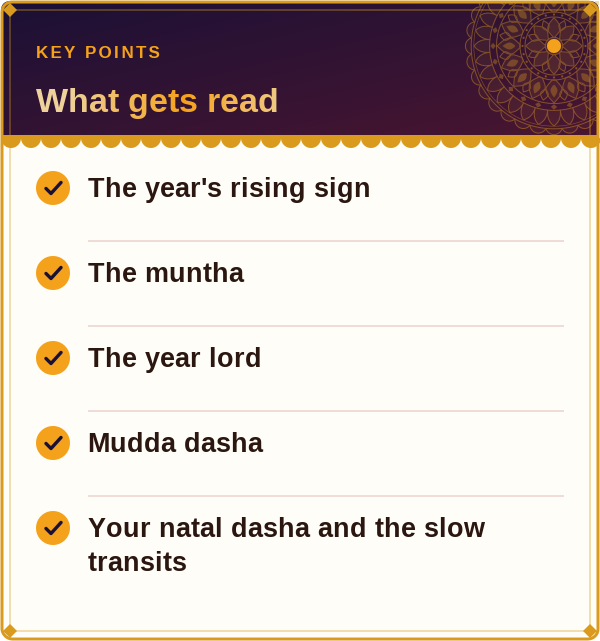
- The year's rising sign (varsha lagna) and the houses it sets up for the twelve months.
- The muntha, a sensitive point that advances one sign each year from your natal lagna and shows which area of life the year leans on.
- The year lord (varsheshvara), chosen from five candidate planets by strength, which sets the year's general tone.
- Mudda dasha, a compressed sequence of planetary periods that divides the year into stretches of weeks or months.
- Your natal dasha and the slow transits, because an annual chart never overrides the larger period you are living through. The dasha and transit reading covers that larger frame in depth.
Month by month, with your calendar beside it
The reading moves through the year in order, naming the months that look supportive for plans and the ones that suggest patience. Bring your real calendar: a planned move, a wedding to attend in India, a lease that ends, a child starting school, a big project at work. The aim is to set the chart's tendencies next to dates you already know about, so the outlook becomes useful rather than abstract.
Chicago families often mark more than one new year. Gujarati households may count from the day after Diwali, Telugu and Kannada families keep Ugadi, Maharashtrian families keep Gudi Padwa, and Makar Sankranti marks the Sun's move into Capricorn in mid-January. The Hindu calendar overview explains why these dates differ by region. The posts on Ugadi and Gudi Padwa in Chicagoland and keeping Makar Sankranti in a Chicago winter are worth a look if you like to begin plans on one of these days. For a general view of the coming calendar year rather than your personal one, see a Vedic look at 2027 for Chicago readers.
How a month is described
Expect plain language. A note for one month might say that the mudda dasha moves to Mercury, that Mercury rules the year's 10th house, and that the stretch suits paperwork, interviews and study. Another might say that Mars crosses the year's 8th house and that a renovation or a large loan deserves extra checks before you commit. Each note comes with its reasoning, so you can judge how much weight to give it. Pressure points are never presented as threats. A quieter month is a good time to rest, review and finish things, which is worth something in its own right, and a busy month is no promise that everything will go your way.
Who finds it useful
A varshaphal suits people who plan in yearly rhythms: those deciding when to start a business, a degree or a family; those who want to know which months to keep light; and those who simply like to begin each year with a quiet look at its shape. If a specific date matters, such as a house-warming, the muhurta consultation can pick one inside a supportive month.
Booking and the session
Send your birth details through the contact page, along with where you expect to be on your next birthday. The session takes place by phone, WhatsApp or video, at a time agreed in Central Time. Have your calendar and a list of the plans you already know about ready, and note down the months mentioned as you go. Astrologer and Psychic Vijayram will explain each factor as it comes up, so you can follow how the outlook is built.
What a year-ahead reading is not
The word forecast is used loosely here. A varshaphal describes the shape of a year as the tradition reads it: where effort is likely to flow easily and where it may meet resistance. It cannot tell you that a particular event will happen, it cannot replace financial or medical planning, and a quieter month is never a reason to cancel something important. Treat it as faith-based guidance for planning, and keep your own judgment in charge.
Common questions
When is the best time to book a varshaphal?
A few weeks before your birthday is ideal, so the year can be planned from its first day. You can book at any point, though; the chart runs from one birthday to the next, so a reading in month five still covers the seven months ahead.
I will be in India on my birthday. Does that matter?
It can. The annual chart is usually cast for the place where you are when the Sun returns, so a birthday spent in Pune produces a different rising sign than one spent in Chicago. Mention your travel plans when you book.
Is a varshaphal the same as a yearly horoscope in a newspaper?
No. Newspaper horoscopes are written for a whole Sun sign. A varshaphal is calculated from your own birth data for one specific year and read alongside your natal chart.
Can my spouse and I get a joint year-ahead reading?
Yes. The annual forecast for married couples reads both charts together for shared timing and plans.
Related services

Muhurta: Choosing Auspicious Dates
A muhurta consultation in Chicago: auspicious dates and times for moves, openings and ceremonies, calculated for Chicago sunrise and Central Time.
View service →
Gemstone and Remedy Consultation
A gemstone astrology consultation in Chicago: which Vedic remedies suit your chart, when a gemstone is not advised, and how to buy safely, by phone or video.
View service →Read more

Kites, Til-Gud and Snow: Keeping Makar Sankranti in Chicago
Keeping Makar Sankranti in Chicago: the Sun's move into sidereal Capricorn, til-gud, Pongal and Lohri indoors, and why kite flying here waits for a milder day.
Read article →
A Vedic Look at 2027 for Chicago Readers
A 2027 Vedic astrology forecast for Chicago readers: Jupiter, Saturn, Rahu and Ketu through the year by Moon sign, written as tendencies, not fixed outcomes.
Read article →
Six Tastes for a New Year: Ugadi Pachadi and Gudi Padwa in Chicagoland
Ugadi in Chicago: the six-taste pachadi as a picture of the year, the gudi in Marathi homes, and how families here read the panchang.
Read article →
Holika Dahan on a Cold March Night: Timing Holi in Chicago
Holi in Chicago: how the Holika Dahan bonfire night is set by the Phalguna full moon and the Bhadra rule, and why color play here often moves indoors or later.
Read article →
Jupiter Transit by Moon Sign: Twelve Short Notes for the Year
Jupiter transit by Moon sign: twelve short notes, one per rashi, on how a guru gochar is read from the Moon, written as tendencies rather than fixed outcomes.
Read article →Quick answers
Can a Western birth chart printout be turned into a kundli?
What is a kundli, and can a Western birth chart printout become one? Yes, from the same birth data. Here is what the sidereal shift and Indian layout change.
Read answer →How exact does my birth place need to be: city, hospital or village?
The birth chart reading details needed: date, clock time and town. Why the nearest city is usually close enough, and when a more exact birthplace helps.
Read answer →Talk to Astrologer and Psychic Vijayram
Tell us what you are facing. If a reading is unlikely to help, you will be told that plainly.