
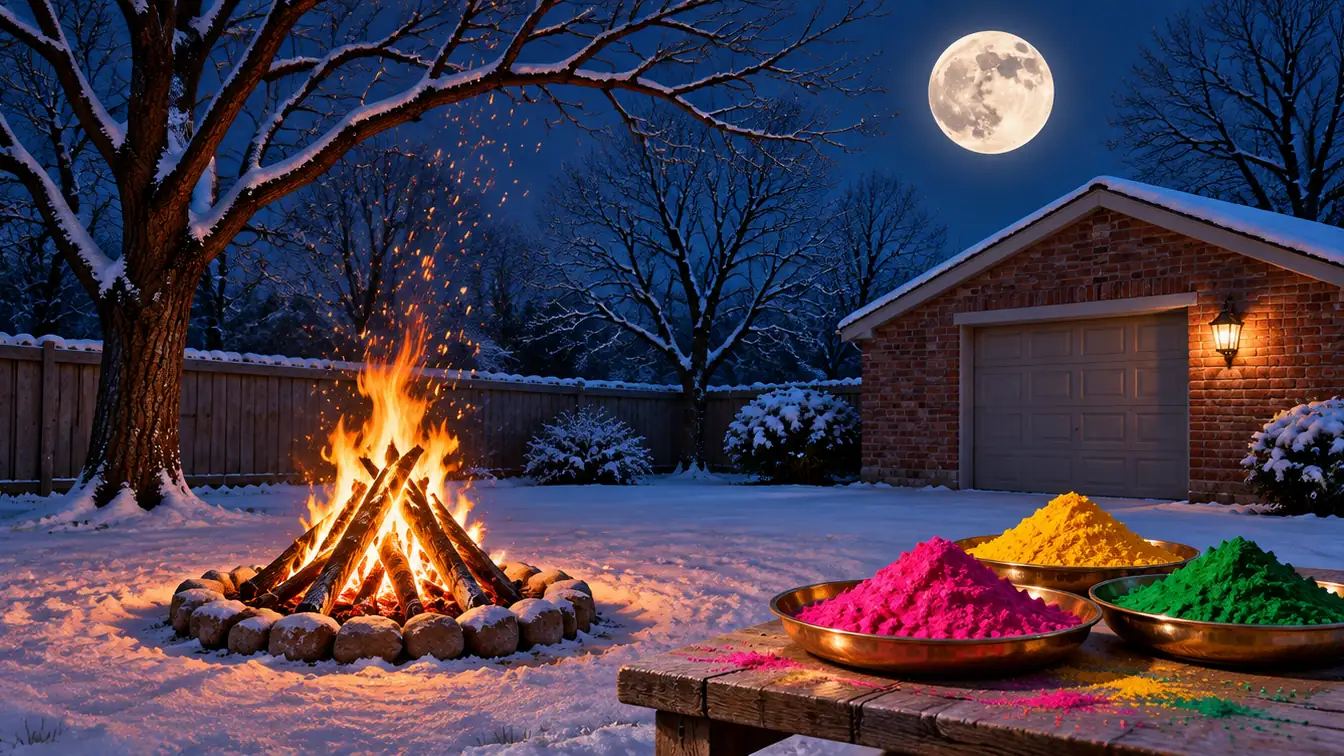
Holika Dahan on a Cold March Night: Timing Holi in Chicago
Holika Dahan in Chicago is held on the evening of the Phalguna full moon, after sunset and outside the Bhadra period, using times worked out for Chicago. Because March nights here are cold and many towns limit open fires, families often keep a small symbolic fire, and move the color play indoors or to a warmer weekend.
Key takeaways
- Holika Dahan , the bonfire, takes place on the evening of the full moon in the month of Phalguna.
- Three conditions guide the traditional timing:
- Holi falls between late February and late March, often within a few weeks of the second Sunday of March, when Chicago's clocks spring forward.
- Chicago's late winter is cold and often wet, with nights near freezing, as the city's climate record shows.
- Throwing water and powder at each other outdoors at 38 degrees is nobody's idea of fun.
In much of North India, Holika Dahan happens on a mild spring night, with a community bonfire at the crossroads and children circling it with grains and coconuts. In Chicago, the same full moon often rises over frozen puddles. The festival still comes, right on time, but it takes a few local adjustments.
Two days, two timings
Holi has two parts. Holika Dahan, the bonfire, takes place on the evening of the full moon in the month of Phalguna. It recalls the story of Prahlad, protected by his devotion to Vishnu, and his aunt Holika, who burned in the fire meant for him. The next day brings the play of colors, Rangwali Holi or Dhulandi, the part most people picture when they hear the word. As the overview of Holi notes, it marks the arrival of spring and the triumph of good over evil.
The colors are a celebration and can move. The bonfire is a ritual with a time.
How the bonfire time is worked out
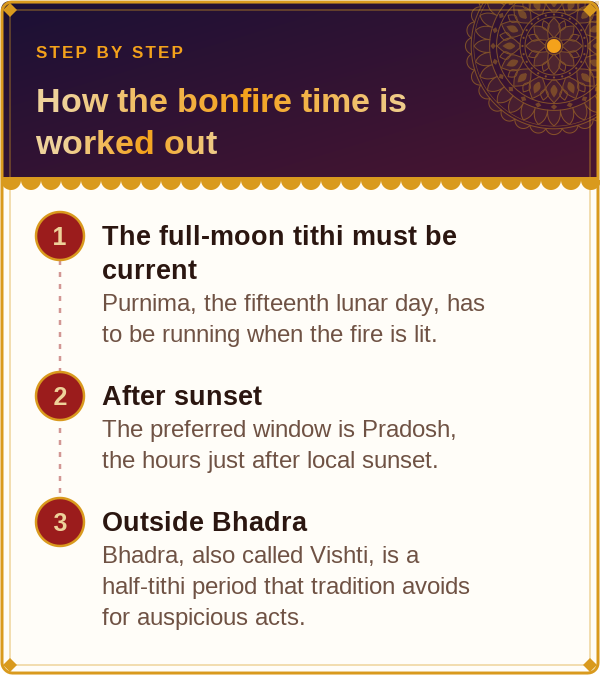
Three conditions guide the traditional timing:
- The full-moon tithi must be current. Purnima, the fifteenth lunar day, has to be running when the fire is lit.
- After sunset. The preferred window is Pradosh, the hours just after local sunset.
- Outside Bhadra. Bhadra, also called Vishti, is a half-tithi period that tradition avoids for auspicious acts. When it overlaps the evening, panchangs move the lighting to after Bhadra ends, sometimes close to midnight, or to its final portion.
The tithi and Bhadra change at the same instant worldwide, but they meet a very different evening in Chicago than in Delhi. A Bhadra period that ends before sunset in India may still be running at sunset here, or the other way round. That is why a time copied from an Indian calendar can be wrong by hours, not minutes.
The March clock change
Holi falls between late February and late March, often within a few weeks of the second Sunday of March, when Chicago's clocks spring forward. Most panchang software handles this correctly, but a printed sheet prepared earlier, or a time converted by hand, can be an hour off. When the date is close to the change, double-check. Clock rules have caught Chicago families out before; the post on old Chicago birth times and daylight saving tells a longer version of that story.
A bonfire in a Chicago March
Chicago's late winter is cold and often wet, with nights near freezing, as the city's climate record shows. Add municipal fire rules, apartment living and wind off the lake, and a full crossroads bonfire is rarely practical. Families adapt:
- Temple or community bonfires. Some temples and community associations hold a shared Holika Dahan. Check their websites for the year's plans.
- A small fire where allowed. In a suburban backyard with a permitted fire pit, a small fire with a few cow-dung cakes or wood, grains and a coconut keeps the ritual. Check your village's rules, never leave it unattended and keep water close.
- A lamp instead. In an apartment, a diya, a short prayer and the Prahlad story told to children carry the meaning. The fire is a symbol; the devotion is the point.
Why the colors often wait
Throwing water and powder at each other outdoors at 38 degrees is nobody's idea of fun. In Chicago, color play tends to happen:
- indoors in a basement or garage with old sheets on the floor, using dry colors only;
- at community events, often on a weekend after the date, sometimes weeks later when it is warmer;
- in April or May at university and temple celebrations.
Whatever the setting, use skin-safe colors, protect eyes, and be careful with anyone who has asthma or sensitive skin.
Holi as a turning of the year
In calendars that end each month at the full moon, Holi closes the lunar year, and the new month of Chaitra begins the next day. That makes the bonfire a natural moment for a small personal reset: write down one habit, worry or grudge you want to leave behind, and let the fire, or the lamp, stand for its release. Two weeks later, Ugadi and Gudi Padwa open the new year for other communities, described in six tastes for a new year.
For people who like to plan the year around such turning points, a year-ahead Varshaphal reading maps your own months from your birthday, and the broader transits for the year are in a Vedic look at 2027. If you simply need the exact Holika Dahan window for your suburb, a short muhurta consultation with Astrologer and Psychic Vijayram gives it in Central Time, by phone, WhatsApp or video.
What the fire cannot do
Holika Dahan is a story of devotion protecting the innocent, told each spring with fire and color. Lighting it at the perfect minute does not remove misfortune, and missing the window does not invite any. Keep it safe, keep it joyful, and keep the story at the center.
Common questions
What is Bhadra and why does it matter for Holika Dahan?
Bhadra, also called Vishti, is a half-day division of the lunar calendar that tradition considers unsuitable for auspicious acts. If it covers the evening, the bonfire is lit after it ends, even late at night, or in its tail portion, as your panchang directs.
Can we play Holi on a different day?
Many Chicago families do. The bonfire is tied to the full moon, but the color play is a celebration and moves easily to a warmer weekend or a community event.
Is a backyard bonfire allowed?
It depends on your city or village. Many places restrict open burning, and fire pits have their own rules. Check with your municipality, keep the fire small and attended, and have water or an extinguisher at hand.
Why does the daylight saving change matter around Holi?
Holi often falls within a few weeks of the second Sunday of March, when clocks spring forward. Make sure the times you are using were calculated with the right offset for that date.
Related service
Keep reading
Clay, Paper or Metal? Choosing a Ganesh Murti for a Chicago Apartment
Ganesh Chaturthi in Chicago: choosing a murti's size and material for an apartment, dissolving clay at home, and checking local rules before outdoor immersion.
Read article →
Akshaya Tritiya and Gold Shopping on Devon Avenue
Akshaya Tritiya in Chicago: why the day is considered lasting for purchases, how the Devon Avenue gold custom fits it, and how to keep it without overspending.
Read article →
The Chart of Chicago: A Playful Look at March 4, 1837
A playful Chicago birth chart: reading the city's incorporation on March 4, 1837 the way mundane astrologers read a founding chart, with Saturn exalted.
Read article →Quick answers
Can a Western birth chart printout be turned into a kundli?
What is a kundli, and can a Western birth chart printout become one? Yes, from the same birth data. Here is what the sidereal shift and Indian layout change.
Read answer →How exact does my birth place need to be: city, hospital or village?
The birth chart reading details needed: date, clock time and town. Why the nearest city is usually close enough, and when a more exact birthplace helps.
Read answer →Talk to Astrologer and Psychic Vijayram
Tell us what you are facing. If a reading is unlikely to help, you will be told that plainly.