
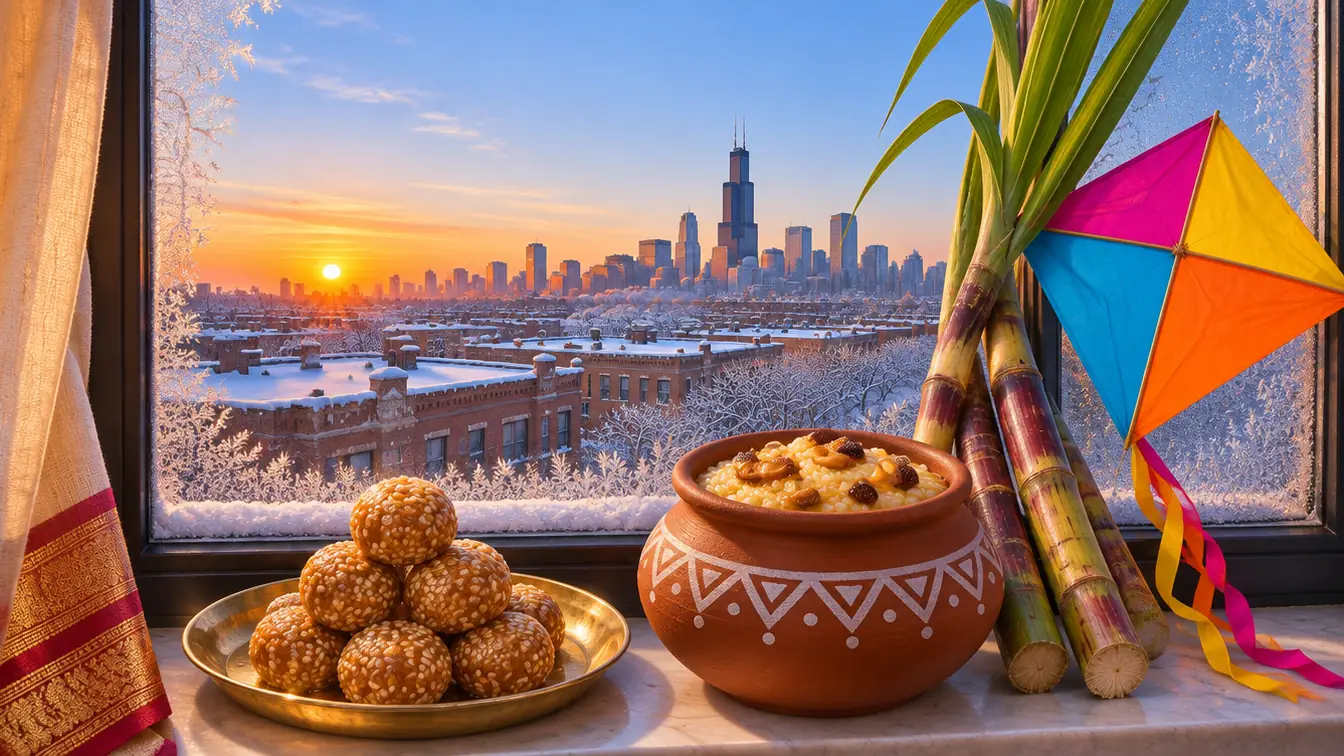
Kites, Til-Gud and Snow: Keeping Makar Sankranti in Chicago
Makar Sankranti marks the Sun's entry into sidereal Capricorn, around January 14. In Chicago, where mid-January highs hover near freezing, families keep it mostly indoors: sesame and jaggery sweets, a pot of Pongal on the stove, a small Lohri fire where allowed, and kites saved for a milder, breezy day by the lake.
Key takeaways
- Makar Sankranti is the moment the Sun enters Makara, sidereal Capricorn.
- Chicagoland has families from every one of these regions, sometimes in the same cul-de-sac in Naperville or the same building in West Ridge.
- Chicago's winters are cold and snowy, with average January highs near freezing, as the city's climate record shows.
- Flying a kite at minus ten wind chill is miserable, and lakefront ice is dangerous.
- Because the day marks the Sun's turn, some people use it as a point to review the year ahead.
Gujarati families call the day Uttarayan and grow up on rooftops, flying kites until their fingers are cut by the string. In Chicago in mid-January, the roof is under snow and the wind off Lake Michigan would take a kite to Indiana. So the festival changes shape here, while its meaning stays the same.
What the day marks
Makar Sankranti is the moment the Sun enters Makara, sidereal Capricorn. As the overview of Makar Sankranti explains, it is one of the few Hindu festivals fixed to the solar calendar rather than the Moon, which is why it falls on or near January 14 almost every year. By our own calculation, the Sun's entry in 2027 comes on the morning of January 14, Central Time.
It also opens Uttarayana, the half-year of the Sun's northward course, which tradition regards as an auspicious period for beginnings. Strictly, the Sun starts moving north at the winter solstice around December 21. The three-week gap between the solstice and Sankranti is the slow drift between the tropical and sidereal zodiacs, the same drift that makes many people's Vedic sign differ from their Western one.
One festival, many names
| Region | Name | What families do |
|---|---|---|
| Gujarat | Uttarayan | Kites, undhiyu, chikki |
| Maharashtra | Makar Sankranti | Til-gul sweets and the saying "take til-gul, speak sweetly" |
| Tamil Nadu | Pongal | Rice boiled with milk and jaggery until it spills over |
| Punjab | Lohri (the night before) | A bonfire, songs, sesame, peanuts and popcorn |
| Andhra Pradesh, Telangana, Karnataka | Sankranti | Rangoli, ellu-bella mixtures, cattle honored |
| Uttar Pradesh, Bihar | Khichdi | Khichdi cooked and shared, a ritual bath |
| Assam | Magh Bihu | Feasting after the harvest |
Chicagoland has families from every one of these regions, sometimes in the same cul-de-sac in Naperville or the same building in West Ridge. A Sankranti potluck can easily have chikki, pongal and gajak on one table.
Keeping it indoors
Chicago's winters are cold and snowy, with average January highs near freezing, as the city's climate record shows. That makes a few adjustments sensible.
- Pongal on the stove. The Pongal festival centers on a pot of rice, milk and jaggery allowed to boil over, with the cry "Pongalo Pongal." A heavy pot on a kitchen burner works fine; watch it closely, because the overflow is the point but a pan fire is not.
- Til-gud and chikki. Sesame and jaggery are warming foods by tradition, well suited to a Chicago January. Making them with children is half the festival.
- Lohri fire. If you have a backyard fire pit, check your village's burning rules and the forecast first. In an apartment, a lamp and the songs carry the meaning.
- Sun prayer. Many families offer water to the Sun at sunrise. In mid-January that is a little after 7 a.m. here, often through cloud; a window facing east is enough.
Why the kites wait
Flying a kite at minus ten wind chill is miserable, and lakefront ice is dangerous. Many Gujarati families in the suburbs save their kites for the first warm, breezy weekend of spring or a clear autumn afternoon in a forest preserve or a park. Some make a small indoor version for children with paper kites hung from the ceiling. The tradition survives; the date shifts.
A Sankranti check-in on the year
Because the day marks the Sun's turn, some people use it as a point to review the year ahead. A simple version you can do at home:
- Write down three things that went well since last Sankranti.
- Write one thing you want to finish by Uttarayana's end in mid-July.
- Note one habit to drop, in the spirit of Bhogi, the day when old things are cleared out.
- Share a sweet with someone you have had words with. "Speak sweetly" is the oldest remedy on the list.
For a fuller look, a year-ahead Varshaphal reading works from your own solar return chart, cast for your birthday rather than for Sankranti, and maps the months in detail. The broader picture for 2027, by Moon sign, is in a Vedic look at 2027 for Chicago readers. Spring's lunar new year, celebrated by Telugu, Kannada and Marathi families, has its own post on Ugadi and Gudi Padwa.
When winter weighs on you
January is the hardest month for many people here, especially newcomers from warmer places. If the dark weeks bring more than ordinary gloom, talk to a doctor; seasonal low mood is common and treatable. The post on winter low mood and spiritual practice offers gentle routines alongside proper care.
What the festival cannot do
Sankranti is a day of gratitude for the harvest and the returning light. It does not change your chart, and no special puja on this day fixes a difficult year. Astrologer and Psychic Vijayram is glad to talk through the year ahead by phone, WhatsApp or video, but the sweets, the shared meal and the kind words are the real substance of the day.
Common questions
Why is Makar Sankranti on January 14 and not at the winter solstice?
Because it follows the sidereal zodiac, measured against the stars. The solstice, when the Sun actually turns north, comes around December 21; the gap of about three weeks is the drift that astronomers call precession.
Can I fly a kite on the lakefront in January?
You can, but strong wind, ice and cold make it hard work and risky for small children. Many families fly kites on a mild spring or autumn day instead and keep Sankranti itself for food and prayer.
Is Sankranti a good day to start something new?
Many families treat the start of Uttarayana as auspicious. For a specific event such as a purchase or a ceremony, a muhurta looks at more than the day, so it is worth checking the details.
What is the difference between Lohri, Pongal and Sankranti?
They are regional faces of the same solar turning point: Lohri is the Punjabi bonfire night before, Pongal the Tamil harvest festival over several days, and Sankranti the name used in much of the rest of India.
Related service
Keep reading
Staying Steady Through Sade Sati: Routines for Each of the Three Phases
Sade Sati remedies without fear: what each of Saturn's three phases is said to emphasize, who is in it now, and steady routines for long Chicago winters.
Read article →
What the Adler Planetarium Sky Shows: Sidereal vs Tropical Zodiac
Sidereal vs tropical zodiac, explained with the real sky over Chicago's Museum Campus: why your Vedic sign sits about 24 degrees from your Western one.
Read article →
A Twelve-Month Transit Check-In After a Move to Chicago
New to Chicago? A first-year astrology check-in: which dasha changes and transits to note after the move, and the practical settling-in steps no chart replaces.
Read article →Quick answers
Can a Western birth chart printout be turned into a kundli?
What is a kundli, and can a Western birth chart printout become one? Yes, from the same birth data. Here is what the sidereal shift and Indian layout change.
Read answer →How exact does my birth place need to be: city, hospital or village?
The birth chart reading details needed: date, clock time and town. Why the nearest city is usually close enough, and when a more exact birthplace helps.
Read answer →Talk to Astrologer and Psychic Vijayram
Tell us what you are facing. If a reading is unlikely to help, you will be told that plainly.