
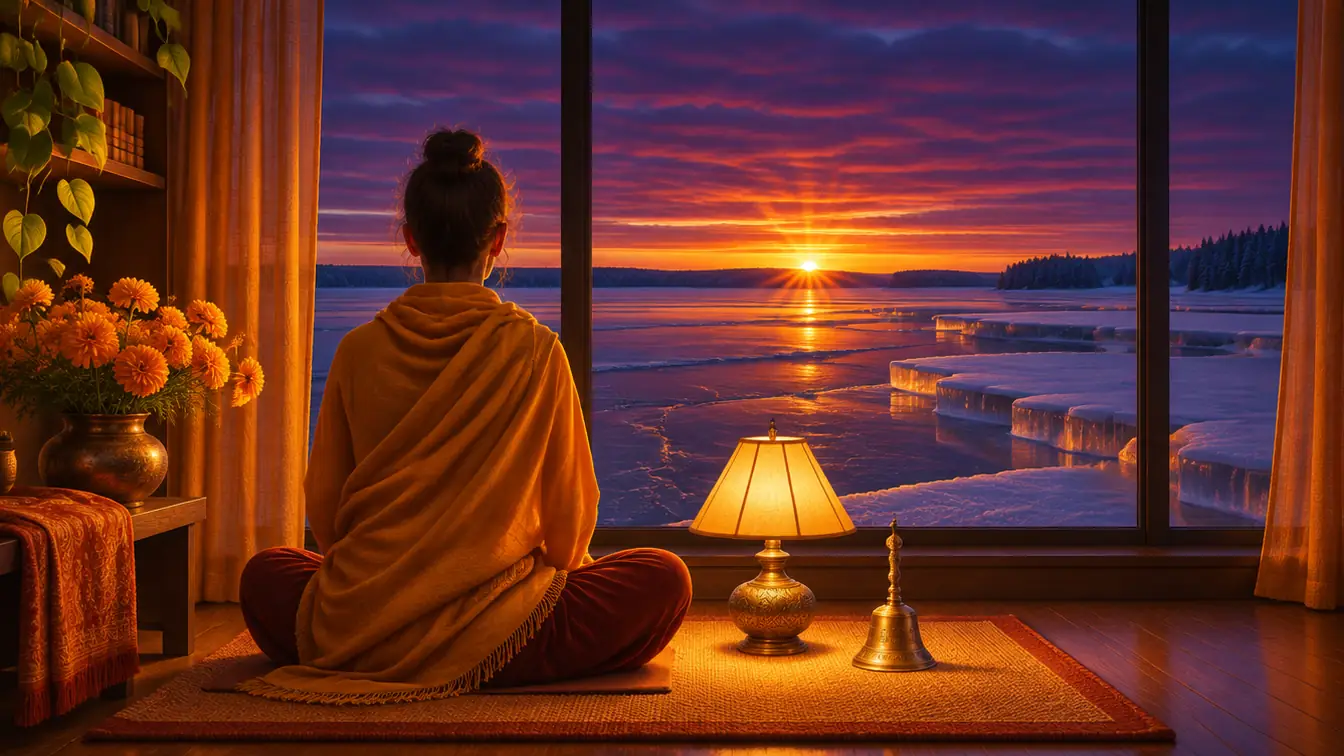
The Darkest Weeks Around the Solstice: A Chicago Morning Practice
A winter blues spiritual practice for Chicago can be twenty minutes each morning: daylight or a lamp by the window, slow breathing, a sun mantra such as the Gayatri and a little movement. It suits mild seasonal low mood. Low mood most days for two weeks or more needs a doctor, since seasonal depression is treatable.
Key takeaways
- Many people feel slower and flatter in December.
- Chicago sits on Lake Michigan, with cold, gray winters and average January highs near freezing, as the city's climate overview describes.
- The month around the solstice is treated in many Hindu traditions as a time for early-morning devotion.
- A morning routine cannot treat depression.
On the winter solstice, Chicago gets about nine hours of daylight. The sun rises after seven and sets before half past four, and many commuters leave home and return in the dark for weeks. A winter blues spiritual practice will not change the sky, but a short morning routine can give those weeks some shape. Before the routine, though, comes an honest word about health.
First: winter blues or seasonal depression?
Many people feel slower and flatter in December. For some, it is more than that. The National Institute of Mental Health describes seasonal affective disorder as a type of depression that usually starts in late fall or early winter and lifts in spring and summer. It is real, common and treatable.
See a doctor if, for two weeks or more, you feel low most of the day, lose interest in things you usually enjoy, sleep far more or far less, find your appetite changing sharply, feel hopeless or worthless, or struggle to get through work. If you have thoughts of death or ending your life, contact the Suicide and Crisis Lifeline now, or call emergency services. Treatment may include light therapy, talk therapy, medication or a mix, and a doctor will help you decide. Never stop or change medication on the strength of any spiritual practice, including this one.
What follows is for the ordinary winter heaviness, or for use alongside treatment if your doctor agrees.

How dark it really gets
Chicago sits on Lake Michigan, with cold, gray winters and average January highs near freezing, as the city's climate overview describes. The darkest mornings actually come in early January rather than at the solstice, when sunrise drifts to about 7:18. You can look up exact times for any date with the U.S. Naval Observatory's sun and moon data tool. Knowing the numbers helps you plan: if the sun is up at 7:15, a routine at 7:00 can end with the first daylight at the window.
The tradition already has a dark-month practice
The month around the solstice is treated in many Hindu traditions as a time for early-morning devotion. In Tamil households it is Margazhi, when families rise before dawn, draw kolam at the door and recite Andal's Tiruppavai. Across India, the sun's turn northward is celebrated in mid-January at Makar Sankranti; the post on keeping Makar Sankranti in a Chicago winter explains how families keep it here. In other words, rising early to honor the returning light in the darkest weeks is an old idea. This routine borrows it.
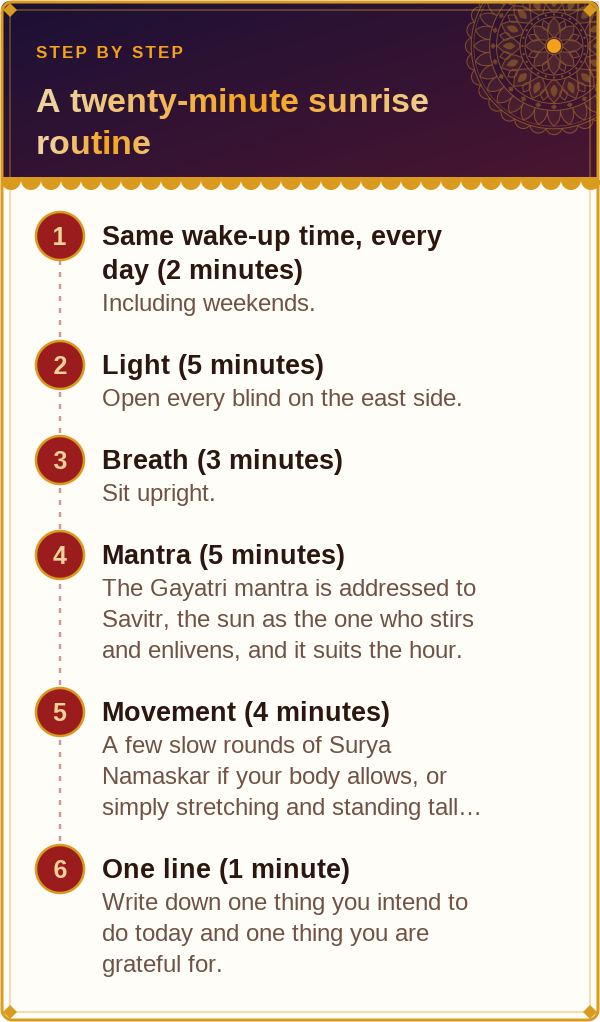
A twenty-minute sunrise routine
- Same wake-up time, every day (2 minutes). Including weekends. A steady rhythm matters more than an early one.
- Light (5 minutes). Open every blind on the east side. Sit by the brightest window. Light a small diya or a battery lamp as a sign of the sun you are waiting for. If your doctor has recommended a light box, this is where it goes.
- Breath (3 minutes). Sit upright. Breathe in for a slow count of four, out for six. Let the longer out-breath settle you.
- Mantra (5 minutes). The Gayatri mantra is addressed to Savitr, the sun as the one who stirs and enlivens, and it suits the hour. The guide to learning the Gayatri mantra line by line walks through it. If that feels like too much, repeat Om Suryaya Namah eleven or twenty-one times.
- Movement (4 minutes). A few slow rounds of Surya Namaskar if your body allows, or simply stretching and standing tall by the window. Anyone with a heart condition, a joint problem or a pregnancy should check with a doctor first.
- One line (1 minute). Write down one thing you intend to do today and one thing you are grateful for.
If you would like a mantra chosen for you, or a routine shaped around shift work or small children, personal mantra and meditation guidance builds one with you by phone or video.
Getting daylight outside the window
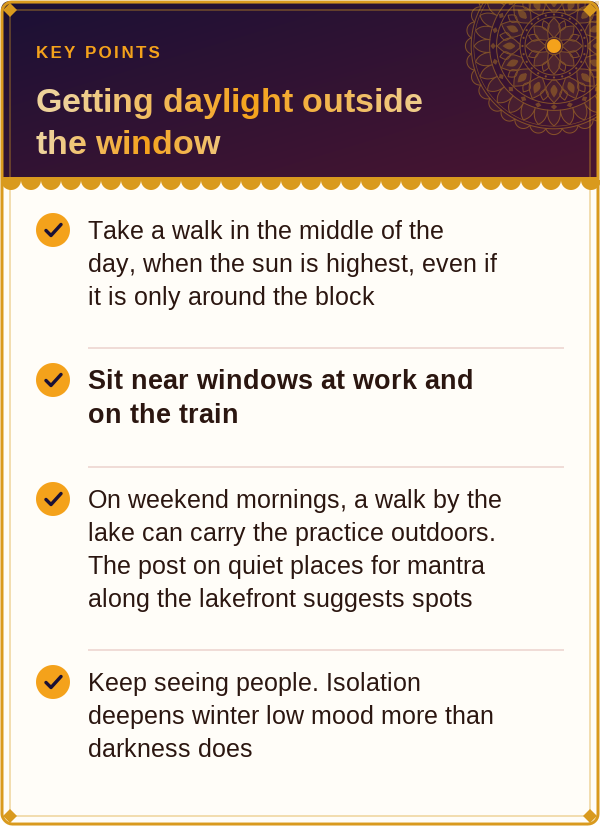
- Take a walk in the middle of the day, when the sun is highest, even if it is only around the block.
- Sit near windows at work and on the train.
- On weekend mornings, a walk by the lake can carry the practice outdoors. The post on quiet places for mantra along the lakefront suggests spots.
- Keep seeing people. Isolation deepens winter low mood more than darkness does.
What this practice cannot do
A morning routine cannot treat depression. It can give a dark season a steady start, a sense of devotion and a reason to stand by the window each day. If the heaviness grows or does not lift, please see a doctor or therapist. Astrologer and Psychic Vijayram offers this practice as faith-based support beside that care, and the post on why energy cleansing and therapy do different jobs explains why one never replaces the other.
Common questions
Should I buy a light box?
Talk to your doctor first. Light therapy is a standard treatment for winter-pattern seasonal affective disorder, but timing, brightness and length matter, and it is not right for everyone, including some people with eye conditions or bipolar disorder. If your doctor recommends one, it can sit naturally inside this morning routine.
Can I do this practice if I am on antidepressants?
Yes. Prayer, breathing and gentle movement sit comfortably alongside medication. Keep taking it as prescribed and never stop or change a dose without your doctor. If the practice brings up difficult feelings, mention it at your next appointment.
What if I cannot get up early?
Move the practice rather than drop it. The point is light and attention early in your day, whenever your day starts. Shift workers can do the same routine after waking in the afternoon, near the brightest window available.
Is there a mantra for depression?
There is no mantra that treats depression. People do use calming mantras, such as the Gayatri or a short Surya mantra, as part of a steadier daily rhythm. If you are depressed, please see a doctor or therapist; a mantra can sit beside that care, never in place of it.
Related service

Keep reading

Quiet Places for Mantra Practice Along the Lakefront Trail
Meditation spots in Chicago for mantra and japa along the Lakefront Trail, north to south, with notes on dawn, wind, winter ice and leaving no offerings behind.
Read article →
A Five-Minute Mantra for the Metra or the 'L'
A mantra for the commute, sized for Chicago's Metra and 'L' rides: a five-minute silent practice, finger counting instead of a mala, and train etiquette.
Read article →
The Aura Cleansing Ritual Step by Step, as Practiced in Chicago Homes
Aura cleansing in Chicago, step by step: the salt bath, lamp, water and mantra rite for an apartment or a house, smoke-free options and the limits of ritual.
Read article →Quick answers
How will I know if an aura cleansing helped?
What is aura cleansing, and how do you know if it helped? What people describe afterward, the plain limits of a traditional practice, and when to see a doctor.
Read answer →Should I tell my doctor I am having spiritual healing sessions?
Is spiritual healing medical treatment? No. Why to tell your doctor about spiritual healing sessions, and how faith practice can sit beside your medical care.
Read answer →Talk to Astrologer and Psychic Vijayram
Tell us what you are facing. If a reading is unlikely to help, you will be told that plainly.