

Gayatri Mantra at Sunrise: Learning the Pronunciation Line by Line
The Gayatri mantra's meaning, in plain English, is: we meditate on the radiant light of the divine sun, Savitr; may it inspire our minds. It comes from the Rig Veda and is traditionally chanted at sunrise. Learn it one line at a time, start with three repetitions a day, and build toward a mala of 108.
Key takeaways
- The mantra is a verse of the Rig Veda, book three, hymn sixty-two, verse ten, addressed to Savitr, the sun as the power that rouses and enlivens.
- Say it: ohm · bhoor · bhoo-vah · svah (one quick syllable, the s and v run together).
- The traditional time is sandhya, the junctions of the day: sunrise, noon and sunset.
- The Gayatri is a prayer for an awakened mind.
For many Hindu families, the Gayatri mantra is the first prayer a child learns and the last words said before a long trip. It is short, just twenty-four syllables after the opening line, but dense with meaning. This guide takes the Gayatri mantra meaning line by line, gives a plain pronunciation for each line, and suggests a way to start a daily count at sunrise.
Where the verse comes from
The mantra is a verse of the Rig Veda, book three, hymn sixty-two, verse ten, addressed to Savitr, the sun as the power that rouses and enlivens. It is attributed to the sage Vishvamitra. The overview of the Gayatri mantra explains that the name comes from its meter, the gayatri, three lines of eight syllables, and that it is also called the Savitri mantra. The opening line, with Om and three sacred words, was added before the Vedic verse in later practice. For centuries it was taught mainly at the sacred-thread ceremony; modern reform movements opened it to everyone, and it is now chanted very widely.
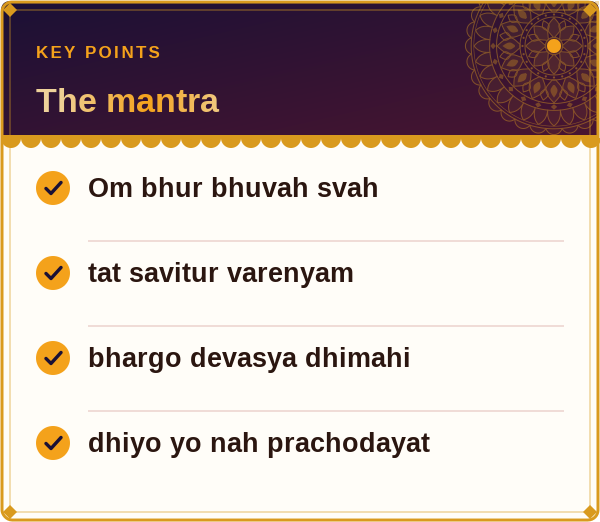
The mantra
Om bhur bhuvah svah
tat savitur varenyam
bhargo devasya dhimahi
dhiyo yo nah prachodayat
Line by line: meaning and pronunciation
Om bhur bhuvah svah
Say it: ohm · bhoor · bhoo-vah · svah (one quick syllable, the s and v run together).
Meaning: Om, the sacred sound, followed by three words for the three worlds: bhur, the earth; bhuvah, the space between; svah, the heavens. Before the prayer begins, you name everything, from the ground beneath you to the sky above.
tat savitur varenyam
Say it: tut · sah-vi-toor · vah-rayn-yum. Some traditional reciters stretch the last word to vah-ray-ni-yum, which keeps the line at exactly eight syllables.
Meaning: "That most excellent [light] of Savitr." Tat, that, points to something greater than any word can hold. Varenyam means worthy of being chosen, the best.
bhargo devasya dhimahi
Say it: bhar-go · day-vus-yah · dhee-mah-hee.
Meaning: "We meditate on the radiance of the divine." Bhargas is a shining, purifying brilliance. Dhimahi, we meditate, is plural: the prayer is said as part of a community, even when you chant alone.
dhiyo yo nah prachodayat
Say it: dhee-yo · yo · nah · pruh-cho-duh-yaat, with a long final "aat".
Meaning: "May it stir our minds." Dhi is thought, understanding, intelligence. The request is not for wealth or rescue but for clear, awakened thinking.
Put together: We meditate on the adorable radiance of the divine sun; may it inspire our minds.
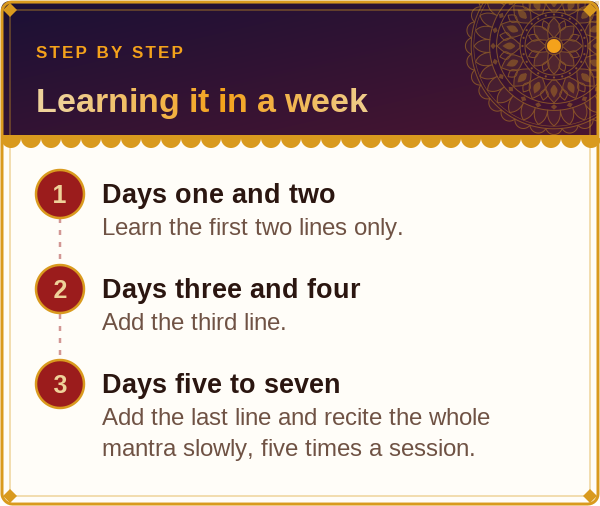
Learning it in a week
- Days one and two: learn the first two lines only. Say them slowly ten times, morning and evening.
- Days three and four: add the third line. Recite all three together.
- Days five to seven: add the last line and recite the whole mantra slowly, five times a session.
A recording helps. If you want each line checked as you say it, personal mantra and meditation guidance teaches the sounds by video, line by line, and leaves you with a recording to practice with.
Beginning a daily count at sunrise
The traditional time is sandhya, the junctions of the day: sunrise, noon and sunset. Sunrise is the one most people keep. In Chicago it moves a long way through the year, from around 5:15 a.m. in late June to around 7:15 a.m. in early January; the U.S. Naval Observatory's sun and moon data gives the exact time for any date. The post on why local sunrise matters on a Chicago panchang explains why times calculated for India do not apply here.
- Sit facing east, near a window if you can.
- Start with three repetitions. After a week or two, move to eleven.
- When eleven feels easy, try one round of 108 on a mala. It takes roughly fifteen to twenty minutes at a steady pace.
- Some people offer a little water toward the rising sun afterward, a simple act of thanks.
In the dark weeks of December, this short routine can anchor the morning; the post on a Chicago morning practice for the darkest weeks builds a fuller routine around it. If you are still deciding whether the Gayatri is the right mantra for you, the guide to choosing a mantra compares it with other options.
What the mantra is, and is not
The Gayatri is a prayer for an awakened mind. It is not a charm for success, a cure for illness or a shortcut past effort. Astrologer and Psychic Vijayram teaches it as one of the oldest and most beautiful prayers in the tradition, to be said with care and without expectation of reward.
Common questions
What are the benefits of the Gayatri mantra?
People who chant it regularly describe a calmer start to the day, steadier focus and a sense of connection to a very old prayer. Those are the honest benefits. The mantra is a prayer for clear thinking; it is not a remedy for illness or a way to change outside events.
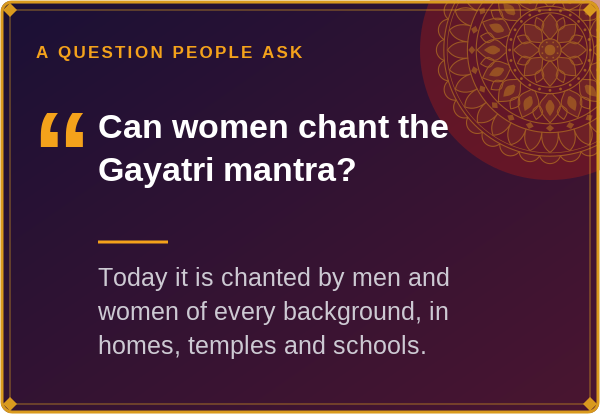
Can women chant the Gayatri mantra?
Today it is chanted by men and women of every background, in homes, temples and schools. Some traditional families keep older customs about who recites it and when. If your family has a view, talk it through with them or a priest you trust; the prayer itself asks only for sincerity.
Should I chant it aloud or silently?
Either. Many people learn it aloud, so they can hear and correct the sounds, then move to a soft murmur or silent repetition once it is familiar. Silent chanting suits a shared apartment or a train ride.
Is it all right to chant it at a time other than sunrise?
Yes. Sunrise, noon and sunset are the traditional times, but a sincere prayer at whatever hour your life allows is better than none. Night-shift workers often chant it on waking, whatever the clock says.
Related service
Keep reading
The Mahamrityunjaya Mantra: When Families Chant It
The Mahamrityunjaya mantra, its meaning and when families chant it: at a diagnosis, on surgery day, in recovery. A prayer for strength said beside treatment.
Read article →
Energy Cleansing and Therapy: Different Jobs
Energy healing vs therapy: what each one is for, why one never replaces the other, how to tell which you need first, and how to use both without conflict.
Read article →
Vastu Basics: Entrance, Kitchen, Bedroom
Vastu basics for the three rooms that matter most, the entrance, kitchen and bedroom, with adjustments that need no building work and what not to worry about.
Read article →Quick answers
How will I know if an aura cleansing helped?
What is aura cleansing, and how do you know if it helped? What people describe afterward, the plain limits of a traditional practice, and when to see a doctor.
Read answer →Should I tell my doctor I am having spiritual healing sessions?
Is spiritual healing medical treatment? No. Why to tell your doctor about spiritual healing sessions, and how faith practice can sit beside your medical care.
Read answer →Talk to Astrologer and Psychic Vijayram
Tell us what you are facing. If a reading is unlikely to help, you will be told that plainly.