
Abhijit Muhurta and Choghadiya: Daily Time Windows on a Chicago Panchang
A Chicago panchang starts each day at Chicago's own sunrise, then divides the daylight into parts: Abhijit Muhurta is the window around local solar noon, Choghadiya splits the day into eight periods, and Rahu Kalam is one of those eighths. Because Chicago's day length swings widely, every window changes length through the year.
Key takeaways
- A Hindu day runs from one sunrise to the next, not from midnight.
- Daylight is divided into fifteen equal muhurtas.
- The tithi, or lunar day, is different: it is a property of the Moon's angle from the Sun and changes at the same instant everywhere on Earth.
- Daily windows are a refinement, not a rulebook.
- Festival evenings are where local calculation matters most; the Diwali post on fitting Lakshmi Puja around a Chicago weeknight is a worked example.
Open a panchang for Mumbai and a panchang for Chicago on the same date and almost nothing lines up except the festival names. That is not an error. A panchang is a local document: its day begins at sunrise, and every window on the page is measured from that sunrise and the sunset that follows. In Chicago, those two moments move a great deal across the year.
Start with sunrise and sunset
A Hindu day runs from one sunrise to the next, not from midnight. Sunrise here is defined the way astronomers do it, the moment the Sun's upper edge clears the horizon, allowing for the bending of light by the atmosphere, as the US Naval Observatory's definitions of sunrise and sunset explain. For Chicago that moment ranges from about 5:15 a.m. in late June to around 7:15 a.m. in early January, and briefly later still in the last days of October before clocks fall back.
The city's position adds a twist. Chicago sits a little east of the line the Central time zone is built around, and its longitude, about 87.6 degrees west according to the city's profile, means local solar noon only sits near 12:00 for a few weeks each winter. It comes as early as about 11:34 a.m. in early November and as late as about 1 p.m. just after daylight saving starts in March.
Three windows people use most
Abhijit Muhurta
Daylight is divided into fifteen equal muhurtas. The eighth, straddling local solar noon, is Abhijit, traditionally a strong default window for beginning something when no special muhurta has been chosen. Many panchangs exclude it on Wednesdays. Its length follows the day: about 36 minutes in late December, close to an hour in late June.
Choghadiya
Widely used by Gujarati and Rajasthani families, Choghadiya divides the daytime into eight equal periods and the night into eight more. Each period carries a name: Amrit, Shubh, Labh and Char are considered favorable or workable; Udveg, Rog and Kaal are avoided for new starts. The order shifts with the weekday. Shopkeepers often open the cash box or sign deals in a Labh or Amrit choghadiya.
Rahu Kalam
One of the eight daytime parts, chosen by weekday, is Rahu Kalam, a period many South Indian families avoid for beginnings. Monday's is the second eighth of the day, Sunday's the last. The post on Rahu Kalam and daily timing covers the tradition in more depth.
The same windows, winter and summer
Here is how much Chicago's seasons stretch the windows, by our own calculation:
| Monday, December 21, 2026 | Monday, June 21, 2027 | |
|---|---|---|
| Sunrise | 7:14 a.m. CST | 5:15 a.m. CDT |
| Sunset | 4:22 p.m. | 8:29 p.m. |
| Length of daylight | About 9 hours 8 minutes | About 15 hours 14 minutes |
| Abhijit Muhurta | About 11:30 a.m. to 12:06 p.m. | About 12:21 p.m. to 1:22 p.m. |
| One choghadiya | About 68 minutes | About 1 hour 54 minutes |
| Rahu Kalam | About 8:23 to 9:31 a.m. | About 7:09 to 9:03 a.m. |
A rule of thumb that works in India, "Rahu Kalam on Monday is 7:30 to 9," is close in June and wrong in December. Always read the local page.
Tithi today in Chicago
The tithi, or lunar day, is different: it is a property of the Moon's angle from the Sun and changes at the same instant everywhere on Earth. What differs by place is which tithi is current at local sunrise, and that is what decides the date of a fast or festival. Because Chicago's sunrise falls ten and a half to eleven and a half hours after India's, an Ekadashi or Purnima occasionally lands on a different calendar day here.
A sensible way to use the windows
Daily windows are a refinement, not a rulebook. A practical approach:
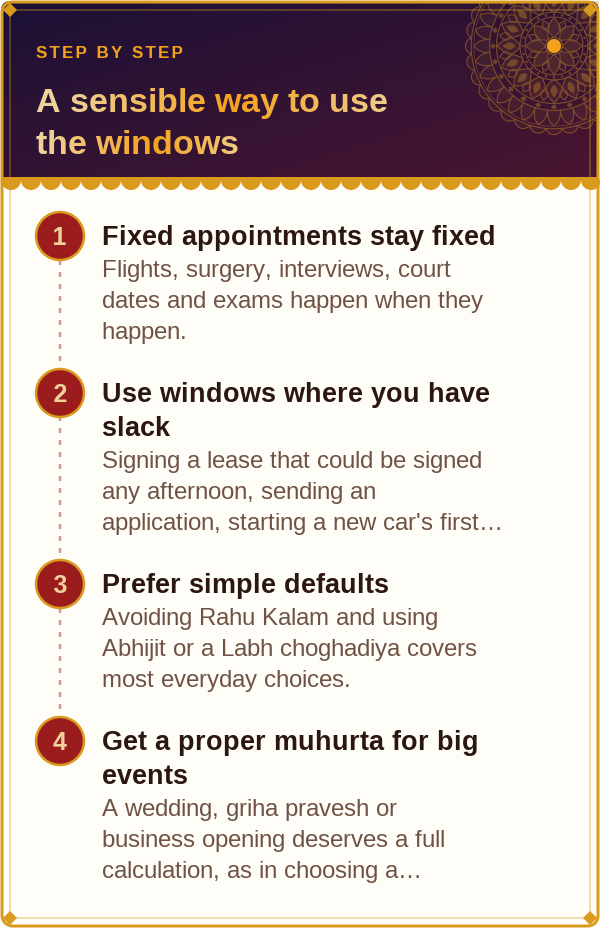
- Fixed appointments stay fixed. Flights, surgery, interviews, court dates and exams happen when they happen.
- Use windows where you have slack. Signing a lease that could be signed any afternoon, sending an application, starting a new car's first drive, opening a shop's register.
- Prefer simple defaults. Avoiding Rahu Kalam and using Abhijit or a Labh choghadiya covers most everyday choices.
- Get a proper muhurta for big events. A wedding, griha pravesh or business opening deserves a full calculation, as in choosing a business opening muhurta in Chicago.
For a purchase, the post on choosing a date for a new car or purchase shows how the daily windows combine with the day's nakshatra. And if you wonder how precise any of this needs to be, the short answer to whether a muhurta must be exact to the minute is reassuring.
When to ask for help
Festival evenings are where local calculation matters most; the Diwali post on fitting Lakshmi Puja around a Chicago weeknight is a worked example. For any date that matters to your family, a muhurta consultation with Astrologer and Psychic Vijayram gives you the windows for your exact town in Central Time, by phone, WhatsApp or video.
What a daily window cannot do
A favorable choghadiya does not make a poor decision good, and Rahu Kalam does not spoil a good one. These windows are a traditional way of beginning things with attention. They are not forecasts, and nothing important should be skipped because of them.
Common questions
Can I use a panchang app set to an Indian city?
Only for the festival names. Every window on the page depends on sunrise and sunset, and those must be calculated for Chicago. Most apps let you change the location; set it to Chicago or your suburb.
Do Naperville and Evanston need different panchang times from Chicago?
The differences are usually a minute or two, which is well inside the margin anyone needs for ordinary plans. For a precise ceremony, give the exact town.
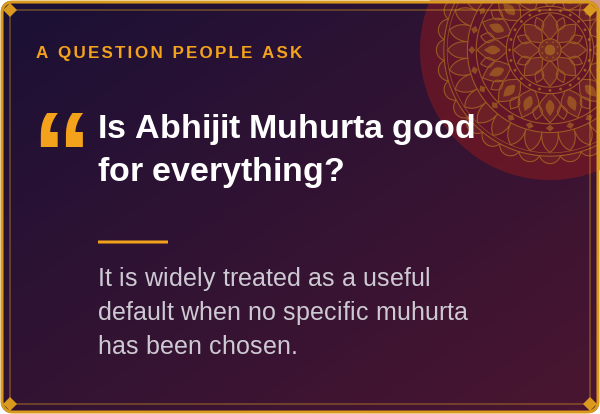
Is Abhijit Muhurta good for everything?
It is widely treated as a useful default when no specific muhurta has been chosen. Many panchangs exclude it on Wednesdays, and major events such as weddings are timed with a full muhurta instead.
Should I cancel an appointment that falls in Rahu Kalam?
No. Keep doctor's appointments, flights, exams and work meetings regardless. Some people prefer to avoid starting new things in Rahu Kalam when they have a choice, and that is all the custom asks.
Related service
Keep reading
Visible or Not? Deciding on Grahan Customs When an Eclipse Crosses Chicago's Sky
Grahan rules in the USA start with one question: can the eclipse be seen from Chicago? How visibility decides sutak, meals and temple closures.
Read article →
Visiting Chicago-Area Temples After a Reading: Lemont, Aurora, Bartlett
Hindu temples near Chicago in Lemont, Aurora and Bartlett: how a temple visit fits a remedy suggested in a reading, what to ask for and what to check first.
Read article →
Exam Seasons and the Chart: Notes for Chicago University Students
Education astrology for Chicago university students: the 4th and 5th houses, Mercury and Jupiter periods, and the study habits that outweigh any transit.
Read article →Quick answers
Does a muhurta have to be exact to the minute?
What is muhurta, and must it be exact to the minute? How much leeway a chosen time usually has, and why it is worked out for the city where the event happens.
Read answer →Can a Western birth chart printout be turned into a kundli?
What is a kundli, and can a Western birth chart printout become one? Yes, from the same birth data. Here is what the sidereal shift and Indian layout change.
Read answer →Talk to Astrologer and Psychic Vijayram
Tell us what you are facing. If a reading is unlikely to help, you will be told that plainly.