
Rahu Kalam and Daily Timing: How Much Should You Worry?
Rahu Kalam is one eighth of the daytime, from local sunrise to sunset, that tradition treats as poor for starting new ventures. Which eighth depends on the weekday. It should be worked out from your own city's sunrise. Use it to time optional new starts, never to delay medical care, travel or fixed appointments.
Key takeaways
- Classical timekeeping divides daylight, from local sunrise to local sunset, into eight equal parts.
- Many wall calendars and apps show fixed times, such as 7:30 to 9:00 on Monday.
- Two other eighths are watched in many calendars.
- Very little, if you use it the way it was designed.
- Tradition also offers a favorable daily window: Abhijit muhurta, a short span around local midday, considered good for most beginnings except on Wednesdays in some calendars.
Some people check the day's Rahu window before every errand. Others have never heard of it until a relative frowns at the moment they chose to sign a lease. The useful answer sits between the two. The window is a real part of the traditional day, it is easy to calculate correctly, and it deserves far less worry than it often gets.
What the window is
Classical timekeeping divides daylight, from local sunrise to local sunset, into eight equal parts. On each weekday one of those parts is assigned to Rahu, the shadow planet linked with confusion and sudden obstacles, and that part is called Rahu Kalam. Tradition considers it a poor time to begin something new: launching a business, signing an agreement, setting out on a trip or starting a ceremony. It is not considered dangerous to be alive, working or eating during it.
The part assigned to Rahu changes with the weekday:
| Day | Which eighth of daylight |
|---|---|
| Monday | 2nd |
| Tuesday | 7th |
| Wednesday | 5th |
| Thursday | 6th |
| Friday | 4th |
| Saturday | 3rd |
| Sunday | 8th |
A common English memory aid is "Mother Saw Father Wearing The Turban Suddenly": the initials give Monday, Saturday, Friday, Wednesday, Thursday, Tuesday and Sunday for the 2nd through 8th parts.
Why the printed times are often wrong for Chicago
Many wall calendars and apps show fixed times, such as 7:30 to 9:00 on Monday. Those figures assume sunrise at 6:00 and sunset at 6:00, which is roughly true in much of India year round. Chicago is nowhere near that. Here is the same Monday window worked out from Chicago's own sunrise and sunset, using figures of the kind the U.S. Naval Observatory publishes for any date and place:
- Around the December solstice: sunrise near 7:15 and sunset near 4:20 Central Time give about nine hours of daylight. Each eighth lasts roughly 68 minutes, so Monday's window falls at about 8:25 to 9:30 in the morning.
- Around the June solstice: sunrise near 5:15 and sunset near 8:30 daylight time give over fifteen hours of daylight. Each eighth lasts nearly two hours, so Monday's window runs from about 7:10 to 9:05.
The fixed 7:30 to 9:00 slot is wrong in both seasons. An app set to an Indian city is wrong by about half a day. If you observe the window at all, calculate it for where you are standing. Our post on why a Chicago panchang uses local sunrise explains the same principle for the rest of the calendar.
Yamagandam and Gulika Kalam
Two other eighths are watched in many calendars. Yamagandam, linked with Yama, is also avoided for new starts. Gulika Kalam, linked with Saturn's son Gulika, is read differently: things begun in it are said to repeat, so some avoid it for a funeral or a loan, while others welcome it for buying property or making a deposit. Both are worked out exactly the same way, from local sunrise and sunset, using their own weekday sequence.
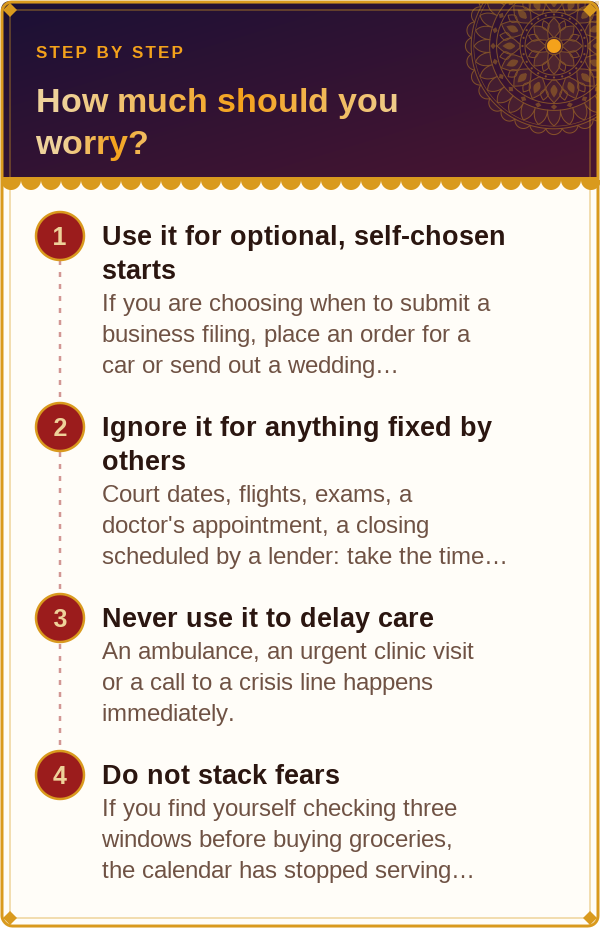
How much should you worry?
Very little, if you use it the way it was designed. A practical way to think about it:
- Use it for optional, self-chosen starts. If you are choosing when to submit a business filing, place an order for a car or send out a wedding invitation, nudging the moment out of Rahu Kaal is easy and harmless.
- Ignore it for anything fixed by others. Court dates, flights, exams, a doctor's appointment, a closing scheduled by a lender: take the time you are given.
- Never use it to delay care. An ambulance, an urgent clinic visit or a call to a crisis line happens immediately. No tradition asks otherwise.
- Do not stack fears. If you find yourself checking three windows before buying groceries, the calendar has stopped serving you. That anxiety is worth mentioning to a doctor or counselor.
For larger events, a single window is a crude tool anyway. A proper muhurta weighs the tithi, nakshatra, weekday and your own chart, and the Rahu window is only one line in that list. Our short answer on whether a muhurta must be exact to the minute covers how much precision really matters, and the post on choosing a date for a car or big purchase shows the checks used for everyday buying.
The brighter counterpart
Tradition also offers a favorable daily window: Abhijit muhurta, a short span around local midday, considered good for most beginnings except on Wednesdays in some calendars. Like Rahu's eighth, it moves with the seasons and must be worked out locally.
When to ask for help
If you are timing something that matters, such as an opening, a griha pravesh or a signing, a muhurta consultation works out the full set of factors for Chicago's sunrise and Central Time, including daylight saving changes. Astrologer and Psychic Vijayram offers these by phone, WhatsApp or video. If Rahu itself is the planet troubling your chart, our plain guide to Rahu and Ketu remedies is a calmer place to start than any app.
The limit is simple: this daily window can help you choose among moments you are free to choose. It cannot make a poor plan sound, and starting a good plan ninety minutes later will not make it fail.
Common questions
Is Rahu Kalam the same length every day?
No. It is one eighth of the time between sunrise and sunset, so it is long in summer and short in winter. In Chicago it runs close to two hours around the June solstice and a little over an hour around the December solstice.
Should I avoid Rahu Kalam for a job interview?
If you can choose the slot, some people prefer to. If the employer sets the time, take it. Missing an opportunity to avoid a time window would be a far bigger setback than anything tradition attributes to the window.
Does Rahu Kalam apply at night?
The classical calculation covers daytime only. Some modern calendars give a night version, but most families who observe it look only at the hours between sunrise and sunset.
Is Rahu Kalam observed by all Hindus?
It is most widely followed in South Indian families. Many North Indian and Gujarati households pay more attention to the choghadiya divisions of the day, and plenty of families observe neither.
Related service

Keep reading

Choosing a Date for a Car or a Big Purchase
A muhurta for buying a car, step by step: the simple panchang checks families use for vehicles and big purchases, and which moment actually counts.
Read article →
Before Your First Astrology Session: Checking Your Birth Details Twice
Getting ready for a first astrology reading: how to confirm your birth date, time and place from documents or family memory, and which questions to bring.
Read article →
How to Choose an Astrologer: Honest Signs to Look For
How to choose a good astrologer: clear fees, no fear, no promises and a willingness to say "I do not know". Red flags to avoid and where to report a scam.
Read article →Quick answers
Does a muhurta have to be exact to the minute?
What is muhurta, and must it be exact to the minute? How much leeway a chosen time usually has, and why it is worked out for the city where the event happens.
Read answer →Can a Western birth chart printout be turned into a kundli?
What is a kundli, and can a Western birth chart printout become one? Yes, from the same birth data. Here is what the sidereal shift and Indian layout change.
Read answer →Talk to Astrologer and Psychic Vijayram
Tell us what you are facing. If a reading is unlikely to help, you will be told that plainly.