

Before Your First Astrology Session: Checking Your Birth Details Twice
Before a first astrology reading, confirm three things: your birth date (watch day-month order on Indian documents), the time as exactly as any record allows, and the town of birth. If sources disagree, bring every version. Then write down two or three questions that matter most, worded openly, so the session goes where you need it.
Key takeaways
- Indian and British documents write dates day first; American forms write month first.
- The time decides your rising sign and the houses, which change roughly every two hours, so it is worth hunting for.
- Give the town or city, plus the district or state, and the country.
- Before the call, sit with a sheet of paper and write down what is actually on your mind.
- A first consultation with a Vedic astrologer in Chicago usually opens with a few minutes confirming the details above.
The most common reason a first Jyotish session goes sideways has nothing to do with the planets. It is a birth time that turns out to be wrong, a date read the wrong way round, or a client who arrives with eleven questions and leaves with no clear answer to any of them. Twenty minutes of preparation fixes nearly all of that. Here is the checklist.
Step 1: The date, read the right way
Indian and British documents write dates day first; American forms write month first. A certificate reading 04/07/1988 could mean April 7 or July 4, and those are two completely different charts. Look at the original document, find the month written in words if possible, and give your date in that form: 4 July 1988, not 04/07/88.
If your family has always celebrated your birthday by the Hindu calendar rather than the civil one, give the civil date too, or the tithi and month if that is all anyone remembers. The astrologer can work backwards.
Step 2: The time, from the best source you have
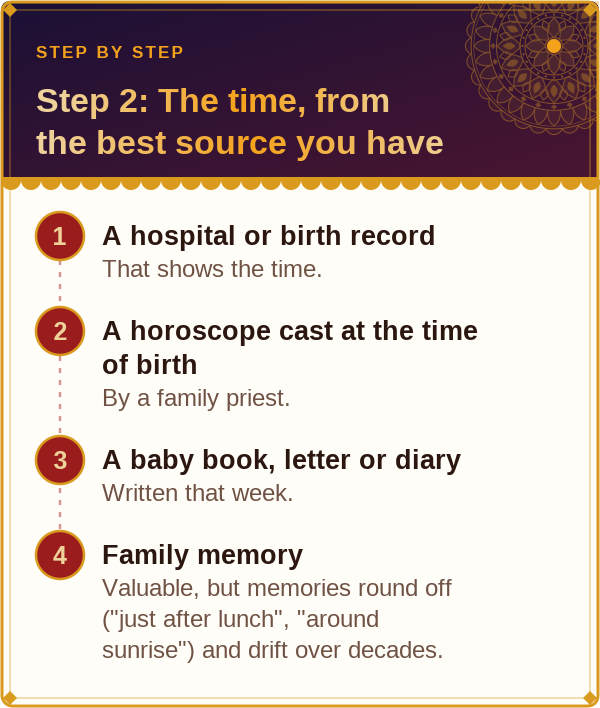
The time decides your rising sign and the houses, which change roughly every two hours, so it is worth hunting for. Sources, roughly from most to least reliable:
- A hospital or birth record that shows the time. Not every birth certificate includes it, but a long-form record or the hospital's own file sometimes does.
- A horoscope cast at the time of birth by a family priest. These are often handwritten and may give the time in ghatis and palas counted from sunrise, which a trained reader can convert.
- A baby book, letter or diary written that week.
- Family memory. Valuable, but memories round off ("just after lunch", "around sunrise") and drift over decades.
Two warnings about clocks. First, check AM and PM, and be careful with births near midnight, where the date itself can be off by one. Second, clocks have not always kept the same rules. In the United States, daylight saving time was observed unevenly before the Uniform Time Act of 1966, and our post on old Chicago birth times and daylight saving explains how that affects people born here. In India, the clock was set an hour ahead during the Second World War, as the history of Indian Standard Time records. Tell the reader where and when you were born, and they should check the clock in force.
If sources disagree, do not choose one quietly. Bring every version and where each came from. A reader can often test the candidates against events in your life. Our short answer on what to do when family members remember different times covers this, and if the gap is large, birth time rectification is the formal method.
Step 3: The place, named precisely
Give the town or city, plus the district or state, and the country. A village name alone can match three villages in different states. If you were born in a small place, name the nearest town as well. For births in the Chicago area, the suburb is enough; the difference between Evanston and Oak Lawn is small for the chart, but the difference between Chicago, Illinois and a similarly named town elsewhere is not. Our answer on how exact a birth place needs to be goes into more detail.
Step 4: Two or three questions, worded well
This is where most of the value of a session is won or lost. Before the call, sit with a sheet of paper and write down what is actually on your mind. Then cut the list to the two or three items that matter most, and rank them.
Wording matters. Compare:
- "Will I get the promotion?" with "What does the next two years look like for my work, and is staying or moving the better use of this period?"
- "Is he the one?" with "What does my chart show about partnership right now, and what should I watch for in this relationship?"
- "When will my troubles end?" with "Which period am I in, and what does it ask of me?"
Open questions let the reader show you the shape of a period. Yes-or-no questions invite a guess.
Step 5: The practical setup
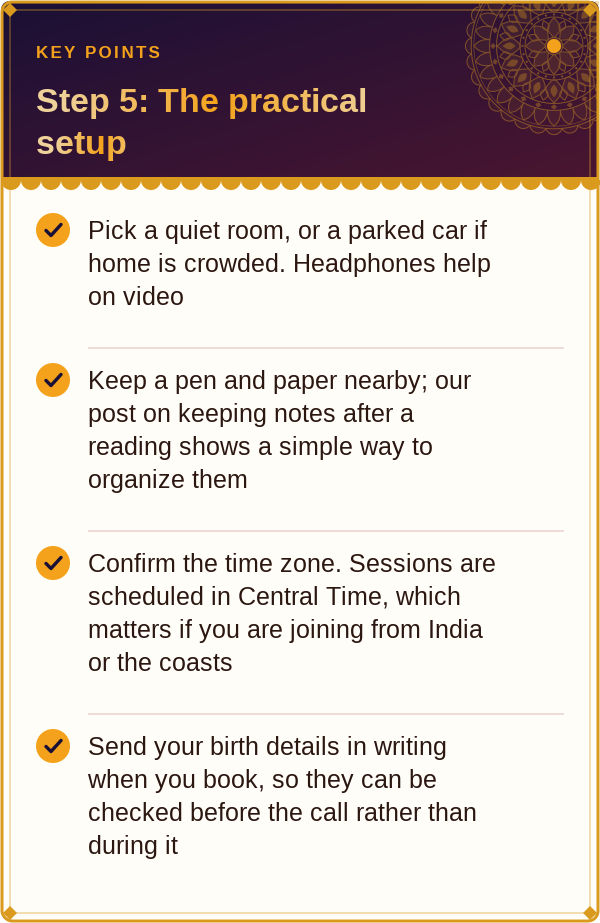
- Pick a quiet room, or a parked car if home is crowded. Headphones help on video.
- Keep a pen and paper nearby; our post on keeping notes after a reading shows a simple way to organize them.
- Confirm the time zone. Sessions are scheduled in Central Time, which matters if you are joining from India or the coasts.
- Send your birth details in writing when you book, so they can be checked before the call rather than during it.
What the session itself usually looks like
A first consultation with a Vedic astrologer in Chicago usually opens with a few minutes confirming the details above. Then comes an overview of the chart: rising sign, Moon, the main strengths and pressures. Then the current planetary period, then your questions, in your order. Remedies, if any, are discussed last and are always optional. Astrologer and Psychic Vijayram holds these sessions by phone, WhatsApp or video, and the booking page lists what to send ahead of time.
What preparation cannot fix
Careful details make a reading more precise, but no reading is a forecast you can bank on. A chart describes tendencies and timing as tradition understands them. It cannot replace a doctor's diagnosis, a lawyer's advice or your own judgment about your life, and a good reader will tell you so in the first session.
Common questions
My birth certificate has no time on it. Can I still have a reading?
Yes. A hospital record, a horoscope written by the family priest or a parent's memory can all help. If none exists, the reader can work from the Moon and the planets, or estimate the time from events in your life.
Should I tell the astrologer about my problem in advance?
A short note on the area you want covered, such as career or marriage, helps the reader prepare. You do not need to share private details you are not comfortable with.
Can a relative join the session?
Usually yes, by speakerphone or a group video call. Decide beforehand whose questions come first, so the hour is not spent on everyone's concerns at once.
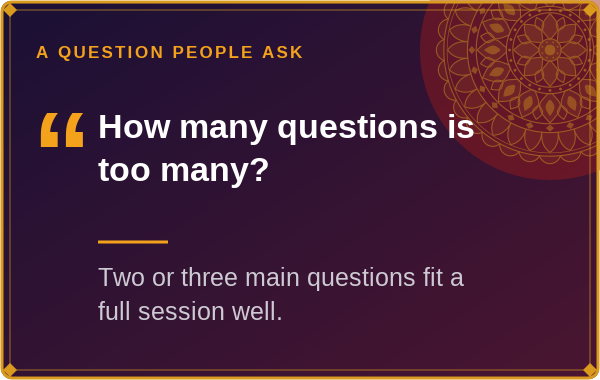
How many questions is too many?
Two or three main questions fit a full session well. A long list tends to get shallow answers to all of it rather than useful answers to what matters.
Related service

Keep reading

How to Choose an Astrologer: Honest Signs to Look For
How to choose a good astrologer: clear fees, no fear, no promises and a willingness to say "I do not know". Red flags to avoid and where to report a scam.
Read article →
Picking a Surgery Date by Muhurta? Why Your Doctor's Schedule Comes First
Families sometimes ask for a muhurta for surgery or a planned delivery. Why medical timing always leads, and the short prayers that can sit beside it.
Read article →
Hoping for a Child: What Tradition Reads in the Fifth House, and What Only Doctors Can
What childbirth astrology traditionally reads in the fifth house, Jupiter and the D7 chart, said carefully, with fertility questions left to doctors.
Read article →Quick answers
Which is better for timing questions, Vedic or Western astrology?
Vedic vs Western astrology for timing questions: dasha periods against transits and progressions, plus the sidereal zodiac and the Moon-sign emphasis.
Read answer →What fits into a short reading versus a full astrology session?
How long is an astrology reading? What fits into a short single-question session versus a full chart review, and how to pick the format for your question.
Read answer →Talk to Astrologer and Psychic Vijayram
Tell us what you are facing. If a reading is unlikely to help, you will be told that plainly.