

Keep Notes After a Reading: A Simple Honesty Test
Write down what the reader said as soon as the session ends, separating specific statements from general ones and noting which details you supplied. Date it, then review it after three and six months. Notes turn a vague impression into something you can check, and an honest reader will welcome that.
Key takeaways
- Two well-studied habits of the mind shape how we remember readings.
- Within an hour of the session, while it is fresh, write a page under these headings:
- Put a reminder in your calendar for three months after the reading, and again at six.
- Some people consult two or three readers over the years, or a tarot reader and an astrologer for the same question.
- Notes are not about catching anyone out.
A week after a reading, most people remember two or three things that struck them, usually the ones that seemed to fit, and very little of the rest. A month later, even those have shifted to match what happened since. That is not a flaw in you. It is how memory works. A few minutes with a notebook changes the picture completely.
Why memory is not enough
Two well-studied habits of the mind shape how we remember readings. The first is the Barnum effect: the tendency to accept vague, general statements as uniquely true of ourselves, such as "you are hard on yourself, though you hide it well." The second is confirmation bias: remembering the statements that came true and forgetting the ones that did not.
Together they can make an ordinary reading seem remarkable, or make a careful, honest one seem flat. Notes give you a fair record, so you can judge the reading, and the reader, on what was actually said.
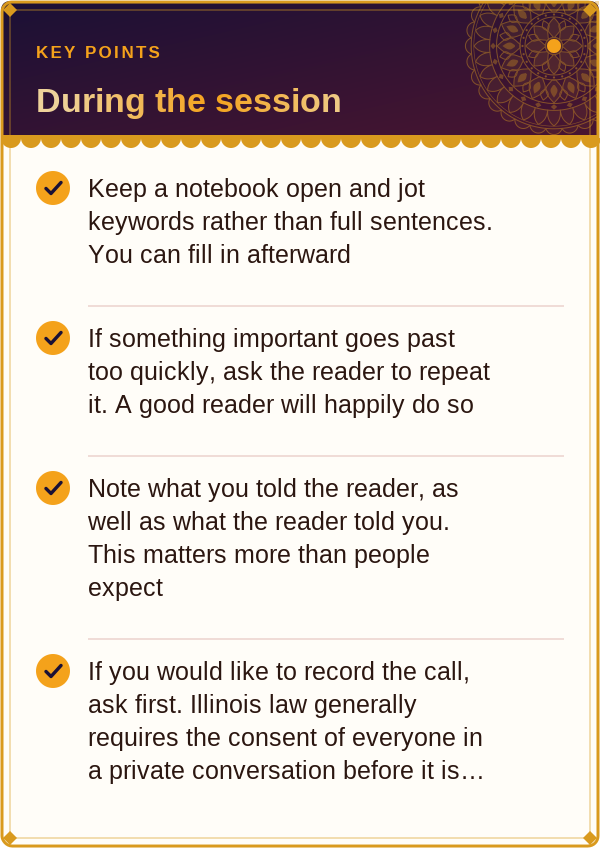
During the session
- Keep a notebook open and jot keywords rather than full sentences. You can fill in afterward.
- If something important goes past too quickly, ask the reader to repeat it. A good reader will happily do so.
- Note what you told the reader, as well as what the reader told you. This matters more than people expect.
- If you would like to record the call, ask first. Illinois law generally requires the consent of everyone in a private conversation before it is recorded, and asking is simple courtesy anyway.
Right after: a simple template
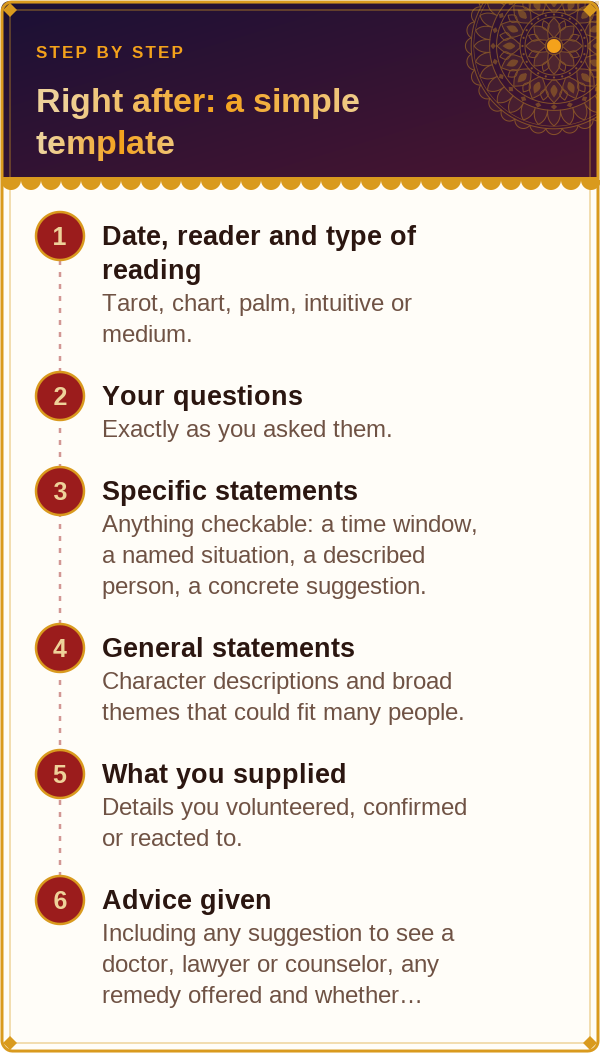
Within an hour of the session, while it is fresh, write a page under these headings:
- Date, reader and type of reading. Tarot, chart, palm, intuitive or medium.
- Your questions. Exactly as you asked them.
- Specific statements. Anything checkable: a time window, a named situation, a described person, a concrete suggestion.
- General statements. Character descriptions and broad themes that could fit many people.
- What you supplied. Details you volunteered, confirmed or reacted to.
- Advice given. Including any suggestion to see a doctor, lawyer or counselor, any remedy offered and whether anything was sold.
- How you felt. Clearer, calmer, anxious, pressured, hopeful.
Journaling also has a quieter benefit: it helps you process what came up emotionally, as the University of Rochester Medical Center notes in its guidance on journaling for emotional wellness.
The three-month review
Put a reminder in your calendar for three months after the reading, and again at six. Then go through the specific statements one by one:
| Statement | Specific or general? | Outcome so far | Detail from me or the reader? |
|---|---|---|---|
| "A change at work before spring" | Specific, with a time window | Team reorganized in March | I had mentioned rumors of a reorganization |
| "You carry other people's worries" | General | Not checkable | Reader |
| "Someone with an R name will help" | Specific | Nothing yet | Reader |
Be strict with yourself. If you mentioned the reorganization rumors, a statement about change at work is a reasonable inference, not a remarkable insight. If the statement was too vague to fail, it cannot really succeed either.
What the results tell you
- Mostly general statements, and you feel clearer: the session worked as reflection. Value it for that, and do not treat it as a forecast.
- Specific statements that often missed: worth knowing before you book that reader again.
- Specific statements that held up, with details you did not supply: interesting, and still worth holding lightly. Coincidence is more common than it feels.
- Fear, pressure or a costly remedy in the notes: whatever else happened, that is a reason to step back. The checklist on red flags in Chicago psychic ads explains why.
If you see more than one reader
Some people consult two or three readers over the years, or a tarot reader and an astrologer for the same question. Notes make comparison possible. When readers agree on something specific that you did not tell either of them, that is worth noticing. When they contradict each other on timing or outcomes, that is a useful reminder that readings are interpretation, not measurement. And when every reader tells you the same general thing, such as "you give too much to others," ask whether it is insight or simply a statement that fits most people who book readings. Keep one notebook for all of them, so the comparison is easy and you can also see how often you are booking, and why.
A test that works both ways
Notes are not about catching anyone out. They protect you from being swept along by a single striking moment, and they protect an honest reader from being remembered as having promised something they never said. A reader who welcomes notes, repeats points clearly and states limits up front is showing you something important.
The same method works for any format; the post asking whether phone readings are as useful as face to face builds on it. Going in with good questions helps too, as the guide to open questions or yes-or-no in a psychic reading explains.
A psychic reading in Chicago with Astrologer and Psychic Vijayram is offered as guidance and reflection, by phone, WhatsApp or video. Take all the notes you like. No reading can promise outcomes, and your notes will show you exactly what was and was not said.
Common questions
Will a reader mind if I take notes?
A good one will not. Many readers encourage it and will pause or repeat a point so you can write it down. If a reader objects to notes, treat that as a warning sign.
Should I share my notes with the reader at the next session?
You can, and it can make the conversation more useful. Some people prefer to keep them private and simply use them to decide whether another session is worthwhile. Either is fine.
What if most of what was said was general?
That is common, and it does not mean the session had no value. A reading that helped you think clearly is doing what reflection does. Just be careful not to treat general statements as predictions.
How long should I keep notes from a reading?
At least a year, so you can see how statements about timing played out. Many people keep a single notebook for all readings, which also shows how often they book and why.
Related service

Keep reading

Aura Reading on a Video Call: What a Reader Can and Cannot See
How an online aura reading works on a video call: what the reader relies on at a distance, why camera colors mislead, and why it is reflective, not diagnostic.
Read article →
Aura Reading or Aura Cleansing? Choosing the Right Session
Aura reading vs aura cleansing: one describes, the other is a traditional ritual. How to choose, whether to do both, and why neither replaces rest or a doctor.
Read article →
Booking a Psychic for a Chicago Party or Office Event: A Planner's Checklist
Hiring a psychic for a Chicago party or office event? A checklist for guest numbers, reading length, space, timing and house rules, with readings by video.
Read article →Quick answers
Do I have to tell a psychic anything before the reading starts?
What happens in a psychic reading, and what must you share first? Often just your first name and question; you never need to tell more than you wish.
Read answer →What should I do if a reader keeps asking for more money?
How to spot a psychic scam: what to do if a reader uses fear and keeps asking for more money. Stop paying, keep records, report it, and know the warning signs.
Read answer →Talk to Astrologer and Psychic Vijayram
Tell us what you are facing. If a reading is unlikely to help, you will be told that plainly.