

Open Questions or Yes-or-No: Getting More From a Psychic Reading
The most useful questions to ask a psychic are open ones that start with what, how or where, such as "What do I need to understand about this job offer?" Yes-or-no questions invite false certainty and close the conversation. Open questions keep the focus on your choices and lead to practical next steps.
Key takeaways
- A "yes" feels like a promise; a "no" feels like a verdict.
- Every open question puts you back in charge of the decision and gives the reader something to explore with you.
- The short answer on what to tell a psychic before the reading starts covers the opening in more detail.
- The post on how to phrase a tarot question gives card-specific examples, and the limits of yes-or-no tarot explains why single-card yes-or-no draws mislead.
- Write your two or three questions down before a psychic reading with Astrologer and Psychic Vijayram, held by phone, WhatsApp or video.
"Will I get the job?" "Is he the one?" "Should I move?" These are the questions most people arrive with, and they are understandable. They are also the questions least likely to help you. A small change in wording, from closed to open, can turn a reading from a coin toss into a conversation you actually learn from.
Why yes-or-no questions backfire
They invite false certainty
A "yes" feels like a promise; a "no" feels like a verdict. Neither is something a reading can honestly give. Readers who answer such questions confidently are claiming more than any method can deliver.
They end the conversation
Once you have a yes or a no, there is nowhere to go. You either feel relieved and stop thinking, or feel crushed and stop listening. Either way, the useful part of the reading, understanding your situation, never happens.
They give the game away
Closed questions reveal what you hope for. "Is he going to propose this year?" tells a reader your relationship, your hope and your timeline in one sentence. That is the raw material of cold reading, where a reader feeds your own information back to you. Open questions protect you from that, with any reader.
They feed confirmation bias
If you go in wanting a yes, you will remember the parts of the reading that sounded like one and forget the rest. Psychologists call this confirmation bias. An open question makes it harder to hear only what you hoped to hear.
Ten questions rewritten
| Closed | Open |
|---|---|
| Will I get the job? | What should I focus on to give myself the best chance with this application? |
| Is he the one? | What does this relationship bring out in me, and what do I need from it? |
| Should I move to the suburbs? | What would a move to the suburbs change for us, and what would it not change? |
| Will my ex come back? | What do I need to understand about this breakup so I can move forward? |
| Am I going to be rich? | Where am I holding myself back with money, and what is one step I can take? |
| Will my parents accept my partner? | How can I approach my parents about my partner in a way that respects everyone? |
| Is my business going to fail? | What is the biggest weakness in my plan right now, and how could I address it? |
| Is someone working against me at work? | What is behind the tension at work, and how can I protect my position? |
| Will I find love this year? | What patterns from past relationships should I watch for as I date again? |
| Should I quit? | What is this job giving me, what is it costing me, and what would make the decision clearer? |
Notice what changes. Every open question puts you back in charge of the decision and gives the reader something to explore with you.
A simple formula
When in doubt, use this shape:
"What do I need to understand about [situation] so that I can [what you want]?"
For example: "What do I need to understand about my relationship with my sister so that I can stop dreading family gatherings?" It names the situation, states your goal and leaves room for an answer that helps.
Question starters by topic
- Work: "What am I not seeing about...?" "How can I approach my manager about...?"
- Love: "What do I need in a partner that I keep overlooking?" "How can I communicate better about...?" The short answer on asking about someone else's feelings in a love reading has more.
- Family: "Where is my responsibility here, and where does it end?"
- Timing: "Is this a period to push forward or to consolidate?" This kind of question suits a birth chart well.
- Feeling stuck: "What is the smallest step that would make a difference?"
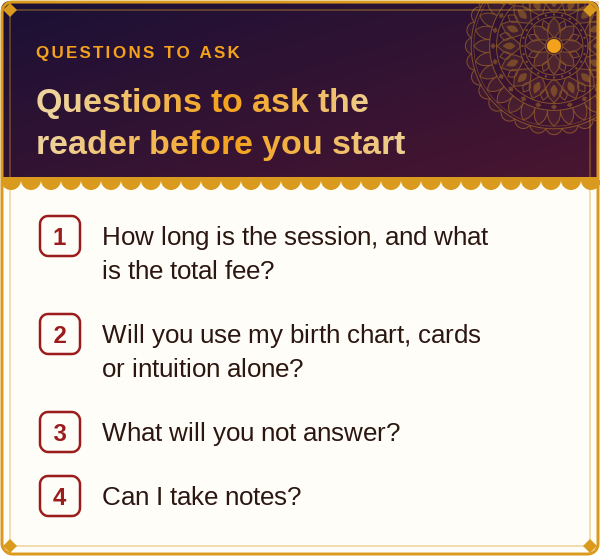
Questions to ask the reader before you start
- How long is the session, and what is the total fee?
- Will you use my birth chart, cards or intuition alone?
- What will you not answer?
- Can I take notes?
The short answer on what to tell a psychic before the reading starts covers the opening in more detail. For the topics a careful reader declines, see the requests we turn down and what we offer instead.
Same idea, with cards
Tarot follows the same principle. The post on how to phrase a tarot question gives card-specific examples, and the limits of yes-or-no tarot explains why single-card yes-or-no draws mislead.
Bringing your questions to a session
Write your two or three questions down before a psychic reading with Astrologer and Psychic Vijayram, held by phone, WhatsApp or video. Send them ahead if you like, so the reader can prepare. You will get far more from the time.
What a reading cannot do
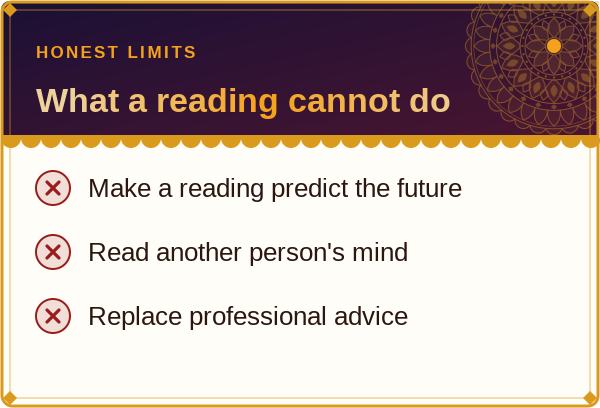
Even the best question cannot make a reading predict the future, read another person's mind or replace professional advice. What a good question does is make sure the guidance you receive is about the part of the situation you can actually change.
Common questions
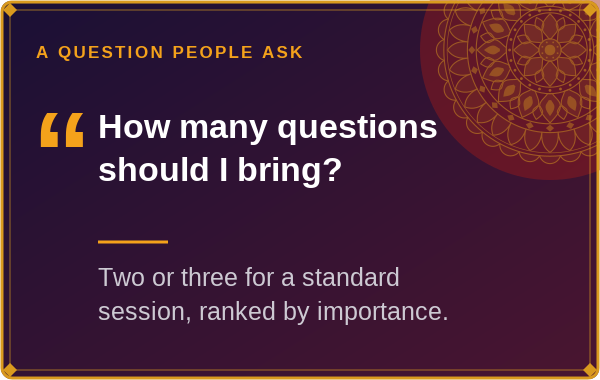
How many questions should I bring?
Two or three for a standard session, ranked by importance. One well-explored question is worth more than six rushed ones.
Is it all right to ask a yes-or-no question at all?
You can, and a reader may give a leaning. Just treat it as one impression rather than an answer, and follow it with an open question about what would help either way.
Should I tell the reader the background first?
A sentence or two of context helps the reader focus. You do not need to test the reader by holding back. A reading is a conversation, not a guessing game.
Can I ask questions about someone else?
You can ask about your relationship with them and how to approach them. Questions about what another person secretly thinks or will do are beyond what any reading can answer honestly.
Related service

Keep reading

When a Reader Says No: The Requests We Turn Down and What We Offer Instead
Psychic ethics in practice: death dates, diagnoses, court outcomes and naming culprits are declined. Why, and what a responsible session offers in their place.
Read article →
Barnum Statements and Fishing: Spotting Cold-Reading Tricks
Cold reading psychic techniques explained with examples: Barnum statements, fishing, the rainbow ruse and hot reading, so you can judge any reader, us too.
Read article →
Fees That Keep Growing: Warning Signs With Any Spiritual Service and Where to Report in Illinois
How a psychic scam escalates, from the egg trick to cash handed over and rising fees, how honest curse removal differs, and where to report it in Illinois.
Read article →Quick answers
Do I have to tell a psychic anything before the reading starts?
What happens in a psychic reading, and what must you share first? Often just your first name and question; you never need to tell more than you wish.
Read answer →What should I do if a reader keeps asking for more money?
How to spot a psychic scam: what to do if a reader uses fear and keeps asking for more money. Stop paying, keep records, report it, and know the warning signs.
Read answer →Talk to Astrologer and Psychic Vijayram
Tell us what you are facing. If a reading is unlikely to help, you will be told that plainly.