

Barnum Statements and Fishing: Spotting Cold-Reading Tricks
Cold reading is a set of techniques that make a reader seem to know things they have not been told. Common ones include Barnum statements that fit almost anyone, fishing with questions disguised as statements, the rainbow ruse that covers both sides of a trait, and hot reading from public information. Notes and open questions help you spot them.
Key takeaways
- Cold reading is a technique used by mentalists, illusionists and some psychics to give the impression of knowing a stranger.
- Statements that sound personal but fit almost everyone.
- A statement that covers a trait and its opposite, so it cannot miss.
- A rapid string of names, letters, dates or objects, hoping some will land.
- Close observation of things you show without saying a word: your age, clothes, ring finger, accent, hands, posture, the way you flinch at a topic.
A reader looks at you for a moment and says, "You have a lot of potential that you have not fully used yet." You nod; it is true. Then, "There is someone with a J or a G in your life, maybe an older relative." Your uncle is called Gurpreet. It feels uncanny. It is also, very likely, cold reading: a set of techniques that can make anyone appear to know more than they do. This post explains the common ones so you can judge any reader, including Astrologer and Psychic Vijayram.
What cold reading is
Cold reading is a technique used by mentalists, illusionists and some psychics to give the impression of knowing a stranger. It works by combining general statements, close observation and the client's own reactions. The client does most of the work without noticing, by filling in details and remembering the hits.
Technique 1: Barnum statements
Statements that sound personal but fit almost everyone. The effect is named after the showman P. T. Barnum and was famously demonstrated by the psychologist Bertram Forer, who gave his students what they thought were individual personality profiles. Every student received the same text, and on average they rated it as a highly accurate description of themselves. The Barnum effect has been reproduced many times since.
Examples:
- "You can be outgoing, but at times you need to withdraw and be alone."
- "You have a tendency to be critical of yourself."
- "There is something from your past you have never fully resolved."
How to spot it: ask yourself whether the statement would be true of your sister, your colleague or a stranger on the Red Line. If yes, it tells you nothing.
Technique 2: Fishing
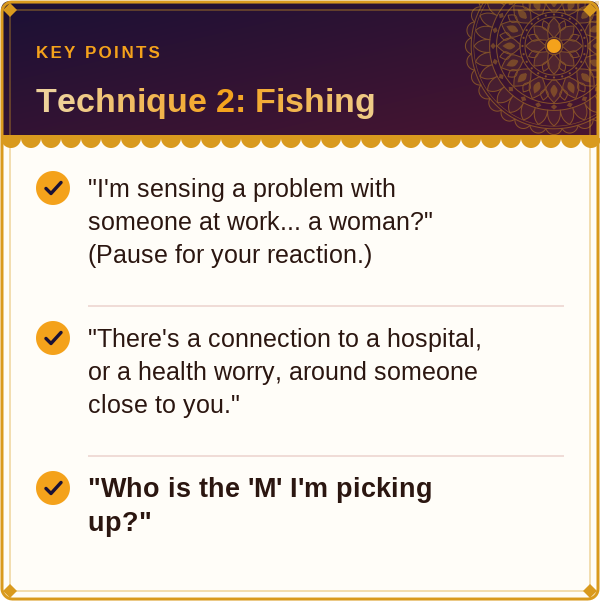
Questions disguised as statements, or statements left open so you finish them.
Examples:
- "I'm sensing a problem with someone at work... a woman?" (Pause for your reaction.)
- "There's a connection to a hospital, or a health worry, around someone close to you."
- "Who is the 'M' I'm picking up?"
How to spot it: notice how often the reader's lines end with a rising tone or a pause. Notice who supplies the details. If you are doing most of the talking and the reader is mostly repeating it back, that is fishing.
Technique 3: The rainbow ruse
A statement that covers a trait and its opposite, so it cannot miss.
Examples:
- "You are generous with people you trust, but you can be guarded with new people."
- "Most of the time you are calm, but when pushed you can surprise people."
How to spot it: listen for "but" joining two opposites. A statement that would be true whichever way you are is not a reading.
Technique 4: Shotgunning
A rapid string of names, letters, dates or objects, hoping some will land. You remember the two that hit and forget the twelve that missed.
How to spot it: keep count. If you write down every specific claim and tick the hits afterward, the ratio is often very different from how it felt.
Technique 5: Reading you
Close observation of things you show without saying a word: your age, clothes, ring finger, accent, hands, posture, the way you flinch at a topic. A wedding ring, a nursing badge clipped to a bag or a tired face says a great deal.
How to spot it: ask whether the insight could have come from looking at you or hearing you. On a phone call there is less to see, but your voice, word choice and pauses still give plenty away.
Technique 6: Hot reading
Information gathered in advance: a social media profile, a name searched online, details from a booking form or a friend who referred you.
How to spot it: notice whether "revelations" match what is public about you. If a reader mentions your new job, check whether you announced it online last month.
Why it works on clever people
None of this means you are gullible. These techniques exploit normal ways the mind works. We remember hits and forget misses, a habit psychologists call confirmation bias. We also tend to find personal meaning in general statements when we want them to be true. That is why intelligent, careful people are fooled, especially when they are grieving, anxious or hopeful.
Protecting yourself with any reader
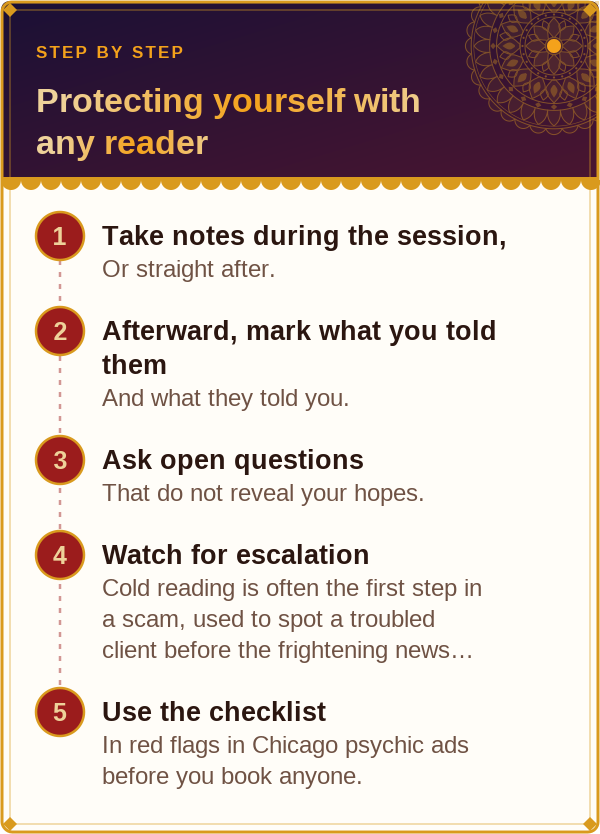
- Take notes during the session, or straight after. The post on keeping notes after a reading has a simple format.
- Afterward, mark what you told them and what they told you. Be honest.
- Ask open questions that do not reveal your hopes. See open questions versus yes-or-no.
- Watch for escalation. Cold reading is often the first step in a scam, used to spot a troubled client before the frightening news and the rising fees begin. The post on how fear and growing fees are used to pressure people explains the pattern.
- Use the checklist in red flags in Chicago psychic ads before you book anyone.
How this practice approaches it
Readings with Astrologer and Psychic Vijayram, held by phone, WhatsApp or video, start from what you choose to share and are grounded in your birth chart, which gives a fixed reference point that does not depend on reading your face or voice. Impressions are offered tentatively, for you to confirm or set aside. You are welcome to take notes and check everything afterward. The short answer on what to tell a psychic before a reading starts explains why there is no test to pass, and the psychic reading page describes the method in full.
What a reading cannot do
No reading can prove psychic knowledge, and no honest reader should claim to. A reading can offer reflection and traditional insight for you to weigh with your own judgment. Knowing how cold reading works makes you better at doing exactly that.
Common questions
Does cold reading mean a reader is deliberately cheating?
Not always. Some readers use these techniques knowingly; others slip into them without realizing, because they work. Either way, knowing the patterns helps you weigh what you hear.
If a reader uses a Barnum statement, is the whole reading worthless?
Not necessarily. General statements can open a conversation. The question is whether the reading moves beyond them into something specific to your situation, built on what you have actually shared.
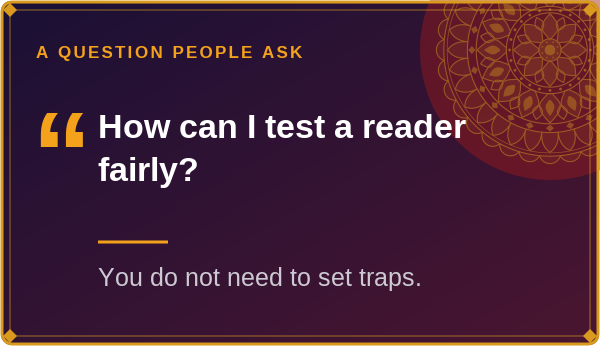
How can I test a reader fairly?
You do not need to set traps. Give a short, honest outline of your question, take notes, and afterward compare what the reader said with what you told them. A good reader will be comfortable with you doing exactly that.
Does this apply to astrology too?
Partly. A birth chart gives an astrologer a fixed starting point, which limits guessing. But the way a chart is described can still slide into vague statements that fit anyone, so the same awareness helps.
Related service

Keep reading

Fees That Keep Growing: Warning Signs With Any Spiritual Service and Where to Report in Illinois
How a psychic scam escalates, from the egg trick to cash handed over and rising fees, how honest curse removal differs, and where to report it in Illinois.
Read article →
A Month Without Readings: A Simple Reset When You Feel Hooked
How often to get a psychic reading, the signs reliance is growing, and a simple four-week pause with journaling in place of sessions when you feel hooked.
Read article →
Your First Medium Session: What to Expect
What to expect at a first medium reading: how the prayer opens it, the slow pace, how to pause or stop, and the grief support that should sit beside it.
Read article →Quick answers
Do I have to tell a psychic anything before the reading starts?
What happens in a psychic reading, and what must you share first? Often just your first name and question; you never need to tell more than you wish.
Read answer →What should I do if a reader keeps asking for more money?
How to spot a psychic scam: what to do if a reader uses fear and keeps asking for more money. Stop paying, keep records, report it, and know the warning signs.
Read answer →Talk to Astrologer and Psychic Vijayram
Tell us what you are facing. If a reading is unlikely to help, you will be told that plainly.