

Picking a Surgery Date by Muhurta? Why Your Doctor's Schedule Comes First
A muhurta for surgery or a planned C-section should never move a date your medical team recommends. Medical timing comes first, always. If doctors offer two dates that are equally safe, a family may prefer one, and prayers such as the Mahamrityunjaya mantra can be said at home. Astrology does not decide when it is safe to operate.
Key takeaways
- In many South Asian households, every significant beginning gets a muhurta : a wedding, a griha pravesh, a shop opening, the first rice ceremony for a baby.
- Some parents worry that a scheduled birth gives an "artificial" horoscope.
- Faith has a real place around surgery: before, during and after.
- A chart can be a place to think through a hard season: a long recovery, a caregiving stretch, worry about a parent.
The short version first. If a surgeon or obstetrician has recommended a date or time, keep it. Do not delay, cancel or push for a different slot because of a chart. If the timing feels wrong to you for any reason, ask your medical team to explain it; that is their job, and good teams welcome questions. For anything urgent, call emergency services or go to the nearest emergency room. MedlinePlus, from the National Library of Medicine, explains procedures and recovery in plain language if you want to read before an appointment.
With that settled, here is how this practice answers families who ask for a muhurta for surgery or a planned birth, and why.
Why families ask
The request is understandable. In many South Asian households, every significant beginning gets a muhurta: a wedding, a griha pravesh, a shop opening, the first rice ceremony for a baby. When a parent faces a hip replacement, or a daughter-in-law is scheduled for a C-section, the instinct to choose a good hour comes from love and from wanting to do something at a moment when doctors hold most of the control. Grandparents in India may be calling to ask whether the time has been checked.
That instinct deserves respect. It does not deserve control of the operating schedule.
Where we stand
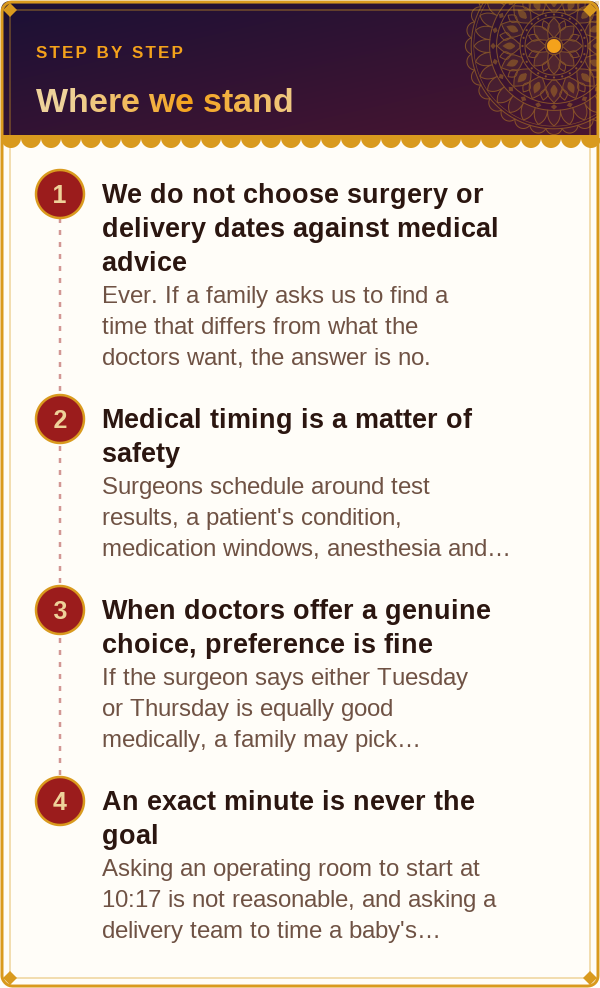
- We do not choose surgery or delivery dates against medical advice. Ever. If a family asks us to find a time that differs from what the doctors want, the answer is no.
- Medical timing is a matter of safety. Surgeons schedule around test results, a patient's condition, medication windows, anesthesia and the availability of the right team. For planned births, US obstetric guidance discourages delivering before 39 weeks without a medical reason, because babies born earlier face more risks. None of that can be weighed in a chart.
- When doctors offer a genuine choice, preference is fine. If the surgeon says either Tuesday or Thursday is equally good medically, a family may pick Thursday for its own reasons. Even then, hospital schedules move, and an operation set for 9:00 may begin at noon. Make peace with that in advance.
- An exact minute is never the goal. Asking an operating room to start at 10:17 is not reasonable, and asking a delivery team to time a baby's birth to a planetary moment is not safe.
The baby's chart is real either way
Some parents worry that a scheduled birth gives an "artificial" horoscope. Tradition does not see it that way. A chart is drawn for the moment the child takes its first breath, wherever and however that happens. A baby born by planned C-section on a Wednesday morning has a Wednesday-morning chart, just as valid as any other. The useful step is to make sure that moment is written down accurately; our note on recording a newborn's birth minute in Chicago explains how to ask the delivery team.
What can sit beside medical care
Faith has a real place around surgery: before, during and after. None of it changes the medical plan, and all of it is optional.
- A prayer before leaving home. Many families say the Mahamrityunjaya mantra, a prayer to Shiva traditionally chanted in illness. Our post on when families chant the Mahamrityunjaya mantra explains the words and the custom.
- Quiet chanting in the waiting room. Silent repetition on a mala, or prayer under your breath, does not disturb anyone.
- A lamp at home. Hospitals do not allow open flames, so lamps and incense stay at home, lit by someone who stays with them.
- Prayers for the surgeons. Some families pray specifically for the steady hands of the team. That is a very old instinct.
- Rest and recovery. After discharge, gentle mantra practice can support rest. Our post on mantra and rest after a hospital stay offers a simple routine that follows the discharge instructions rather than competing with them.
Questions worth asking the doctor instead
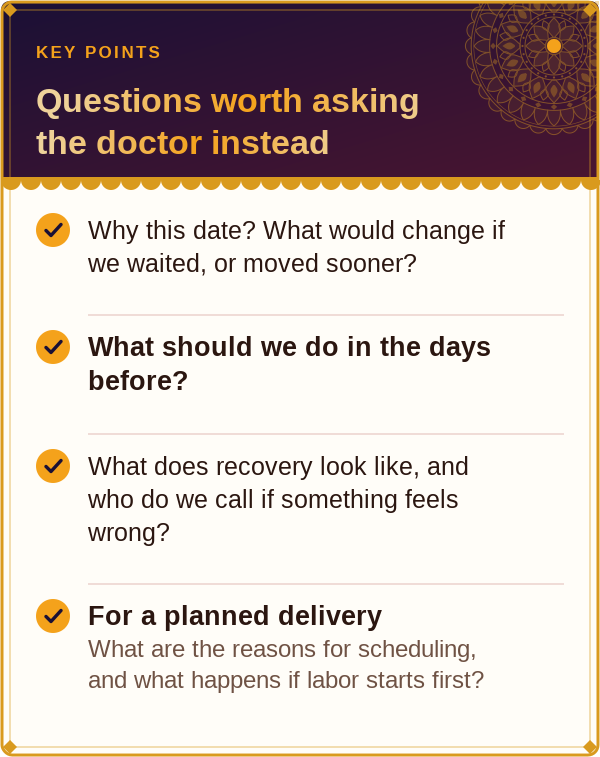
If a family is anxious about timing, the anxiety is often better aimed at the medical team:
- Why this date? What would change if we waited, or moved sooner?
- What should we do in the days before?
- What does recovery look like, and who do we call if something feels wrong?
- For a planned delivery: what are the reasons for scheduling, and what happens if labor starts first?
Where a reading does fit
A chart can be a place to think through a hard season: a long recovery, a caregiving stretch, worry about a parent. A birth chart reading can look at the period you are living through and talk about patience, support and timing for decisions you do control, such as when to return to work or how to share caregiving. For questions focused on wellbeing, wellbeing astrology handled with care keeps medical matters with doctors from the first minute. Astrologer and Psychic Vijayram offers both by phone, WhatsApp or video.
The plain limit: no muhurta makes surgery safer, and no chart can say whether an operation will go well. Skilled people, good preparation and careful recovery do that. Prayer can keep a family steady while they do.
Common questions
Can I ask my obstetrician to schedule a C-section at an auspicious time?
You can ask about scheduling options, but the medical reasons come first. US obstetric guidance discourages scheduling a delivery before 39 weeks without a medical reason, and the team's judgment on timing should not be overridden for a muhurta.
Is a baby's chart less valid if the birth was scheduled?
No. The chart is drawn for the moment the child is actually born, however that moment came about. A planned delivery, an emergency C-section and a natural birth all give a real chart.
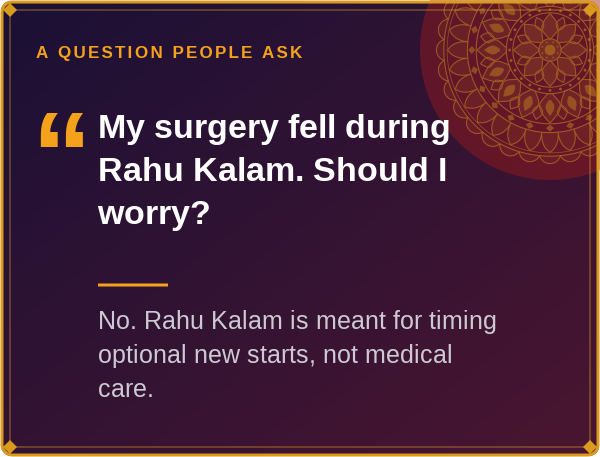
My surgery fell during Rahu Kalam. Should I worry?
No. Rahu Kalam is meant for timing optional new starts, not medical care. Surgery happens when the hospital can do it safely, and your energy is better spent on recovery than on the clock.
What can family members do spiritually while someone is in surgery?
Many say a familiar prayer, chant a mantra quietly in the waiting room, or light a lamp at home. All of these are personal comforts that sit beside medical care, not in place of it.
Related service

Keep reading

Hoping for a Child: What Tradition Reads in the Fifth House, and What Only Doctors Can
What childbirth astrology traditionally reads in the fifth house, Jupiter and the D7 chart, said carefully, with fertility questions left to doctors.
Read article →
Online or In Person: Does It Change the Reading?
Does an online astrology reading differ from one across a table? The chart is the same; what changes is convenience, rapport and how you prepare.
Read article →
Writing Down Your Newborn's Birth Minute: A Note for Expecting Chicago Parents
Why a baby's birth time matters to the minute for a kundli, how Chicago parents can ask the delivery team to note it, and what to do if records differ.
Read article →Quick answers
Can a Western birth chart printout be turned into a kundli?
What is a kundli, and can a Western birth chart printout become one? Yes, from the same birth data. Here is what the sidereal shift and Indian layout change.
Read answer →How exact does my birth place need to be: city, hospital or village?
The birth chart reading details needed: date, clock time and town. Why the nearest city is usually close enough, and when a more exact birthplace helps.
Read answer →Talk to Astrologer and Psychic Vijayram
Tell us what you are facing. If a reading is unlikely to help, you will be told that plainly.