

Writing Down Your Newborn's Birth Minute: A Note for Expecting Chicago Parents
For a baby's kundli, the birth time matters to the minute because the rising sign and divisional charts shift every few minutes. Chicago parents can ask the delivery team to note the exact time, have one person check a phone clock, and keep the hospital's record. If the record and family memory differ, the written record usually wins.
Key takeaways
- A child's horoscope is calculated from the date, time and place of birth.
- Classical texts discuss several moments: the first breath, the first cry, the cutting of the cord, the moment the baby fully emerges.
- Nobody should be distracted from the birth itself to do this.
- Chicago runs on Central Time, which shifts for daylight saving.
- A grandmother remembers the baby arrived "just as the sun came up"; the hospital wrote 6:52.
Expecting parents in Chicago get plenty of lists: what to pack for the hospital, which car seat to buy, how to install it before the first snow. If your family follows Jyotish, add one small item to the birth plan: make sure someone writes down the exact minute your baby is born. It takes ten seconds on the day and saves a great deal of guessing later.
Why the minute matters
A child's horoscope is calculated from the date, time and place of birth. Some parts of it hardly move: the planets' signs stay the same for days or weeks. Others move fast:
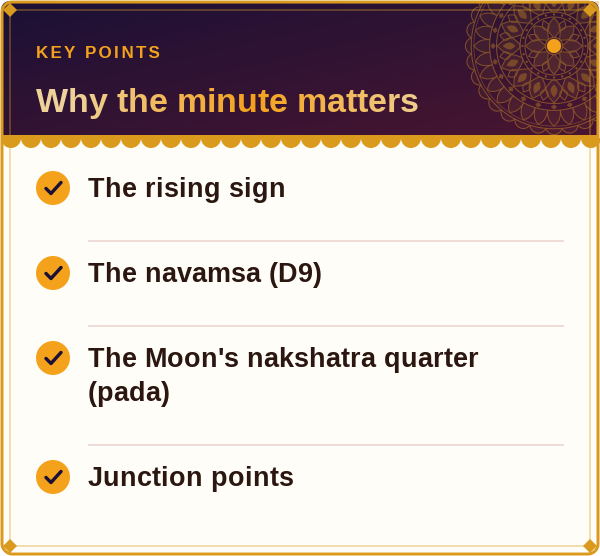
- The rising sign (lagna) changes roughly every two hours, and its exact degree moves about one degree every four minutes.
- The navamsa (D9) and other divisional charts can change every few minutes. The D7, read for children, and the D10, read for career, are especially sensitive.
- The Moon's nakshatra quarter (pada) changes about every six hours. That quarter gives the traditional first syllable for the baby's name.
- Junction points. A birth close to the boundary of a sign or nakshatra can fall on either side depending on a few minutes. Our post on gandanta births explains one such junction calmly.
"Around 3:30" can be good enough for a broad reading. For naming, and for the finer charts a family may want years later, the minute is worth having.
Which moment counts?
Classical texts discuss several moments: the first breath, the first cry, the cutting of the cord, the moment the baby fully emerges. In practice, Jyotishis today work from the time the delivery team records, which is usually when the baby is fully delivered. That is a sensible convention because it is the moment that gets written down. For a cesarean birth, the time is when the baby is lifted out, not when the operation starts.
How to ask the delivery team
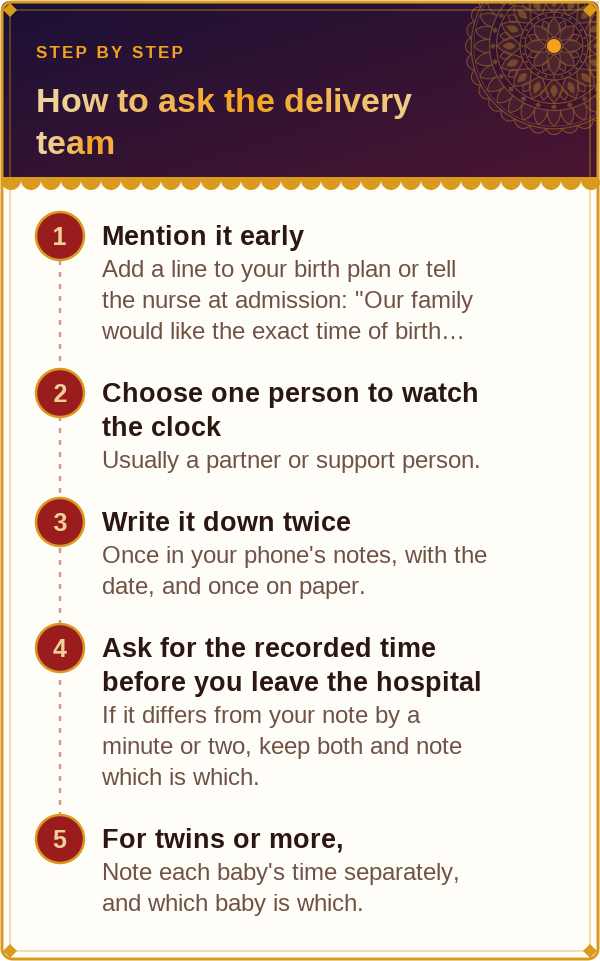
- Mention it early. Add a line to your birth plan or tell the nurse at admission: "Our family would like the exact time of birth noted, to the minute." Labor and delivery teams in Chicago hospitals record birth times routinely; you are simply asking them to share it with you.
- Choose one person to watch the clock. Usually a partner or support person. A phone clock is better than a wall clock, since phones keep network time.
- Write it down twice. Once in your phone's notes, with the date, and once on paper. Note "a.m." or "p.m." in words.
- Ask for the recorded time before you leave the hospital. If it differs from your note by a minute or two, keep both and note which is which.
- For twins or more, note each baby's time separately, and which baby is which.
Nobody should be distracted from the birth itself to do this. If the moment is tense or medical care is the priority, let it be. The hospital's record will still exist.
The November hour that happens twice
Chicago runs on Central Time, which shifts for daylight saving. On the first Sunday in November, clocks fall back at 2:00 a.m., so the hour from 1:00 to 1:59 a.m. happens twice. A baby born at "1:20 a.m." that night could have been born at either 1:20. If your baby arrives in that window, write down whether it was before or after the change (CDT or CST). The National Institute of Standards and Technology explains how the clock change works. A similar gap occurs in March, when 2:00 to 2:59 a.m. is skipped entirely.
When the record and family memory disagree
It happens more than you might think. A grandmother remembers the baby arrived "just as the sun came up"; the hospital wrote 6:52. Some guidance:
- A time written at the moment usually beats a memory, however confident.
- If you suspect the record was filled in later (for example, after an emergency), ask the hospital whether the time came from the delivery notes.
- Bring both versions to the astrologer and say where each came from. Do not quietly pick one.
- If the gap is wide and matters later in life, birth time rectification is the formal way to test candidate times against events.
Sending the time to family abroad
The Chicago area has one of the largest Indian American communities in the country, as the history of Indians in Chicago shows, and many babies born here have grandparents in India waiting to have a janam kundli cast. Send the Chicago clock time, the date, and "Chicago, Illinois, USA". Do not convert it to Indian time yourself. Converted times, especially across a daylight saving change, are the most common source of wrong charts for children born abroad.
After the birth
Many families have the first chart made around the naming ceremony. A child horoscope and nakshatra naming session uses the exact time to find the Moon's nakshatra and pada and suggest name syllables; our post on namakaran for Chicago-born babies covers the ceremony itself. Astrologer and Psychic Vijayram offers these sessions by phone, WhatsApp or video, which suits parents who are not leaving the house much in the first weeks. If relatives worry about nazar in those early days, our note on nazar customs for newborns keeps the customs gentle and practical.
One limit to keep in view: an exact birth minute makes a chart more precise, but no chart decides who your child will become. It offers a traditional lens, and your child will keep surprising you regardless.
Common questions
For a C-section, is the birth time when surgery starts?
No. The birth time is the moment the baby is delivered, which can be some minutes after the operation begins. Ask the team to note that moment.
Should I convert the birth time to Indian time before sending it to family?
No. Send the Chicago clock time, the date and the city. Whoever casts the chart should do any conversion, which avoids the most common mistake in diaspora horoscopes.
We have twins. Do they share a chart?
Each baby has its own birth minute and its own chart. Twins born a few minutes apart often share a rising sign but can differ in the finer divisional charts, which is one reason families note each time separately.
How soon after the birth should we have the kundli made?
There is no rush. Many families wait for the naming ceremony. What matters is writing down the exact time on the day, while everyone still remembers.
Related service

Keep reading

Your Child's Nakshatra in the School Years: Strengths to Encourage
Child nakshatra traits grouped by the nine planetary lords: what each set of birth stars is said to favor in learning and temperament, offered as encouragement.
Read article →
How a Prashna Chart Is Cast: Time, Place and the Wording of Your Question
How prashna astrology works: which moment the chart is cast for, where it is set, why your wording matters, and what a horary chart cannot settle.
Read article →
Will the House Sale Close? A Prashna for Chicago Home Sellers
A prashna for a property sale in Chicago: how a single-question chart is read for a pending sale, beside the inspection, lender and market, with no promises.
Read article →Quick answers
Can a Western birth chart printout be turned into a kundli?
What is a kundli, and can a Western birth chart printout become one? Yes, from the same birth data. Here is what the sidereal shift and Indian layout change.
Read answer →How exact does my birth place need to be: city, hospital or village?
The birth chart reading details needed: date, clock time and town. Why the nearest city is usually close enough, and when a more exact birthplace helps.
Read answer →Talk to Astrologer and Psychic Vijayram
Tell us what you are facing. If a reading is unlikely to help, you will be told that plainly.