
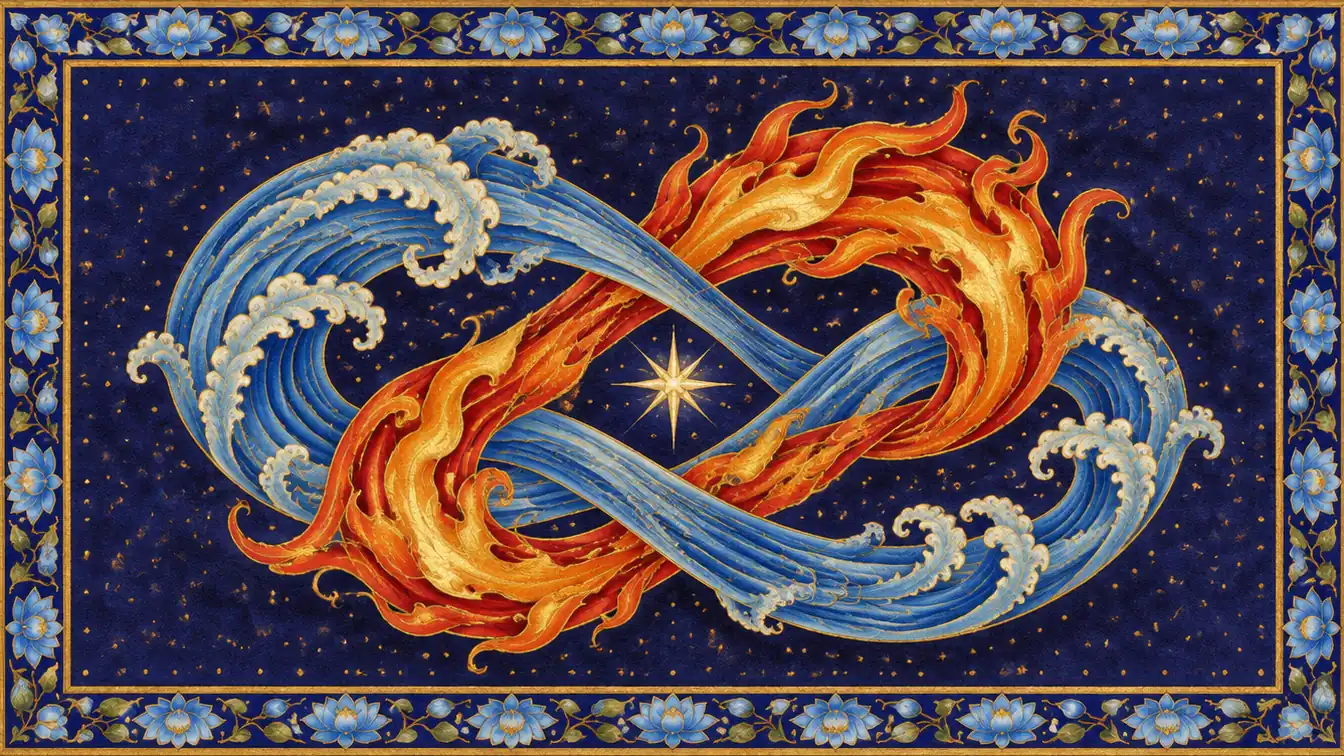
Gandanta Births: The Water-Fire Junctions in a Chart, Calmly Explained
Gandanta in a birth chart is a narrow zone where a water sign ends and a fire sign begins: Cancer into Leo, Scorpio into Sagittarius and Pisces into Aries. Sign and nakshatra boundaries meet there, so tradition treats a Moon or ascendant at these points with care. It is a point of intensity in a chart, not a misfortune.
Key takeaways
- Into twelve signs of 30 degrees each, and into twenty-seven nakshatras of 13 degrees 20 minutes each.
- Planets other than the Moon can sit in these zones too.
- Classical writers regarded transitions as delicate: the change of a day at dawn and dusk, the turn of a season, the move from one sign to the next.
- In this practice gandanta is read as a point of intensity, not misfortune.
- For families who find comfort in it, it can be simple: a prayer for the child, a lamp, a small offering, sometimes a mantra repeated over the following weeks.
Few chart terms cause as much quiet alarm in families as gandanta. A grandmother hears that a new baby's Moon is in Mula or Ashlesha and asks for a priest. An adult reading their own chart online finds the word next to their ascendant and assumes the worst. This post explains what gandanta actually is, why the tradition singles it out, and why it is best approached with curiosity rather than fear.
The geometry behind the word
The zodiac can be divided two ways. Into twelve signs of 30 degrees each, and into twenty-seven nakshatras of 13 degrees 20 minutes each. Most of the time the two sets of boundaries do not line up: a nakshatra may straddle two signs. But every 120 degrees they meet exactly. At 0 degrees of Aries, 0 degrees of Leo and 0 degrees of Sagittarius, a new sign and a new nakshatra begin at the same point.
Those three points are also where a water sign gives way to a fire sign:
| Junction | Water side | Fire side |
|---|---|---|
| Cancer into Leo | End of Ashlesha | Start of Magha |
| Scorpio into Sagittarius | End of Jyeshtha | Start of Mula |
| Pisces into Aries | End of Revati | Start of Ashwini |
"Ganda" means a knot and "anta" an end. Gandanta is the knot where one cycle ends and the next begins, with two elements that do not easily mix pressed together.
Types of gandanta
- Nakshatra gandanta: the Moon in the last quarter of Ashlesha, Jyeshtha or Revati, or the first quarter of Magha, Mula or Ashwini. This is the one families most often hear about.
- Lagna gandanta: the ascendant at one of these junctions.
- Tithi gandanta: a birth at the junction of certain lunar days, such as the end of the fifth and the start of the sixth.
Planets other than the Moon can sit in these zones too. Most readers give them less weight.
Why tradition treats it with care
Classical writers regarded transitions as delicate: the change of a day at dawn and dusk, the turn of a season, the move from one sign to the next. Gandanta is the sharpest of these transitions in the zodiac. Old texts attached strong warnings to some gandanta births, especially Mula, and prescribed a shanti, a calming prayer, usually performed when the Moon returns to the birth nakshatra about 27 days later.
It helps to remember the world those texts were written in. Births were dangerous for mothers and babies alike, and many infants did not survive their first months. A ritual of protection at a vulnerable time made sense. The Moon, whose condition is so central to the birth chart, naturally drew the most attention.
How it is read today
In this practice gandanta is read as a point of intensity, not misfortune. A Moon at a junction is often described as deeply feeling, with emotional experiences that come in strong waves and a capacity for real change. An ascendant there can suggest a life with notable turning points. Some modern authors connect gandanta with spiritual depth precisely because it sits where one element dissolves into another.
Three rules keep this sensible:
- Check the time first. Lagna gandanta lasts only minutes. A small error in the recorded time can put the ascendant in or out of it. Our note on recording a newborn's exact birth minute explains how to get an accurate record.
- Read the whole chart. A Moon in gandanta with strong support elsewhere reads very differently from one without. No single factor defines a life.
- Never blame. Old warnings about fathers, mothers-in-law or other relatives are not read as literal predictions here. A baby does not harm anyone by being born at a certain hour.
If your family wants a shanti
A gandanta or Mula shanti is optional. For families who find comfort in it, it can be simple: a prayer for the child, a lamp, a small offering, sometimes a mantra repeated over the following weeks. It can be done at home or at a temple, and it never needs to be expensive. A graha shanti consultation explains what is involved before anything is arranged. Many families fold it into the naming ceremony; our post on namakaran for Chicago-born babies describes that day.
For adults who find it in their own chart
If you discover gandanta in your chart as an adult, nothing has changed except your vocabulary. You have already been living with it. A birth chart reading can place it in context: what it touches, how the rest of the chart supports it, and which periods may bring its themes forward. Astrologer and Psychic Vijayram offers these readings by phone, WhatsApp or video. For more on the stars involved, our plain guide to the 27 nakshatras covers each one, and the post on nakshatra strengths in the school years looks at Ashwini, Magha, Mula and the others in a more encouraging light.
The limit
Gandanta is a traditional description of a point in the sky. It cannot tell you whether a child will be healthy, whether a family will prosper or how long anyone will live. Those questions belong to doctors, to circumstances and to choices. No birth time is a misfortune.
Common questions
My baby was born with the Moon in Mula. Should we be worried?
No. Many families arrange a simple shanti prayer for a Mula birth, often on the day the Moon returns to Mula about 27 days later. It is a custom of blessing, not a sign that anything is wrong, and it is entirely optional.
How wide is the gandanta zone?
Definitions vary. A common one takes the last quarter of the water nakshatra and the first quarter of the fire nakshatra, about 3 degrees 20 minutes on each side. Stricter definitions use much narrower bands right at the boundary.
Does an old text's warning about a parent or relative still apply?
Those statements come from very different times and are not read as literal predictions in this practice. No child's birth causes harm to a relative, and no one should be blamed for when a baby was born.
Can gandanta be wrong if the birth time is a few minutes off?
Yes, especially for the ascendant, which moves through the zone in minutes. For the Moon it lasts several hours, so a small error matters less. Check the recorded time before drawing any conclusion.
Related service
Keep reading
Combust Planets: When a Planet Sits Too Close to the Sun
Combust planets in Vedic astrology: what asta means, the usual distance for each planet, why Mercury is so often combust, and how combustion is read.
Read article →
Chicago's Trading Floors and the Chart: Mercury, Jupiter and Risk-Heavy Careers
Astrology for traders and finance workers in the Loop: how Mercury, Jupiter and Rahu are read for risk-heavy careers, with no market tips or financial advice.
Read article →
Born in Chicago Before 1967? Checking Old Birth Times for Daylight Saving
Old Chicago birth time and daylight saving: how the city's own clock rules before 1967 can shift a chart by an hour, and how to check yours before it is cast.
Read article →Quick answers
Can a Western birth chart printout be turned into a kundli?
What is a kundli, and can a Western birth chart printout become one? Yes, from the same birth data. Here is what the sidereal shift and Indian layout change.
Read answer →How exact does my birth place need to be: city, hospital or village?
The birth chart reading details needed: date, clock time and town. Why the nearest city is usually close enough, and when a more exact birthplace helps.
Read answer →Talk to Astrologer and Psychic Vijayram
Tell us what you are facing. If a reading is unlikely to help, you will be told that plainly.