
Your Child's Nakshatra in the School Years: Strengths to Encourage
Child nakshatra traits are the qualities tradition links with the star the Moon occupied at birth. Grouped by their nine planetary lords, the 27 stars are said to favor different strengths, such as quick starts, steady effort, a good ear or skilled hands. Use them as encouragement and conversation starters, never as labels or limits.
Key takeaways
- A helpful shortcut follows the Vimshottari dasha system , in which each star is ruled by one of nine planets, three stars apiece.
- Tradition describes quick starters, often independent and drawn to the question "why?" These children may dive into a project with enthusiasm and want to know where things come from.
- Many Chicago-area schools can arrange an evaluation, and early support helps.
- Some stars, especially Mula, Ashlesha and Jyeshtha, have a reputation that worries relatives.
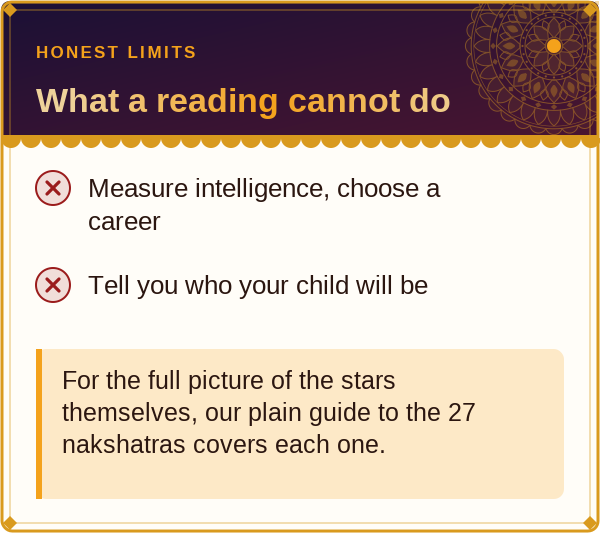
- For the full picture of the stars themselves, our plain guide to the 27 nakshatras covers each one.
Parents who know their child's birth star often hear it described in the language of fate: this star is fierce, that one is lucky, another needs a prayer. This post takes a different and older approach. It treats the nakshatras as a vocabulary of temperament, a way of noticing strengths to encourage during the school years. Every description below is traditional, partial and gentle by design. None of it is a label to pin on a child.
A grouping that keeps it simple
There are twenty-seven nakshatras, which is a lot to keep in mind. A helpful shortcut follows the Vimshottari dasha system, in which each star is ruled by one of nine planets, three stars apiece. Stars sharing a ruler share something of its character. Find your child's birth star in the headings below.
The nine groups
Ketu's stars: Ashwini, Magha, Mula
Tradition describes quick starters, often independent and drawn to the question "why?" These children may dive into a project with enthusiasm and want to know where things come from. To encourage: hands-on experiments, family history, a gentle habit of finishing what they start.
Venus's stars: Bharani, Purva Phalguni, Purva Ashadha
Said to love beauty, music, color and friendship, with a strong sense of what they like. To encourage: an instrument, art supplies, drama club, and steady routines that sit alongside the fun.
The Sun's stars: Krittika, Uttara Phalguni, Uttara Ashadha
Associated with a keen sense of fairness, responsibility and quiet leadership. To encourage: roles with real responsibility, such as class helper or team captain, and reassurance that mistakes are allowed, since these children can be hard on themselves.
The Moon's stars: Rohini, Hasta, Shravana
Often described as sensitive, warm and observant. Hasta is linked with skilled hands, Shravana with listening and learning by ear. To encourage: reading aloud together, crafts and cooking, a calm space for homework.
Mars's stars: Mrigashira, Chitra, Dhanishta
Energetic and searching. Mrigashira, the deer's head, is linked with curiosity; Chitra with design and making; Dhanishta with rhythm and music. To encourage: sport, building kits, drumming or dance, and plenty of physical outlet during long indoor winters.
Rahu's stars: Ardra, Swati, Shatabhisha
Questioning and independent, sometimes unconventional. Swati is likened to a blade of grass moving in the wind; Shatabhisha is linked with healers and research. To encourage: science, coding, open-ended projects, and freedom within clear limits.
Jupiter's stars: Punarvasu, Vishakha, Purva Bhadrapada
Said to be hopeful, idealistic and goal-driven, with an appetite for big questions. To encourage: a mentor or older cousin to look up to, debate and discussion, books that stretch them.
Saturn's stars: Pushya, Anuradha, Uttara Bhadrapada
Associated with steadiness, loyalty and a caring nature. Pushya is the nourisher; Anuradha is linked with lasting friendship. These children may warm up slowly in a new classroom. To encourage: patience with transitions, long-term projects, caring for a pet or a plant.
Mercury's stars: Ashlesha, Jyeshtha, Revati
Sharp, verbal and perceptive. Jyeshtha is the "eldest", often protective; Revati is gentle and imaginative. To encourage: reading, writing, puzzles, word games, and kindness alongside cleverness.
How to use this without boxing a child in
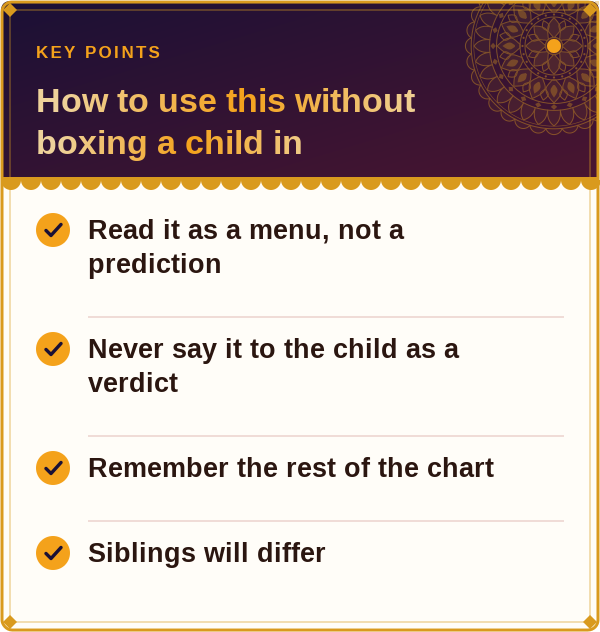
- Read it as a menu, not a prediction. If a description fits, use it. If it does not, drop it.
- Never say it to the child as a verdict. "You are a Saturn star, so you are slow" is a sentence a child can carry for years. "You like to take your time and get things right" carries no such weight.
- Remember the rest of the chart. The rising sign, the planets and the period a child is in all matter, and so does everything that has nothing to do with astrology: friends, teachers, sleep, health.
- Siblings will differ. Two children in one house can sit in very different groups. That can be a helpful way to stop comparing them.
When a child is struggling
If schoolwork, attention, mood or friendships are a worry, the first conversations should be with the teacher, the pediatrician and, where needed, the school psychologist. Many Chicago-area schools can arrange an evaluation, and early support helps. A chart is not a diagnostic tool. It can, at most, offer a parent some patience and a different angle while the real help happens.
Births that worry families
Some stars, especially Mula, Ashlesha and Jyeshtha, have a reputation that worries relatives. Tradition suggests a calming prayer for some of these births, and families who wish can arrange one simply. Our post on gandanta births explains the reasoning without fear. No birth star makes a child unlucky.
Going further
For the full picture of the stars themselves, our plain guide to the 27 nakshatras covers each one. A child horoscope reading with Astrologer and Psychic Vijayram, held by phone, WhatsApp or video, looks at the whole chart with the same encouraging approach, and older students facing entrance tests may find our note on exam timing for Chicago students useful.
The limit is worth repeating: a nakshatra describes a tradition's view of temperament. It cannot measure intelligence, choose a career or tell you who your child will be. Watching them, listening to them and backing them will tell you far more.
Common questions
How do I find my child's nakshatra?
It is the lunar mansion the Moon occupied at birth, calculated from the date, exact time and place. Many families learn it at the naming ceremony; otherwise a reader can calculate it.
My child's nakshatra is supposed to be calm, but my child is anything but. Is the chart wrong?
The nakshatra is one factor among many, and children grow through many phases. Trust what you see in your child over any description. The chart is a lens, not a verdict.
Can a nakshatra explain why my child is struggling at school?
No. Learning difficulties, attention problems and anxiety need a teacher, pediatrician or school psychologist. A reading can sit beside that support, but it cannot diagnose or replace it.
Is a Mula or Ashlesha birth unlucky for a child?
Tradition marks some births for a calming prayer, but no birth star dooms a child. Families who wish can arrange a simple shanti prayer, and children born under these stars grow up just like any others.
Related service
Keep reading
How a Prashna Chart Is Cast: Time, Place and the Wording of Your Question
How prashna astrology works: which moment the chart is cast for, where it is set, why your wording matters, and what a horary chart cannot settle.
Read article →
Will the House Sale Close? A Prashna for Chicago Home Sellers
A prashna for a property sale in Chicago: how a single-question chart is read for a pending sale, beside the inspection, lender and market, with no promises.
Read article →
Chicago, Dallas or the Bay Area? Weighing Job Offers With Relocation Astrology
Relocation astrology for a job offer: how the 4th, 9th and 12th houses, direction and your current dasha are weighed beside salary, costs and family in Chicago.
Read article →Quick answers
Can a Western birth chart printout be turned into a kundli?
What is a kundli, and can a Western birth chart printout become one? Yes, from the same birth data. Here is what the sidereal shift and Indian layout change.
Read answer →How exact does my birth place need to be: city, hospital or village?
The birth chart reading details needed: date, clock time and town. Why the nearest city is usually close enough, and when a more exact birthplace helps.
Read answer →Talk to Astrologer and Psychic Vijayram
Tell us what you are facing. If a reading is unlikely to help, you will be told that plainly.