
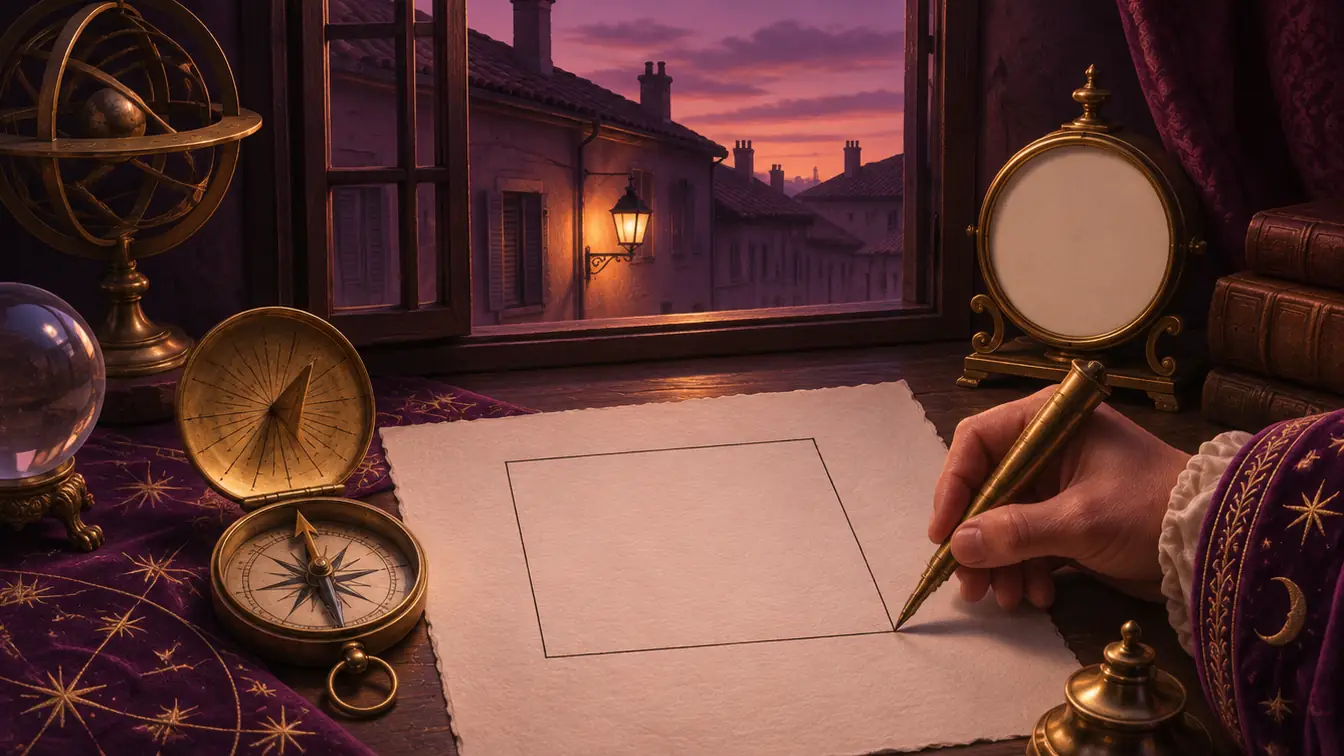
How a Prashna Chart Is Cast: Time, Place and the Wording of Your Question
Prashna astrology casts a chart for the moment a sincere question is received and understood, set for the place where the astrologer receives it. The houses and planets are then read for that one question. Because the chart answers only what was asked, clear wording matters. It works without a birth time but cannot override facts.
Key takeaways
- Everything in prashna depends on the question being real.
- Practices differ, and a careful reader tells you which convention they follow.
- With questions arriving by phone or WhatsApp, two conventions exist: cast for where the astrologer receives the question, or for where the questioner is.
- Once cast, the chart's houses are assigned to the people and things in the question.
- A prashna answers what you asked, not what you meant.
Most astrology starts from a birth. Prashna starts from a question. It is the branch of Jyotish that casts a chart for the moment someone asks about one specific matter, then reads that chart for that matter alone. Western astrology has the same idea under the name horary. Because it does not need a birth time, it is often the method of choice for people whose birth records are missing, and for questions that are sharp and time-bound. Here is how the chart is actually cast, step by step.
Step 1: A sincere, specific question
Everything in prashna depends on the question being real. The classical texts insist on this: a question asked to test the astrologer, out of idle curiosity or for the third time that week is not expected to produce a meaningful chart. The seventeenth-century English astrologer William Lilly, whose Christian Astrology remains the foundational Western horary text, set out conditions for judging whether a chart was "radical", meaning fit to be judged. Indian practice has its own version: the questioner should be sincere and the matter should genuinely concern them.
Step 2: The moment
Which moment is the chart cast for? Practices differ, and a careful reader tells you which convention they follow.
- When the astrologer understands the question. This was Lilly's rule and is widely used today. If you send a message at 9:00 and the reader opens and understands it at 9:40, the chart is cast for 9:40.
- When the question is first asked aloud. In a live session, this is usually the same moment, give or take a minute.
- A number chosen by the questioner. In the Krishnamurti Paddhati system set out in K. S. Krishnamurti's own volumes, the questioner picks a number from 1 to 249. Each number corresponds to a small division of the zodiac, which becomes the rising point of the chart, cast for the time and place of judgment.
- Omens and chosen objects. Kerala's tradition, recorded in texts such as the Prasna Marga, adds signs noticed at the moment of the question and objects or numbers chosen by the questioner.
Whatever the method, the moment is fixed once and not adjusted afterwards.
Step 3: The place
When questioner and astrologer sat in the same room, place was obvious. With questions arriving by phone or WhatsApp, two conventions exist: cast for where the astrologer receives the question, or for where the questioner is. Many practitioners use the astrologer's location, reasoning that the chart is born where the question is understood. Others prefer the questioner's. Both have defenders. What matters is consistency, so ask which one your reader uses.
Step 4: Assigning the houses
Once cast, the chart's houses are assigned to the people and things in the question. The ascendant and its ruler stand for the person asking. The other houses follow the usual meanings:
| Matter | House usually read |
|---|---|
| The other party: a partner, a buyer, an opponent | 7th |
| A job, a promotion, public standing | 10th |
| A home, land, property | 4th |
| Your money | 2nd |
| Gains, a hoped-for result | 11th |
| Children, an exam, a creative project | 5th |
| A dispute, an illness, a debt | 6th |
| Travel abroad, long journeys | 9th or 12th |
The reader then looks at how the planets representing you and the matter relate: whether they are moving toward contact, whether something blocks them, and what the Moon does next. The Moon, fast and changeable, is treated as a co-significator of the questioner and of the flow of events.
Why the wording matters so much
A prashna answers what you asked, not what you meant. Compare:
- "Will things get better at work?" is vague. Better how? Which thing?
- "Will I receive an offer from the company I interviewed with last week?" is specific, but the reader needs to know whether you want it.
- "Is accepting the offer from the Oak Brook company, if it comes, a good step for me this year?" names the matter, your role in it and a time frame.
Good prashna questions concern your own affairs, name one matter, and have a horizon. The same discipline helps in tarot; our post on phrasing a tarot question makes similar points from a different angle.
What a horary chart can and cannot settle
A prashna can describe the tendency of a situation: whether the factors point toward completion or obstruction, delay or movement, and roughly when things may shift. Traditionally it has also been used for lost objects and for choosing between two clear options.
It cannot override facts. If a lender has declined a mortgage, no chart reverses that. It cannot judge a medical outcome or a court verdict, and it should never be the reason to skip a doctor, a lawyer or a hard conversation. And like yes-or-no tarot, it has real limits when people want certainty it cannot give.
Seeing it applied
For a worked example, our post on a prashna for a pending house sale follows one question from wording to reading. A prashna consultation with Astrologer and Psychic Vijayram can be held by phone, WhatsApp or video: you state the question, the reader confirms the wording with you, and the chart is cast for that moment. If your real problem is a missing birth time for your whole life rather than one question, our short answer on what to do when the birth time is uncertain explains the other routes.
Common questions
Do I need my birth time for a prashna?
No. That is one of its main uses. The chart is cast for the moment of the question, so people with no reliable birth record can still ask about a specific matter.
Can I ask the same question again if I do not like the answer?
Tradition says no. A question repeated to get a different result is not considered sincere, and the new chart is not trusted. If circumstances genuinely change, a new question about the new situation can be asked.
Can I ask several questions in one prashna?
One chart is usually read for one question. A session can include more than one question, but each is treated separately, often with its own chart or number.
Can a prashna tell me what someone else is thinking?
This practice does not read other people's private thoughts. A question about your own choices, such as whether to pursue a relationship, works far better than one about another person's mind.
Related service
Keep reading
Will the House Sale Close? A Prashna for Chicago Home Sellers
A prashna for a property sale in Chicago: how a single-question chart is read for a pending sale, beside the inspection, lender and market, with no promises.
Read article →
Chicago, Dallas or the Bay Area? Weighing Job Offers With Relocation Astrology
Relocation astrology for a job offer: how the 4th, 9th and 12th houses, direction and your current dasha are weighed beside salary, costs and family in Chicago.
Read article →
Retire Near the Grandchildren or Return to India? A Chart Look for Chicagoland Parents
Retirement astrology for parents weighing a move back to India or staying near grandchildren in Chicagoland: the 4th and 12th houses, dashas and real needs.
Read article →Quick answers
Can a Western birth chart printout be turned into a kundli?
What is a kundli, and can a Western birth chart printout become one? Yes, from the same birth data. Here is what the sidereal shift and Indian layout change.
Read answer →How exact does my birth place need to be: city, hospital or village?
The birth chart reading details needed: date, clock time and town. Why the nearest city is usually close enough, and when a more exact birthplace helps.
Read answer →Talk to Astrologer and Psychic Vijayram
Tell us what you are facing. If a reading is unlikely to help, you will be told that plainly.