
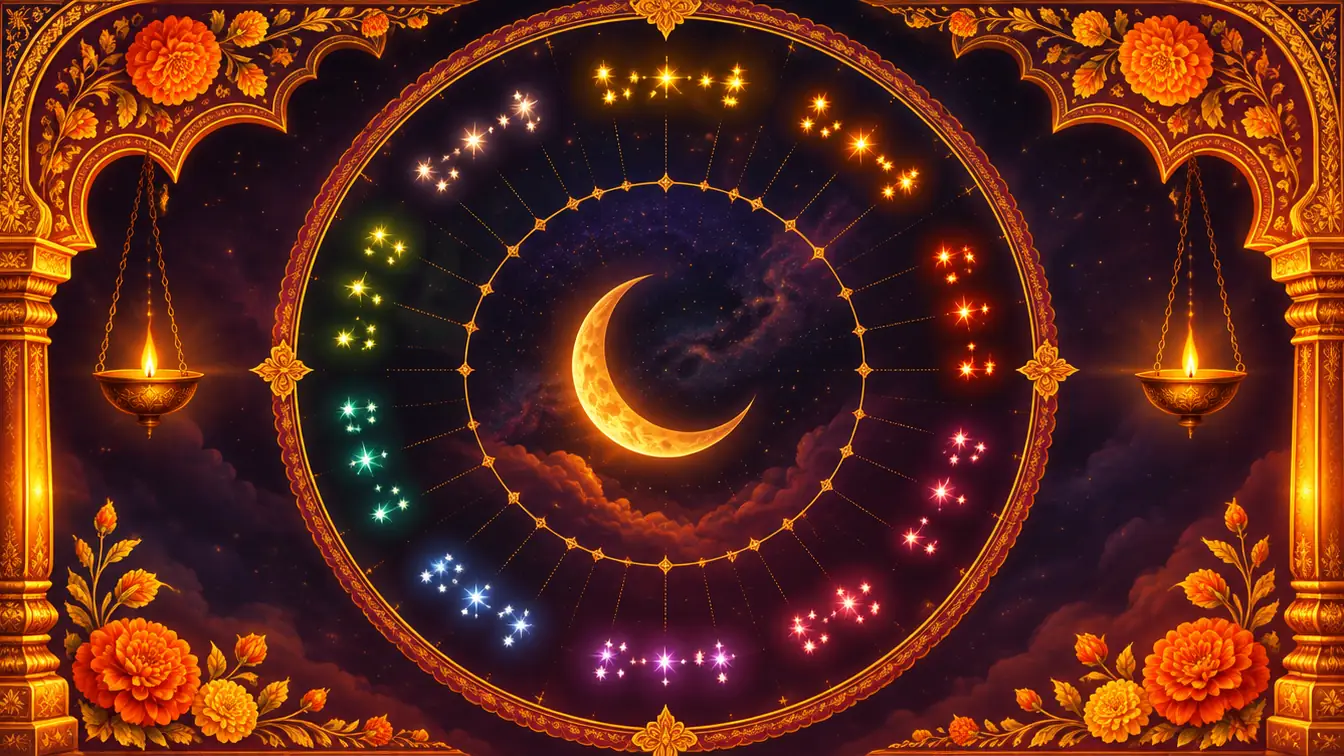
The 27 Nakshatras Grouped by Ruling Planet
The 27 nakshatras are lunar mansions of 13 degrees 20 minutes each. They fall into nine groups of three, one group per planet, starting with Ketu's Ashwini, Magha and Mula. The planet ruling the nakshatra your Moon occupied at birth becomes your first mahadasha, which is why the birth star matters so much for timing.
Key takeaways
- The zodiac's 360 degrees are split into 27 equal parts of 13 degrees 20 minutes.
- The rulers repeat in a fixed order, the same order used for the Vimshottari dashas: Ketu, Venus, Sun, Moon, Mars, Rahu, Jupiter, Saturn, Mercury.
- The Vimshottari dasha system begins your life in the period of whichever planet rules your Moon's nakshatra.
- Knowing your nakshatra is a starting point.
Lists of nakshatras usually run straight from Ashwini to Revati, one after another, with a symbol and a deity for each. That order is useful but it hides a pattern. Sort the same lunar mansions by their ruling planet and they fall neatly into nine sets of three, spaced evenly around the sky. Seeing them that way makes it much easier to understand why your birth star decides the order of your planetary periods.
The basic arithmetic
The zodiac's 360 degrees are split into 27 equal parts of 13 degrees 20 minutes. The Moon covers roughly one of them each day as it circles the sky. The nakshatra system is far older than the twelve-sign zodiac in India, and it remains the backbone of Vedic timing, muhurta and naming.
Each nakshatra has four padas of 3 degrees 20 minutes, giving 108 padas in all. Since 108 is twelve times nine, every sign holds exactly nine padas, which is how the nakshatras connect to the navamsa chart.
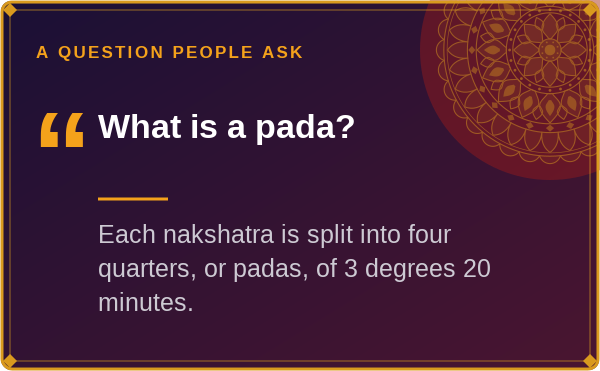
Nine rulers, three stars each
The rulers repeat in a fixed order, the same order used for the Vimshottari dashas: Ketu, Venus, Sun, Moon, Mars, Rahu, Jupiter, Saturn, Mercury. After nine nakshatras the cycle starts again, so it runs three times around the zodiac. Each ruler's three stars sit exactly 120 degrees apart.
Ketu: 7-year period
- Ashwini: 0° to 13°20' Aries
- Magha: 0° to 13°20' Leo
- Mula: 0° to 13°20' Sagittarius
Each opens a fire sign and begins one of the three rounds. Ketu's link with beginnings and roots fits that position.
Venus: 20-year period
- Bharani: 13°20' to 26°40' Aries
- Purva Phalguni: 13°20' to 26°40' Leo
- Purva Ashadha: 13°20' to 26°40' Sagittarius
Sun: 6-year period
- Krittika: 26°40' Aries to 10° Taurus
- Uttara Phalguni: 26°40' Leo to 10° Virgo
- Uttara Ashadha: 26°40' Sagittarius to 10° Capricorn
All three straddle two signs, a fire sign and the earth sign after it.
Moon: 10-year period
- Rohini: 10° to 23°20' Taurus
- Hasta: 10° to 23°20' Virgo
- Shravana: 10° to 23°20' Capricorn
Mars: 7-year period
- Mrigashira: 23°20' Taurus to 6°40' Gemini
- Chitra: 23°20' Virgo to 6°40' Libra
- Dhanishta: 23°20' Capricorn to 6°40' Aquarius
Rahu: 18-year period
- Ardra: 6°40' to 20° Gemini
- Swati: 6°40' to 20° Libra
- Shatabhisha: 6°40' to 20° Aquarius
All three sit wholly inside air signs.
Jupiter: 16-year period
- Punarvasu: 20° Gemini to 3°20' Cancer
- Vishakha: 20° Libra to 3°20' Scorpio
- Purva Bhadrapada: 20° Aquarius to 3°20' Pisces
Saturn: 19-year period
- Pushya: 3°20' to 16°40' Cancer
- Anuradha: 3°20' to 16°40' Scorpio
- Uttara Bhadrapada: 3°20' to 16°40' Pisces
Mercury: 17-year period
- Ashlesha: 16°40' to 30° Cancer
- Jyeshtha: 16°40' to 30° Scorpio
- Revati: 16°40' to 30° Pisces
Each closes a water sign and ends one round. The point where Mercury's water stars meet Ketu's fire stars is the gandanta junction that tradition treats with special care.
How the ruler sets your timeline
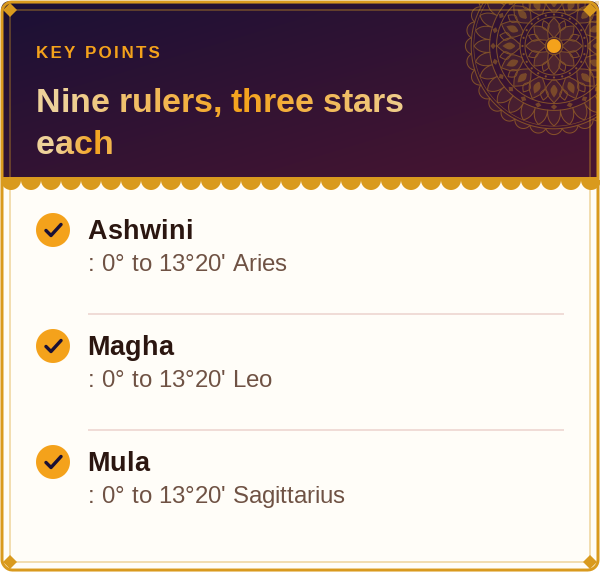
Here is the practical payoff. The Vimshottari dasha system begins your life in the period of whichever planet rules your Moon's nakshatra. If your Moon was in Hasta, your first period was the Moon's. If it was in Swati, it was Rahu's. How far the Moon had traveled through that nakshatra tells you how much of the first period was already used up at birth.
From there the periods follow the same nine-planet order shown above, Ketu after Mercury, round and round. Two people with Moons in Ashwini and Mula therefore share a timeline structure, both starting in Ketu, even though their Moon signs are four signs apart. The post on plotting your own Vimshottari timeline on paper turns this into a step-by-step exercise.
Other uses of your birth star
- Naming. Each pada carries a syllable used for a child's formal name. The post on nakshatra syllables and Chicago school roll calls looks at how families use it today, and the child horoscope and naming session works through the choice with parents.
- Matching. Several of the eight kootas in Guna Milan compare the two birth stars.
- Muhurta. Certain nakshatras are preferred for weddings, travel or starting work.
- Character. Each star has a deity, a symbol and traditional qualities, read alongside the Moon's sign. Your Moon sign itself is covered in why Vedic astrology uses the Moon sign.
What a birth star does not do
Knowing your nakshatra is a starting point. It does not describe your whole personality, and it does not lock in events. The same star is shared by everyone born in the same day or so, around the world. To see how your birth star works with the rest of your chart, a birth chart reading with Astrologer and Psychic Vijayram connects it to your ascendant, houses and current period.
Common questions
How do I find my janma nakshatra?
It is the nakshatra your Moon occupied at birth. Any Vedic chart calculator lists it beside the Moon, often with the pada number. You need a reasonably accurate birth time, since the Moon crosses a full nakshatra in about a day.
Why do some lists show 28 nakshatras?
Older lists include Abhijit, a short span near the end of Uttara Ashadha. It is still used in some muhurta work, but the standard system for charts and dashas uses 27 equal divisions.
Are some birth stars unlucky?
Folk lore attaches warnings to a few, such as Mula or Ashlesha, and to births near sign junctions. A single factor never decides a life. The post on gandanta births looks at the junctions calmly.
What is a pada?
Each nakshatra is split into four quarters, or padas, of 3 degrees 20 minutes. The pada links the nakshatra to the navamsa chart and gives the syllable used in traditional baby naming.
Related service
Keep reading
Your Lagna Lord: Where It Sits and What That Changes
What lagna means in Vedic astrology: how the rising sign fixes the twelve houses, and how the house your lagna lord sits in colors the whole chart.
Read article →
A One-Page Map of the Twelve Bhavas
The 12 houses in Vedic astrology on one page: a one-line meaning for each bhava, plus how they group into kendras, trikonas, dusthanas and upachayas.
Read article →
Plotting Your Own Vimshottari Timeline on Paper
Work out your Vimshottari dasha by hand: from the Moon's nakshatra to a drawn timeline of mahadashas in their 120-year order, so you can see where you are now.
Read article →Quick answers
Can a Western birth chart printout be turned into a kundli?
What is a kundli, and can a Western birth chart printout become one? Yes, from the same birth data. Here is what the sidereal shift and Indian layout change.
Read answer →How exact does my birth place need to be: city, hospital or village?
The birth chart reading details needed: date, clock time and town. Why the nearest city is usually close enough, and when a more exact birthplace helps.
Read answer →Talk to Astrologer and Psychic Vijayram
Tell us what you are facing. If a reading is unlikely to help, you will be told that plainly.