
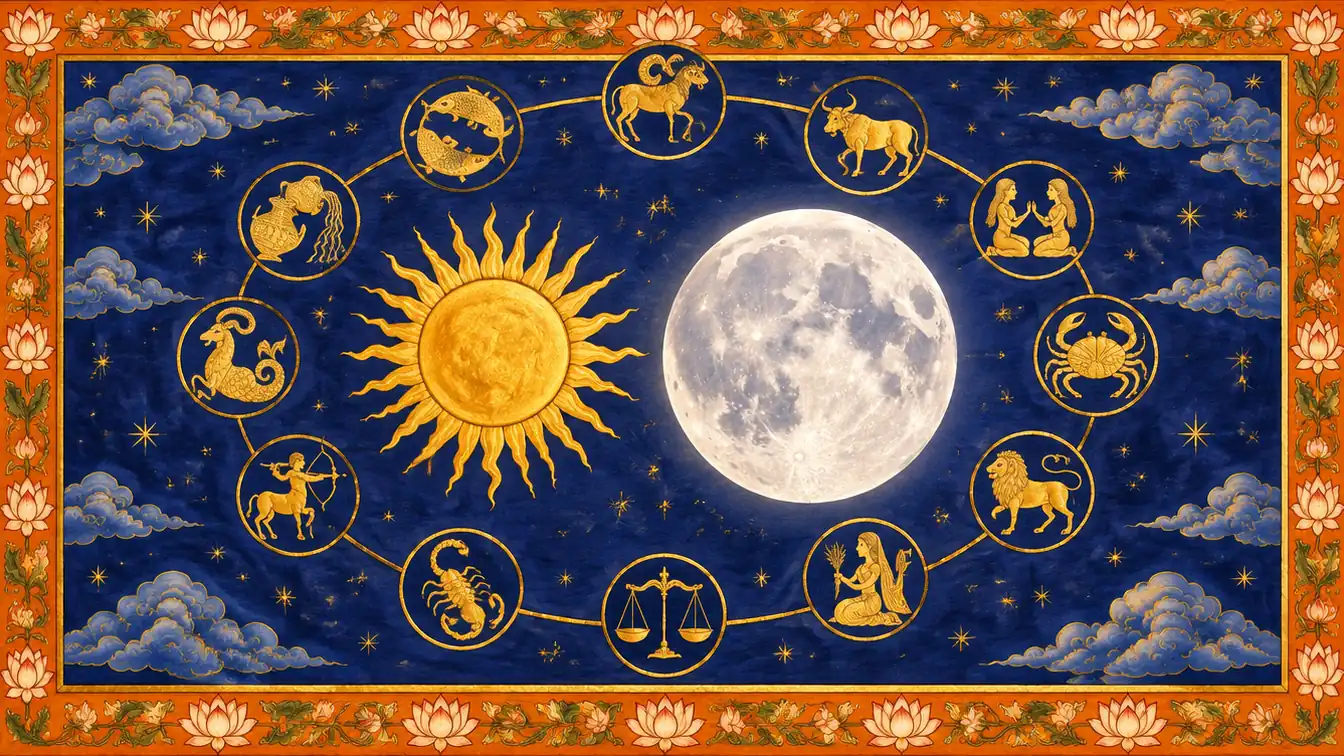
Moon Sign or Sun Sign: Which One Does Vedic Astrology Use?
Vedic astrology uses the Moon sign, called your rashi or chandra rashi, as the main reference for daily horoscopes, transits, naming and marriage matching. Your Sun sign still appears in the chart, but it plays a smaller role. To find your rashi you need your birth date, time and place, calculated in the sidereal zodiac.
Key takeaways
- Indian astrology treats the Moon, Chandra, as the planet of the mind: mood, memory, attachment and the way experience is taken in.
- The Sun, Surya, is read as the soul, vitality, father and authority, and its sign and house are interpreted carefully.
- Western astrology uses the tropical zodiac, where 0 degrees Aries is fixed to the spring equinox.
- A Vedic astrologer looks at three anchors together: the lagna (rising sign), the rashi (Moon sign) and the Sun sign.
- Once you know your rashi, a few other topics open up.
Ask an American friend for their sign and they will name a Sun sign, the one printed beside their birthday in every magazine. Ask a grandmother in Pune or Jaipur the same question and she will name your rashi, which is something else entirely. It is the sign the Moon was in when you were born. Both answers are astrology. They come from different habits about which light in the sky counts most.
Why the Moon leads in Jyotish
Indian astrology treats the Moon, Chandra, as the planet of the mind: mood, memory, attachment and the way experience is taken in. The figure of Chandra in Hindu tradition carries that sense of the mind and its changes. Since the Moon describes how life feels from the inside, many of the system's practical tools are counted from it.
- Transits. The famous seven-and-a-half-year Sade Sati is measured by Saturn's position from your Moon sign, not your Sun. The same goes for reading Jupiter's yearly move.
- Nakshatra. The Moon's birth star sets the order of your planetary periods.
- Matching. The Guna Milan score used in kundli matching compares the Moon signs and birth stars of two people.
- Naming. The first syllable of a traditional name comes from the Moon's nakshatra quarter.
- Daily horoscopes. Vedic columns and panchang apps sort readers by rashi.
What happened to the Sun?
It is still there. The Sun, Surya, is read as the soul, vitality, father and authority, and its sign and house are interpreted carefully. It simply is not the sign people use to introduce themselves. And even the Sun sign itself is usually different in a Vedic chart, for a reason worth understanding.
The 24-degree gap
Western astrology uses the tropical zodiac, where 0 degrees Aries is fixed to the spring equinox. Vedic astrology uses the sidereal zodiac, tied to the background stars. Because of the slow wobble of the earth's axis, the two have drifted apart over many centuries, and today the gap is about 24 degrees. The comparison of sidereal and tropical astrology explains the drift and the different ayanamsa values astrologers use to measure it.
In practice, the Sun enters each sidereal sign around the middle of the Western month. The dates below are approximate and vary by a day from year to year:
| Sidereal Sun enters | Around | Sidereal Sun enters | Around |
|---|---|---|---|
| Aries (Mesha) | April 14 | Libra (Tula) | October 17 |
| Taurus (Vrishabha) | May 15 | Scorpio (Vrischika) | November 16 |
| Gemini (Mithuna) | June 15 | Sagittarius (Dhanu) | December 16 |
| Cancer (Karka) | July 16 | Capricorn (Makara) | January 14 |
| Leo (Simha) | August 17 | Aquarius (Kumbha) | February 13 |
| Virgo (Kanya) | September 17 | Pisces (Meena) | March 14 |
The January date will be familiar: it is Makar Sankranti, when the Sun enters sidereal Capricorn. A person born on March 30 is an Aries in a magazine and a Pisces Sun in a Vedic chart. The post on what the Adler Planetarium sky shows about the two zodiacs looks at this from the astronomy side.
How to find your rashi
The Moon moves fast. It circles the sky in about 27 days, as NASA's Moon facts note, so it spends a little over two days in each sign. That is why you need more than a birth month.
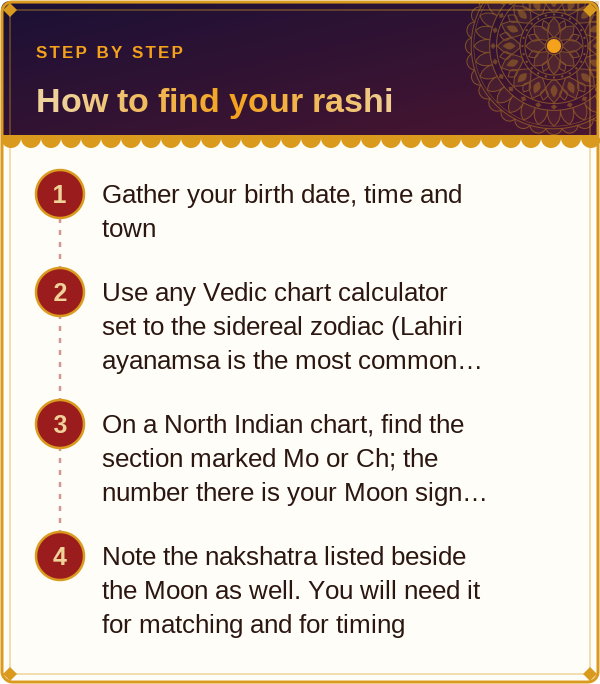
- Gather your birth date, time and town.
- Use any Vedic chart calculator set to the sidereal zodiac (Lahiri ayanamsa is the most common default), or look at an existing kundli.
- On a North Indian chart, find the section marked Mo or Ch; the number there is your Moon sign. On a South Indian chart, the Moon's box names the sign directly.
- Note the nakshatra listed beside the Moon as well. You will need it for matching and for timing.
If you have never read a kundli, the guide to reading a North Indian chart shows where everything sits.
Three signs, not one
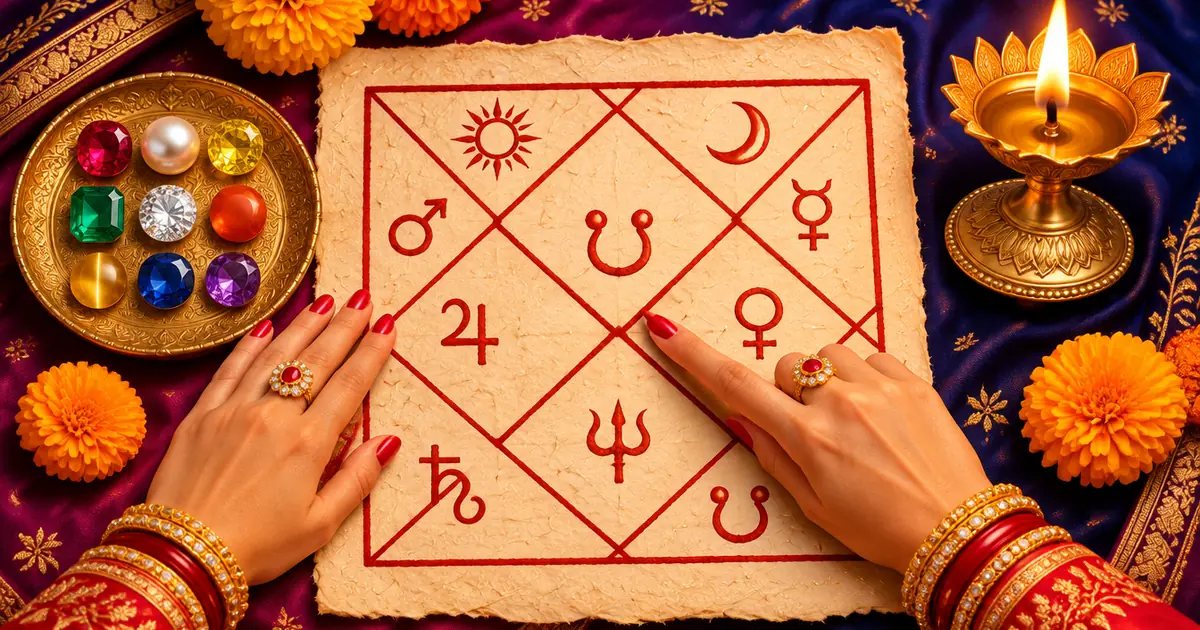
A Vedic astrologer looks at three anchors together: the lagna (rising sign), the rashi (Moon sign) and the Sun sign. The lagna shapes the houses and the outward life. The Moon describes the inner life and is the starting point for transits. The Sun describes purpose and vitality. When people say a horoscope "does not sound like me," it is often because they read only one of the three, and usually the one Vedic tradition weighs least.
Where your Moon sign comes up next
Once you know your rashi, a few other topics open up. The posts on who starts and ends Sade Sati when Saturn changes signs and Jupiter's transit by Moon sign both start from it. The guide to the nakshatras grouped by ruling planet explains your birth star. And if marriage is on your mind, the short answer on what Guna Milan measures shows how two Moon signs are compared.
A limit worth keeping in mind
A sign, whether Sun or Moon, is a single factor. No one sign describes a whole person, and no Moon sign forecast written for millions of readers can speak to your particular circumstances. For a reading that puts your rashi in the context of the whole chart, a Vedic birth chart reading with Astrologer and Psychic Vijayram looks at all three anchors and how they fit together.
Common questions
Can I find my rashi from my birth date alone?
Often, but not always. The Moon spends a little over two days in each sign, so if it changed signs on your birthday, the birth time decides which rashi is yours. With a time and place there is no doubt.
Why is my Vedic Sun sign different from the one in magazines?
Magazines use the tropical zodiac, tied to the seasons. Vedic astrology uses the sidereal zodiac, tied to the stars, and the two are now about 24 degrees apart. Anyone born in roughly the first half of a Western sign month usually has the previous sign in a Vedic chart.
Is my rashi the same as my ascendant?
Only by coincidence. The rashi is the sign the Moon occupied; the ascendant, or lagna, is the sign rising in the east. They are separate points and both matter.
Which sign should I read in a newspaper horoscope?
For Vedic columns, your Moon sign. For most American columns, which are Western and tropical, your Sun sign. Mixing them gives a reading meant for someone else.
Related service
Keep reading
The 27 Nakshatras Grouped by Ruling Planet
The 27 nakshatras in nine groups of three, from Ketu's Ashwini, Magha and Mula onward, with their sign spans and how each ruler sets the dasha sequence.
Read article →
Your Lagna Lord: Where It Sits and What That Changes
What lagna means in Vedic astrology: how the rising sign fixes the twelve houses, and how the house your lagna lord sits in colors the whole chart.
Read article →
A One-Page Map of the Twelve Bhavas
The 12 houses in Vedic astrology on one page: a one-line meaning for each bhava, plus how they group into kendras, trikonas, dusthanas and upachayas.
Read article →Quick answers
Can a Western birth chart printout be turned into a kundli?
What is a kundli, and can a Western birth chart printout become one? Yes, from the same birth data. Here is what the sidereal shift and Indian layout change.
Read answer →How exact does my birth place need to be: city, hospital or village?
The birth chart reading details needed: date, clock time and town. Why the nearest city is usually close enough, and when a more exact birthplace helps.
Read answer →Talk to Astrologer and Psychic Vijayram
Tell us what you are facing. If a reading is unlikely to help, you will be told that plainly.