
How to Read a North Indian Chart in Ten Minutes
To read a North Indian chart, start at the top center diamond: it is always the first house, and the number written in it is your ascendant sign, 1 for Aries through 12 for Pisces. The houses then run counterclockwise. Planet abbreviations sit inside each house, so your Moon and lagna lord are quick to find.
Key takeaways
- The lines divide the square into twelve sections: four diamonds (top, left, bottom, right) and eight triangles around the edges.
- Inside or at the corner of each section you will see a small number from 1 to 12.
- From the top diamond, move to the triangle on its upper left.
- English printouts usually use Su, Mo, Ma, Me, Ju, Ve, Sa, Ra and Ke, plus As or La for the ascendant.
- The sign number in that section is your Moon sign, or rashi, which Vedic astrology uses for daily horoscopes, matching and transits.
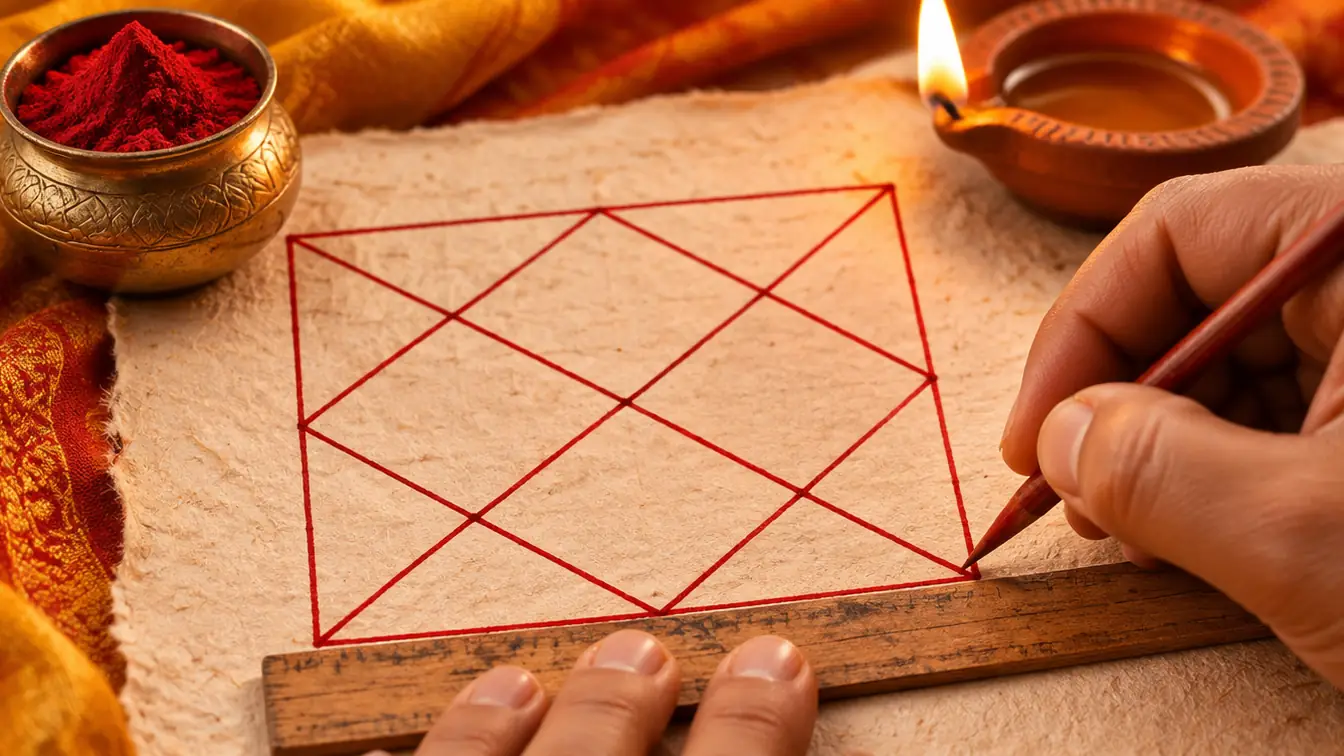
A North Indian kundli looks like a square with an X through it and a diamond tucked inside. The first time you see one it can seem like a puzzle. It is actually one of the quickest chart formats to read once you know where to start, and ten minutes is enough to find the main landmarks in your own chart. Here is a timed walk through, minute by minute.
Minute 1: Get oriented
The lines divide the square into twelve sections: four diamonds (top, left, bottom, right) and eight triangles around the edges. Each section is a house, or bhava. The general idea of the kundali is explained in this overview of the kundali chart; what matters here is that in the North Indian style the houses are fixed. The top diamond is always the 1st house, in every chart ever drawn this way.
Minute 2: Find the number in the top diamond
Inside or at the corner of each section you will see a small number from 1 to 12. These numbers are signs, counted from Aries:
| Number | Sign | Number | Sign |
|---|---|---|---|
| 1 | Aries (Mesha) | 7 | Libra (Tula) |
| 2 | Taurus (Vrishabha) | 8 | Scorpio (Vrischika) |
| 3 | Gemini (Mithuna) | 9 | Sagittarius (Dhanu) |
| 4 | Cancer (Karka) | 10 | Capricorn (Makara) |
| 5 | Leo (Simha) | 11 | Aquarius (Kumbha) |
| 6 | Virgo (Kanya) | 12 | Pisces (Meena) |
The number in the top diamond is your lagna, the sign rising in the east when you were born. If it shows 4, you have Cancer rising. That single number sets up everything else.
Minutes 3 and 4: Walk the houses counterclockwise
From the top diamond, move to the triangle on its upper left. That is the 2nd house. Keep going counterclockwise: the left upper triangle is the 3rd, the left diamond is the 4th, then the lower left triangle (5th), the bottom left triangle (6th), the bottom diamond (7th), bottom right triangle (8th), lower right triangle (9th), right diamond (10th), upper right triangle (11th) and the top right triangle (12th).
The sign numbers climb by one at each step. With Cancer (4) rising, the left diamond holds 7 for Libra, the bottom diamond 10 for Capricorn, and the right diamond 1 for Aries, because after 12 the count wraps back to 1. If your chart does not follow that pattern, you are reading in the wrong direction.
Minute 5: Decode the planet abbreviations
Planets are written in short form. English printouts usually use Su, Mo, Ma, Me, Ju, Ve, Sa, Ra and Ke, plus As or La for the ascendant. Charts printed in Hindi use Devanagari syllables from the planet names: Surya, Chandra, Mangal, Budh, Guru, Shukra, Shani, Rahu and Ketu. An R or an asterisk beside a planet usually marks it as retrograde. Some programs add a small c for a planet close enough to the Sun to count as combust.
Minute 6: Locate your Moon
Find Mo or Ch. The sign number in that section is your Moon sign, or rashi, which Vedic astrology uses for daily horoscopes, matching and transits. The post on why Vedic astrology uses the Moon sign explains why it matters so much.
Minute 7: Find your lagna lord
Every sign has a ruling planet. Mars rules 1 and 8, Venus 2 and 7, Mercury 3 and 6, the Moon 4, the Sun 5, Jupiter 9 and 12, and Saturn 10 and 11. Look up the ruler of the number in your top diamond and find where it sits. A Cancer-rising chart has the Moon as lagna lord, so its house tells you a good deal about where your attention tends to go. The post on where your lagna lord sits takes this step further.
Minute 8: Look at the four diamonds
The four diamonds are the kendras, houses 1, 4, 7 and 10: self, home, partnership and career. Planets placed here are traditionally read as prominent in a life. Note which diamonds are occupied and which are empty.
Minute 9: Do not panic about empty houses
With nine planets and twelve houses, at least three houses will always be empty, and usually more. An empty house is still read through its sign and the placement of its ruler. An empty 7th does not mean no marriage, and an empty 10th does not mean no career. For a quick meaning of each house, keep the one-page map of the twelve bhavas open alongside.
Minute 10: Check which chart you are looking at
Many printouts show two or three diamonds side by side. The main one is usually titled Lagna, Rashi or Janma Kundli. Others may be the Chandra chart, which puts the Moon's sign at the top instead of the ascendant, or the Navamsa, a divisional chart. Reading the Chandra chart by mistake is one of the most common reasons people think their rising sign is wrong.
Common slips
- Counting clockwise, which mirrors every house.
- Treating the sign number as the house number.
- Comparing two charts drawn for different birth times without noticing.
- Assuming a family chart in the South Indian square uses the same rules. It does not; the post on converting a South Indian square into a diamond covers that.
What ten minutes gives you, and what it does not
You now know where things are. You do not yet know what they mean together, because interpretation weighs strength, aspects, divisional charts and timing all at once. A layout lesson is orientation, not a reading, and no chart, however clearly drawn, fixes the future. If you want the whole picture explained, a Vedic birth chart reading with Astrologer and Psychic Vijayram goes through all twelve houses and connects them to the period you are in now.
Common questions
Why is there a small 1 written in the right-hand diamond of my chart?
That number is a sign, not a house. A 1 there means Aries occupies your 10th house. The houses never move in this layout; only the sign numbers change from chart to chart.
Is the North Indian chart more accurate than the South Indian one?
No. Both show the same planetary positions. The North Indian style fixes the houses and the South Indian style fixes the signs. Accuracy depends on the birth data and the calculation, not the drawing.
My printout has a second chart labeled Chalit. Which one do I read?
Start with the main birth chart, often labeled Lagna or Rashi. The Bhava Chalit chart redraws house boundaries by degree and can shift a planet near a cusp into the neighboring house. Astrologers differ on how much weight to give it.
What do the small numbers next to each planet mean?
Usually the degree of the planet within its sign. A planet at 1 or 29 degrees sits near the edge of a sign, which an astrologer will note when judging its strength.
Related service

Keep reading
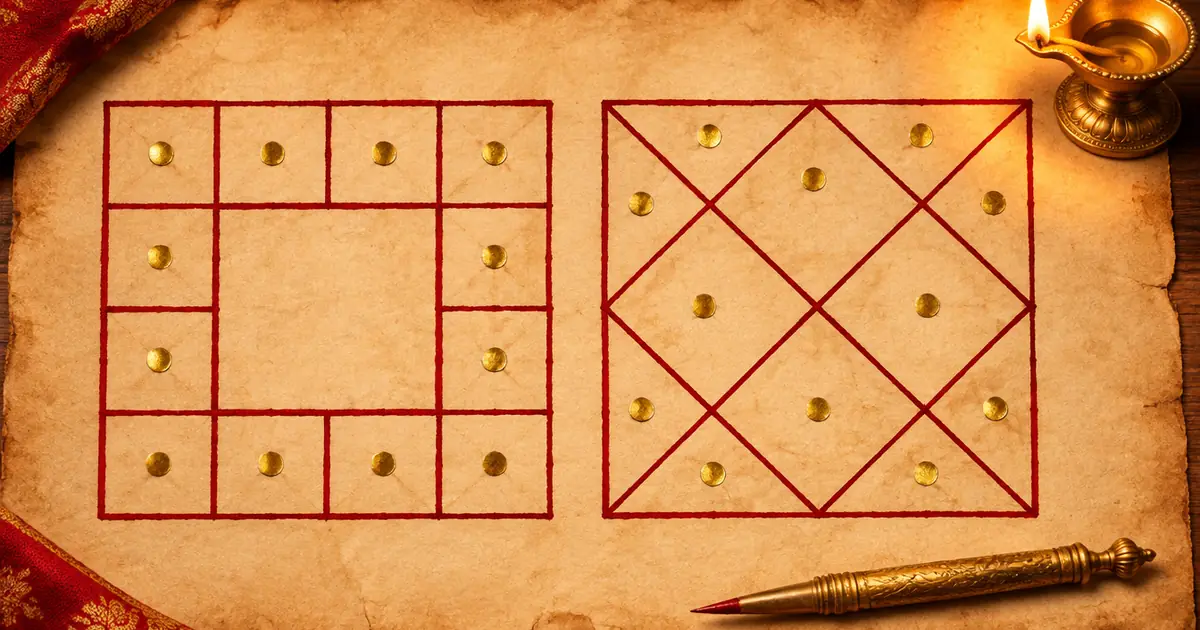
Square or Diamond? Converting a South Indian Chart to the North Indian Layout
South Indian chart vs North Indian chart: find the ascendant in the square grid, then redraw it as a diamond step by step so families holding both can compare.
Read article →
Moon Sign or Sun Sign: Which One Does Vedic Astrology Use?
Moon sign in Vedic astrology: why your rashi is the Moon's sign, how it differs from a newspaper Sun sign, and how to find your own from a birth date and time.
Read article →
The 27 Nakshatras Grouped by Ruling Planet
The 27 nakshatras in nine groups of three, from Ketu's Ashwini, Magha and Mula onward, with their sign spans and how each ruler sets the dasha sequence.
Read article →Quick answers
Can a Western birth chart printout be turned into a kundli?
What is a kundli, and can a Western birth chart printout become one? Yes, from the same birth data. Here is what the sidereal shift and Indian layout change.
Read answer →How exact does my birth place need to be: city, hospital or village?
The birth chart reading details needed: date, clock time and town. Why the nearest city is usually close enough, and when a more exact birthplace helps.
Read answer →Talk to Astrologer and Psychic Vijayram
Tell us what you are facing. If a reading is unlikely to help, you will be told that plainly.