
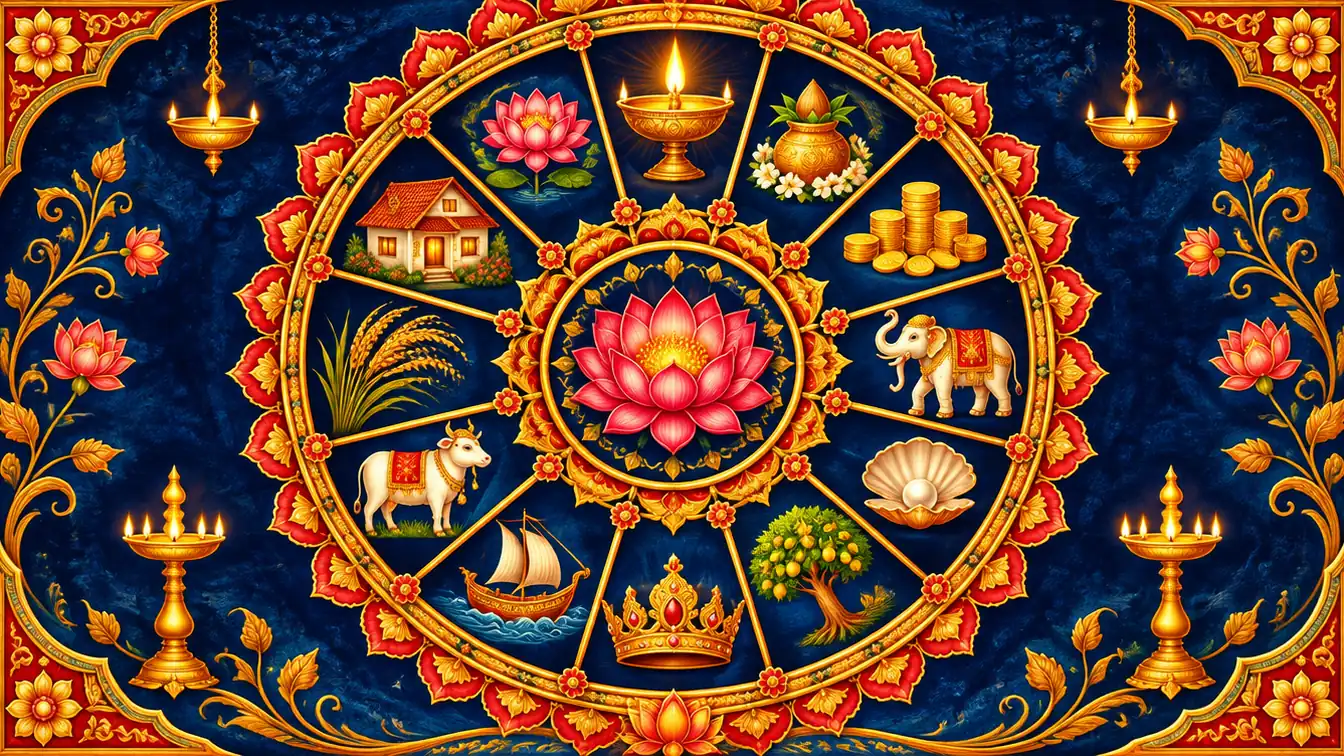
A One-Page Map of the Twelve Bhavas
The 12 houses in Vedic astrology, called bhavas, divide life into departments, from the self in the 1st house to distance and release in the 12th. Astrologers also group them: kendras (1, 4, 7, 10) are pillars, trikonas (1, 5, 9) bring fortune, dusthanas (6, 8, 12) bring difficulty, and upachayas (3, 6, 10, 11) improve with effort.
Key takeaways
- The Sanskrit names below follow the list in Brihat Parashara Hora Shastra, available in the verse naming the twelve bhavas .
- The angles, sometimes called the pillars of the chart: self, home, partner, career.
- Apoklimas (3, 6, 9, 12) fall away from the angles and are read as houses of movement, learning and release.
- The general Western idea of houses differs in its house systems and emphasis.
- A single line per house is a memory aid, not a reading.
Twelve houses, each with a dozen traditional meanings, can feel like too much to hold in mind. This page cuts it down to a single line per house, then shows the handful of groupings that astrologers actually use when they read a chart. Print it, or keep it open beside your kundli.
One line per house
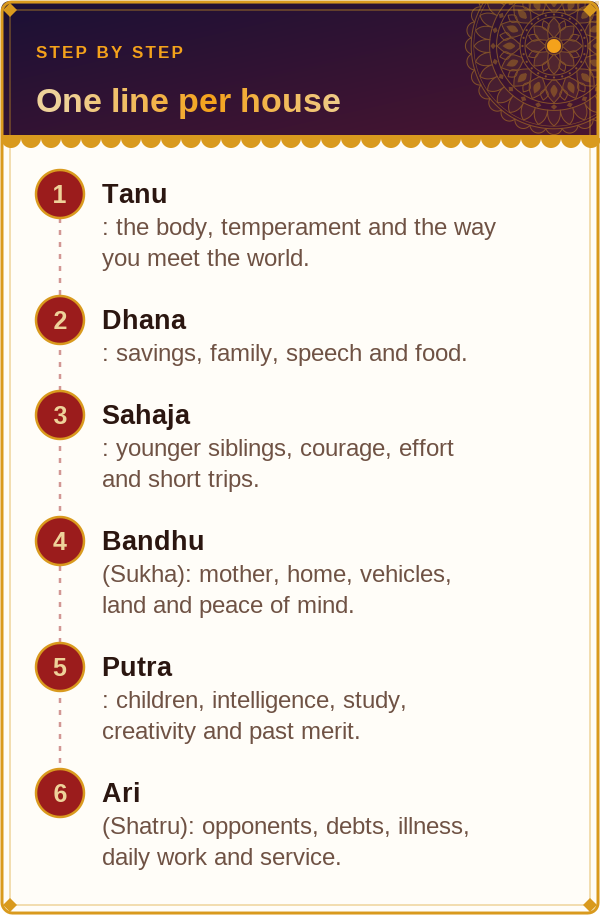
The Sanskrit names below follow the list in Brihat Parashara Hora Shastra, available in the verse naming the twelve bhavas. Where a house has a second common name, it is given in brackets.
- Tanu: the body, temperament and the way you meet the world.
- Dhana: savings, family, speech and food.
- Sahaja: younger siblings, courage, effort and short trips.
- Bandhu (Sukha): mother, home, vehicles, land and peace of mind.
- Putra: children, intelligence, study, creativity and past merit.
- Ari (Shatru): opponents, debts, illness, daily work and service.
- Yuvati (Kalatra): spouse, partners, clients and contracts.
- Randhra (Ayu): longevity, sudden change, hidden matters and shared money.
- Dharma: faith, father, teachers, higher learning and long-distance travel.
- Karma: career, reputation and action in the world.
- Labha: gains, income, friends, elder siblings and hopes.
- Vyaya: expenses, loss, sleep, retreat and foreign lands.
Which sign falls in each house depends on your lagna, the sign rising at birth. The post on your lagna lord and where it sits explains how that works.
The four main groups
Kendras: 1, 4, 7, 10
The angles, sometimes called the pillars of the chart: self, home, partner, career. Planets here are prominent and active. Tradition names these the houses of effort and stability, and a chart with strong kendras is read as well supported.
Trikonas: 1, 5, 9
The trines, houses of fortune and merit. The 5th carries intelligence and past good deeds; the 9th, grace and guidance. The 1st belongs to both groups, which is one reason it matters so much. When the ruler of a kendra joins the ruler of a trikona, the combination is called a raja yoga. The post on checking a raja yoga yourself shows how to test whether an app's claim holds up.
Dusthanas: 6, 8, 12
The difficult houses: conflict and illness, sudden change, loss and distance. They are not curses. The 6th is also where people overcome problems and serve others; the 8th covers research, insurance and inheritance; the 12th covers spiritual life and settling abroad. Rulers of these houses are read with care when they join other houses.
Upachayas: 3, 6, 10, 11
The growing houses. Their results tend to improve with age and effort, and tradition says naturally harsh planets such as Saturn, Mars and Rahu often do well here. A Saturn in the 3rd or 11th is commonly read as slow, steady gain. These houses also matter in career work; see reading career from the D10 chart and the 11th house of gains.
Two smaller groupings worth knowing
Angles, follow-ups and falling houses
Every house is one of three types. Kendras (1, 4, 7, 10) are the angles. Panapharas (2, 5, 8, 11) follow them and are read as houses of gathering and continuity. Apoklimas (3, 6, 9, 12) fall away from the angles and are read as houses of movement, learning and release. A planet's type of house hints at whether its results come forcefully, steadily or through change.
The four aims of life
Another grouping uses the four classical aims:
| Aim | Houses | Theme |
|---|---|---|
| Dharma (purpose) | 1, 5, 9 | Who you are and what you stand for |
| Artha (resources) | 2, 6, 10 | Money, work and practical means |
| Kama (desire) | 3, 7, 11 | Relationships, wishes and ambition |
| Moksha (release) | 4, 8, 12 | Inner peace, transformation and letting go |
A chart with many planets in one group often describes where a person's attention naturally goes. A cluster in the artha houses, for instance, tends to describe someone absorbed in building a working life.
Using the map on your own chart
- Find your lagna and number the houses from it. The guide to reading a North Indian chart helps if the layout is new to you.
- Note which houses hold planets, and which group each belongs to.
- For an empty house that matters to you, find its ruling planet and see where that sits.
- Look at your current dasha lord: which houses does it rule and occupy? Those are the departments of life tradition puts in the foreground now.
The general Western idea of houses differs in its house systems and emphasis. The overview of astrological houses sets out those differences for anyone who knows the Western version first.

What the map leaves out
A single line per house is a memory aid, not a reading. Real interpretation weighs the sign in each house, the planets, their strength, their aspects and the timing all at once, and even then it describes tendencies rather than certain events. For that fuller view, the Vedic birth chart reading with Astrologer and Psychic Vijayram walks through every house in your own chart.
Common questions
Which house is the most important?
The 1st, because it fixes all the others and stands for the person. After it, the kendras and trikonas carry the most weight in traditional reading.
Are the 6th, 8th and 12th houses always bad?
No. They are called dusthanas because they deal with difficulty, but the 6th also rules service and recovery, the 8th research and inheritance, the 12th spiritual practice and life abroad. Many people do their best work through these houses.
What does an empty house mean?
Very little on its own. With nine planets and twelve houses, several are always empty. An empty house is read through its sign and the placement of the planet that rules it.
Why does a house have several Sanskrit names?
Classical texts name each house by its main themes, and different authors emphasize different ones. The 4th, for example, is called Bandhu (kin) and Sukha (happiness).
Related service
Keep reading

Plotting Your Own Vimshottari Timeline on Paper
Work out your Vimshottari dasha by hand: from the Moon's nakshatra to a drawn timeline of mahadashas in their 120-year order, so you can see where you are now.
Read article →
Saturn Mahadasha at Work: Promotions, Delays and Long Projects
Saturn mahadasha and your career: how Shani's nineteen years are read for promotions, delays and long projects, why placement matters, and habits that suit it.
Read article →
Rahu Mahadasha for Immigrants: Ambition, Distance and Reinvention in Chicago
Rahu mahadasha for people who moved countries: Rahu's link with foreign places and new paths, why many in Chicago notice it, and how to read it calmly.
Read article →Quick answers
Can a Western birth chart printout be turned into a kundli?
What is a kundli, and can a Western birth chart printout become one? Yes, from the same birth data. Here is what the sidereal shift and Indian layout change.
Read answer →How exact does my birth place need to be: city, hospital or village?
The birth chart reading details needed: date, clock time and town. Why the nearest city is usually close enough, and when a more exact birthplace helps.
Read answer →Talk to Astrologer and Psychic Vijayram
Tell us what you are facing. If a reading is unlikely to help, you will be told that plainly.