

Reading Career From the Dashamsha (D10) Chart
The dashamsha, or D10, is a divisional chart that splits each sign into ten parts of three degrees and is used to refine career readings. An astrologer starts with the 10th house and its lord in the birth chart, then checks where that lord and the career planets fall in the D10, read as tendency rather than a job title.
Key takeaways
- Vedic astrology uses a family of divisional charts, called vargas, each dividing every sign into smaller parts.
- The counting rule is simple once you see it:
- Because each part is only three degrees, the D10 ascendant moves through all twelve signs in the time the birth-chart ascendant crosses a little over one sign.
- A planet that is strong in the D10 tends to add its style to the career.
- The Department of Labor's My Next Move site includes an interest profiler and occupation details that sit well alongside a chart reading.
The 10th house of a birth chart tells an astrologer that career matters, and its lord gives a broad direction. But two people with the same 10th house can have very different working lives. That is where the dashamsha comes in. It is a finer lens on the same sky, used to see how the career promise of the main chart actually plays out.
What the D10 is
Vedic astrology uses a family of divisional charts, called vargas, each dividing every sign into smaller parts. Parashara's text sets out sixteen of them, with the rules for building each, in chapter 6 of Brihat Parashara Hora Shastra, and its next chapter, on what each divisional chart shows, links the tenth division with deeds and standing in the world. In practice, the D10 is the career chart.
How it is built
Each 30-degree sign is split into ten parts of three degrees. The counting rule is simple once you see it:
- In an odd sign (Aries, Gemini, Leo, Libra, Sagittarius, Aquarius), the ten parts are counted from the sign itself.
- In an even sign (Taurus, Cancer, Virgo, Scorpio, Capricorn, Pisces), they are counted from the 9th sign from it.
Two quick examples
Sun at 17° Aries. 17 divided by 3 is 5.67, so it is in the 6th part. Aries is odd, so count six signs from Aries: Aries, Taurus, Gemini, Cancer, Leo, Virgo. The Sun's D10 sign is Virgo.
Sun at 17° Taurus. Again the 6th part. Taurus is even, so start from the 9th sign from Taurus, which is Capricorn, and count six: Capricorn, Aquarius, Pisces, Aries, Taurus, Gemini. The D10 sign is Gemini.
Any good Vedic software will draw the full chart, but doing one or two placements by hand shows you what you are looking at.
The birth time problem
Because each part is only three degrees, the D10 ascendant moves through all twelve signs in the time the birth-chart ascendant crosses a little over one sign. On average it changes every twelve minutes or so. Planets move far more slowly through the D10, so their signs are usually reliable; the D10's houses are not, unless the birth time is accurate. If yours is uncertain, the post on rectifying a birth time from life events explains how a working time is tested, and career dates are among the most useful evidence.
Reading it in order
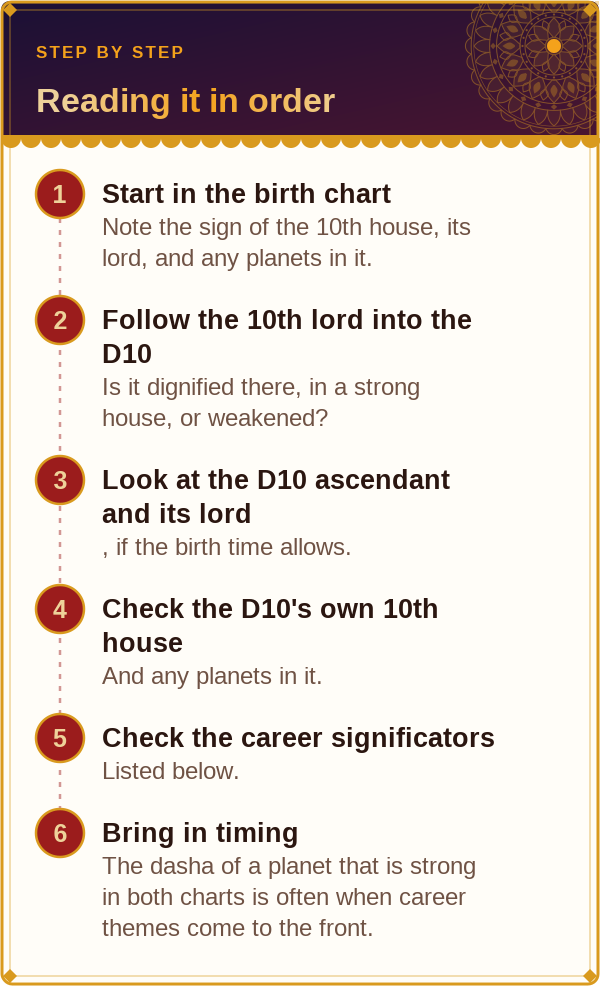
- Start in the birth chart. Note the sign of the 10th house, its lord, and any planets in it. That is the foundation. The house meanings themselves are summarized in a one-page map of the twelve bhavas.
- Follow the 10th lord into the D10. Is it dignified there, in a strong house, or weakened?
- Look at the D10 ascendant and its lord, if the birth time allows.
- Check the D10's own 10th house and any planets in it.
- Check the career significators listed below.
- Bring in timing. The dasha of a planet that is strong in both charts is often when career themes come to the front.
Career significators and their styles
| Planet | Style of work tradition links with it |
|---|---|
| Sun | Authority, government, leadership, visible responsibility |
| Moon | Public-facing work, care, food, hospitality |
| Mars | Engineering, technical skill, property, uniformed services |
| Mercury | Trade, analysis, writing, accounting, communication |
| Jupiter | Teaching, advising, law, finance, religious work |
| Venus | Arts, design, luxury goods, hospitality, client relations |
| Saturn | Systems, operations, labor, long-term institutions |
| Rahu | Technology, foreign links, unconventional or new fields |
A planet that is strong in the D10 tends to add its style to the career. Someone with a Gemini 10th house and Mercury dignified in the D10 might find analytical or communication work suits them; the same 10th house with a strong D10 Saturn might lean toward process and operations. In a city with as many trading, logistics and engineering jobs as Chicago, those differences are easy to recognize. The post on Chicago's trading floors and the chart looks at one example closely.
Strength comparisons
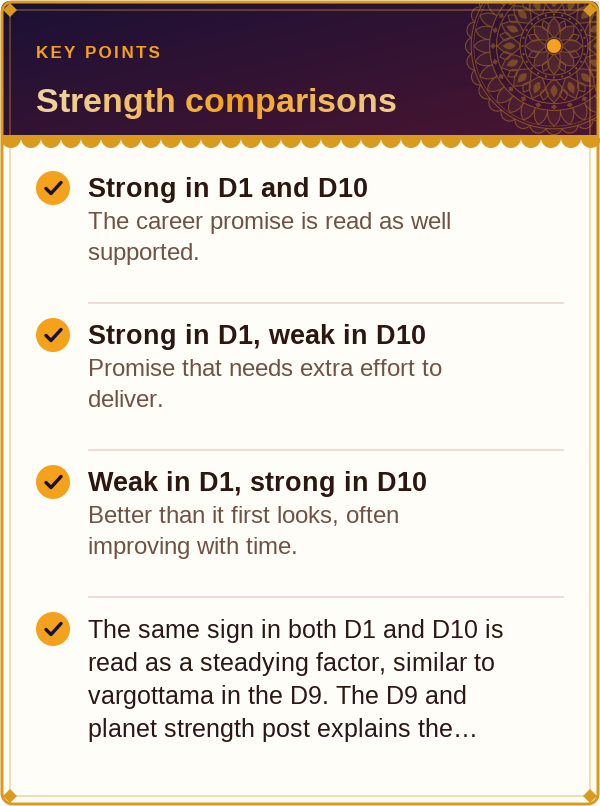
- Strong in D1 and D10: the career promise is read as well supported.
- Strong in D1, weak in D10: promise that needs extra effort to deliver.
- Weak in D1, strong in D10: better than it first looks, often improving with time.
- The same sign in both D1 and D10 is read as a steadying factor, similar to vargottama in the D9. The D9 and planet strength post explains the parallel idea.
Pair it with practical exploration
A chart can suggest a style of work. It cannot tell you what jobs exist, what they pay, or what training they need. The Department of Labor's My Next Move site includes an interest profiler and occupation details that sit well alongside a chart reading. If you are weighing self-employment, see business or job, and what the chart suggests.
Where the D10 stops
The dashamsha refines tendencies; it does not issue job titles or promise promotions. Career outcomes depend on skills, markets, employers and choices. A career and business astrology reading with Astrologer and Psychic Vijayram reads your 10th house, its lord and the D10 together, then sets them against your current period so you can think through the decisions in front of you.
Common questions
Can the D10 tell me which job to take?
No. It describes tendencies, such as work with authority, with systems, with people or with ideas. Choosing between two real offers depends on pay, people, location and your own goals.
My birth time is approximate. Is the D10 still useful?
Only partly. The planets' D10 positions change slowly and stay usable, but the D10 ascendant changes about every twelve minutes, so its houses are unreliable without an accurate or rectified time.
Which planet matters most for career?
The lord of the 10th house in your birth chart is the main one. The Sun, Saturn, Mercury and Jupiter are also traditional career significators, each for a different style of work.
What if the D10 contradicts my birth chart?
The birth chart comes first. The D10 refines it: a strong D1 promise with a weak D10 is read as needing more effort, and a modest D1 with a strong D10 as better than it first looks.
Related service

Keep reading

Second Jobs and Side Businesses in Chicago: The Eleventh House of Gains
The eleventh house of gains in astrology: how the 11th and its link to the 2nd are read for side income and networks, beside Chicago tax and license steps.
Read article →
Business or Job? What the Chart Suggests
Business or job astrology: chart signs read as independence or steadiness, why most charts are mixed, and the due diligence to do before leaving a job.
Read article →
Navamsa Beyond Marriage: Using the D9 to Judge Planet Strength
The navamsa chart is more than a marriage tool: why astrologers check each planet's dignity in the D9, what vargottama means, and the D9's role in matching.
Read article →Quick answers
Can a Western birth chart printout be turned into a kundli?
What is a kundli, and can a Western birth chart printout become one? Yes, from the same birth data. Here is what the sidereal shift and Indian layout change.
Read answer →How exact does my birth place need to be: city, hospital or village?
The birth chart reading details needed: date, clock time and town. Why the nearest city is usually close enough, and when a more exact birthplace helps.
Read answer →Talk to Astrologer and Psychic Vijayram
Tell us what you are facing. If a reading is unlikely to help, you will be told that plainly.