
Navamsa Beyond Marriage: Using the D9 to Judge Planet Strength
The navamsa chart, or D9, divides each sign into nine parts of 3 degrees 20 minutes. Astrologers use it to judge each planet's real strength: one exalted in the birth chart but weak in the D9 delivers less, and one weak in the birth chart but dignified in the D9 recovers. It also helps with marriage questions.
Key takeaways
- The counting rules come from Parashara's chapter on the sixteen divisional charts , and Mantreswara gives the same scheme in Phaladeepika's chapter on divisions of the zodiac .
- The birth chart shows where a planet sits; the D9 shows how well it can deliver.
- Because of the counting rule, this always happens in a predictable spot:
- The D9's best-known use is for marriage and partnership.
- Slow planets change navamsa every few days or longer, so their D9 positions survive a rough birth time.
Most people first hear the word navamsa when a family starts talking about marriage. An astrologer looks at "the D9" alongside the kundli and says something about the spouse or the marriage. That role is real, but it is only part of the chart's job. In everyday reading, astrologers check the D9 for every planet, because it answers a basic question the birth chart leaves open: how strong is this planet, really?
How the D9 is built
Each 30-degree sign is split into nine equal parts of 3 degrees 20 minutes. Each part is a navamsa, and each matches one nakshatra pada, which ties the D9 to the lunar mansions. The counting rules come from Parashara's chapter on the sixteen divisional charts, and Mantreswara gives the same scheme in Phaladeepika's chapter on divisions of the zodiac.
The rule is easiest to remember by element. The nine parts of every sign start counting from a fixed sign of its element:
| Element | Signs | Navamsas start from |
|---|---|---|
| Fire | Aries, Leo, Sagittarius | Aries |
| Earth | Taurus, Virgo, Capricorn | Capricorn |
| Air | Gemini, Libra, Aquarius | Libra |
| Water | Cancer, Scorpio, Pisces | Cancer |
So the twelve signs times nine parts run through the zodiac exactly nine times, starting from Aries and ending at Pisces.
A worked example
Venus at 8 degrees of Virgo. Virgo is an earth sign, so its navamsas start from Capricorn. The first runs from 0° to 3°20', the second to 6°40', the third to 10°. Eight degrees falls in the third: Capricorn, Aquarius, Pisces. Venus's D9 sign is Pisces.
That is a striking result. Venus is debilitated in Virgo in the birth chart but exalted in Pisces in the D9. Tradition reads that as a planet that starts out struggling and recovers, often noticeably in the later years or in its own period.
Why strength is judged here
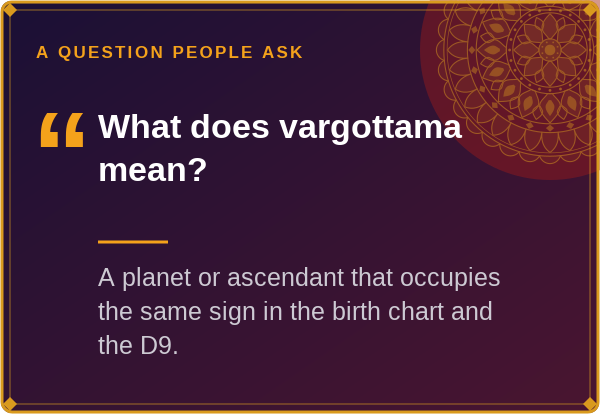
The birth chart shows where a planet sits; the D9 shows how well it can deliver. Common comparisons:
- Dignified in both: the planet's promise is read as reliable.
- Exalted in the birth chart, debilitated in the D9: a promise that does not fully mature. Many astrologers treat this as a warning against overselling an exalted planet.
- Debilitated in the birth chart, exalted or in its own sign in the D9: recovery through effort, sometimes treated as a form of canceled weakness.
- Debilitated in both: the planet's themes need extra care and support.
This is the check that separates a real raja yoga from a nominal one, as described in checking an app's raja yoga claim. It also plays a part in judging the lagna lord and career planets; the career chart has its own divisional chart, the dashamsha or D10.
Vargottama: the same sign twice
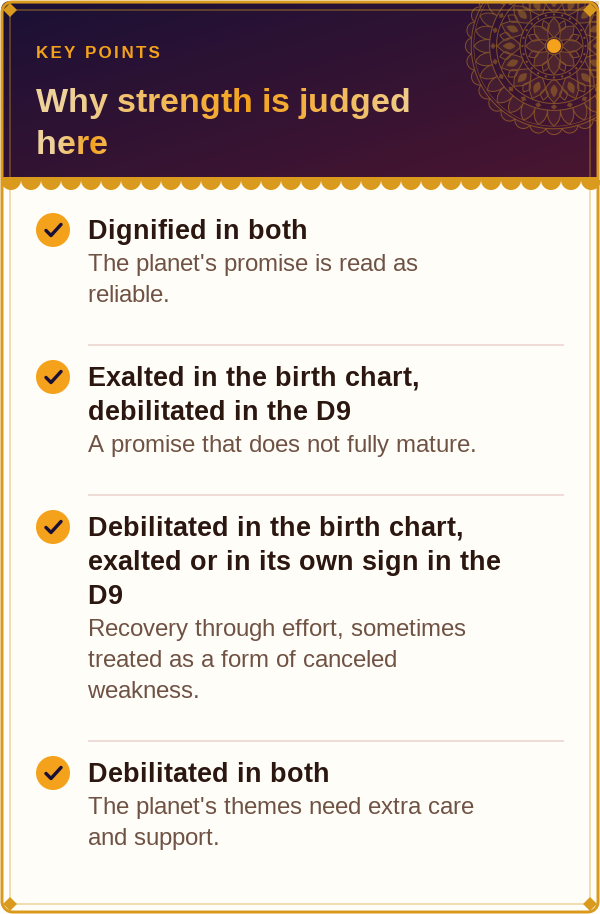
When a planet occupies the same sign in both charts, it is called vargottama, and tradition reads it as strengthened and consistent, almost as if it were in its own sign. Because of the counting rule, this always happens in a predictable spot:
- the first navamsa of a movable sign (Aries, Cancer, Libra, Capricorn);
- the middle, fifth navamsa of a fixed sign (Taurus, Leo, Scorpio, Aquarius);
- the last navamsa of a dual sign (Gemini, Virgo, Sagittarius, Pisces).
A vargottama ascendant is read as a steady, recognizable personality. A vargottama Moon is read as emotional consistency.
The marriage role
The D9's best-known use is for marriage and partnership. An astrologer looks at the D9's 7th house and its lord, at Venus and Jupiter in the D9, and at how the D9 ascendant relates to the birth chart. In kundli matching, comparing the two partners' D9 charts adds depth beyond the Guna Milan score, and in a marriage timing consultation the D9 helps judge which periods bring partnership forward. These readings describe tendencies in married life, never a guaranteed outcome or a specific person.
The wider family of divisional charts, each tied to one area of life, is outlined in the overview of vargas.
The birth-time question
Slow planets change navamsa every few days or longer, so their D9 positions survive a rough birth time. The Moon moves through a navamsa in about six hours, so it needs a time within that range. The D9 ascendant changes about every thirteen minutes on average, which means its houses are only trustworthy with a good birth time. If yours is uncertain, see rectifying a birth time from life events.
Checking a planet yourself
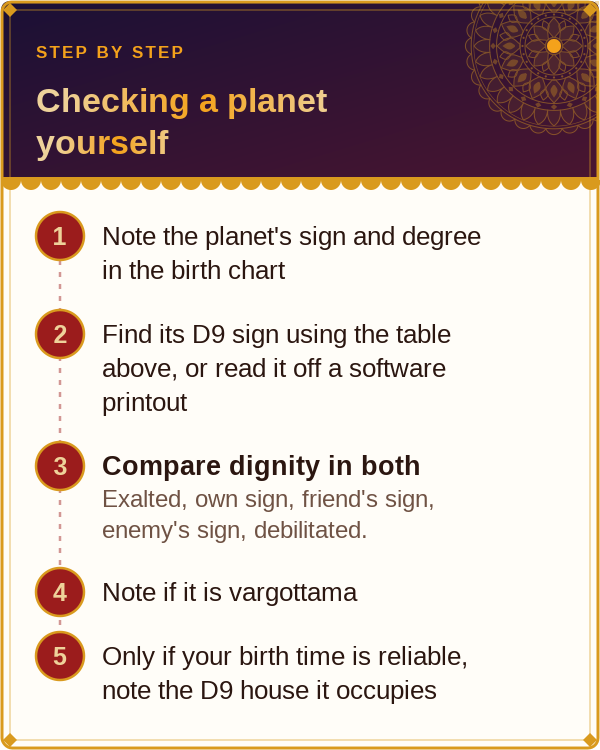
- Note the planet's sign and degree in the birth chart.
- Find its D9 sign using the table above, or read it off a software printout.
- Compare dignity in both: exalted, own sign, friend's sign, enemy's sign, debilitated.
- Note if it is vargottama.
- Only if your birth time is reliable, note the D9 house it occupies.
The limit
The D9 refines the birth chart; it does not overrule it, and it cannot predict a marriage or its success. A birth chart reading with Astrologer and Psychic Vijayram reads both charts together and explains which planets carry real strength in yours.
Common questions
What does vargottama mean?
A planet or ascendant that occupies the same sign in the birth chart and the D9. Tradition reads it as consistent and strengthened. It happens in the first ninth of a movable sign, the middle ninth of a fixed sign and the last ninth of a dual sign.
Is the D9 more important than the birth chart?
No. The birth chart is the foundation. A common saying calls the birth chart the tree and the navamsa its fruit: the D9 shows how the promise matures, especially in the second half of life.
Can the D9 describe my future spouse?
Tradition reads the D9's 7th house and the position of Venus and Jupiter for the nature of marriage. These are tendencies to reflect on, never a portrait of a specific person.
How accurate must my birth time be?
For the planets, a rough time is fine except for the Moon, which changes navamsa about every six hours. The D9 ascendant changes roughly every thirteen minutes, so its houses need an accurate time.
Related service
Keep reading
Rectifying a Birth Time From Life Events: Which Dates to Gather First
Birth time rectification from life events: the marriage, move, job and family dates used to test candidate times, which to gather first, and the limits.
Read article →
Gemstones in Jyotish: Who Should Not Wear Them
Astrology gemstones are not for everyone. When Jyotish discourages a stone, how a trial period works, and the lower-cost remedies to weigh first.
Read article →
Rudraksha Basics: Faces, Use and Care
Rudraksha benefits explained as devotion, not medicine: what the faces mean, which bead people choose, how to spot fakes and how to care for a mala.
Read article →Quick answers
Can a Western birth chart printout be turned into a kundli?
What is a kundli, and can a Western birth chart printout become one? Yes, from the same birth data. Here is what the sidereal shift and Indian layout change.
Read answer →How exact does my birth place need to be: city, hospital or village?
The birth chart reading details needed: date, clock time and town. Why the nearest city is usually close enough, and when a more exact birthplace helps.
Read answer →Talk to Astrologer and Psychic Vijayram
Tell us what you are facing. If a reading is unlikely to help, you will be told that plainly.