
Gemstones in Jyotish: Who Should Not Wear Them
In Jyotish, astrology gemstones are discouraged when the planet rules difficult houses for your rising sign, when the birth time is uncertain, when two clashing stones would be worn together, or when buying one would strain your money. A stone is never required: mantra, charity and steady habits are equally traditional remedies.
Key takeaways
- A gem is believed to strengthen whatever its planet stands for in your chart.
- Planets that rule the 6th, 8th or 12th house from the ascendant carry themes of conflict, upheaval and loss in that particular chart.
- Neelam has a particular reputation in Jyotish as quick and strong in effect, for good or ill, and tradition treats it with more caution than any other stone.
- Because people search for yellow sapphire benefits more than for any other stone, it is worth being exact.
- Most of the tradition's remedies cost little or nothing in money.
A common scene after a first Jyotish consultation: a family in Schaumburg or Skokie unfolds a printout that recommends a blue sapphire for Saturn, an emerald for Mercury and a red coral for Mars, all at once. The list looks thorough. Very often it is the opposite. Classical practice is far more selective about stones than the jewelry trade, and a good part of an astrologer's job is saying who should not wear one.
The idea behind a stone, in one paragraph
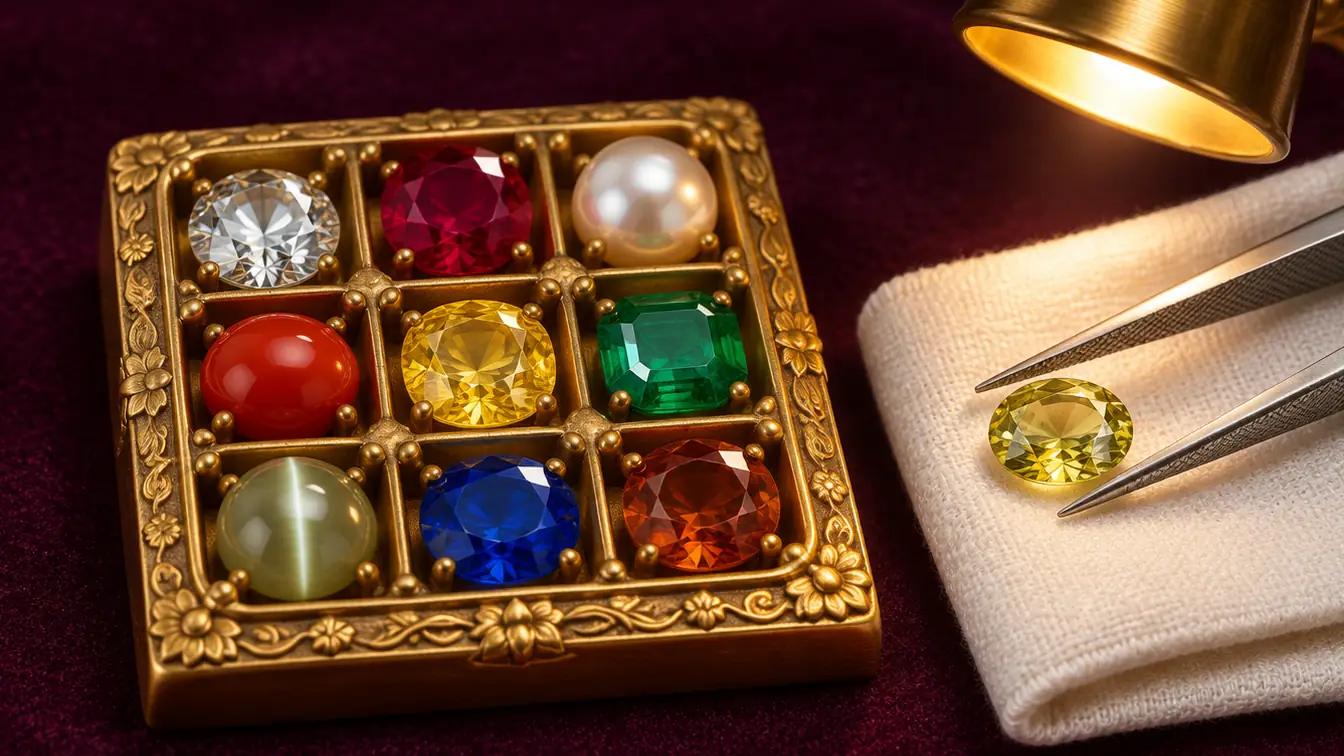
Each of the nine grahas has a traditional gem, the set known as the navaratna, or nine gems: ruby for the Sun, pearl for the Moon, red coral for Mars, emerald for Mercury, yellow sapphire for Jupiter, diamond for Venus, blue sapphire for Saturn, hessonite for Rahu and cat's eye for Ketu. A gem is believed to strengthen whatever its planet stands for in your chart. That single idea explains every caution below. Strengthening a planet only helps if what it governs in your chart is something you want more of.
Six situations where a stone is usually discouraged
1. The planet rules difficult houses for your rising sign
Planets that rule the 6th, 8th or 12th house from the ascendant carry themes of conflict, upheaval and loss in that particular chart. Take yellow sapphire. Jupiter is the great benefic, yet for a Taurus ascendant it rules the 8th and 11th houses, and for Libra it rules the 3rd and 6th. Many astrologers would not suggest pukhraj for either. Blue sapphire runs the other way: Saturn is a builder for Taurus and Libra ascendants, so neelam is sometimes considered for them, while for Cancer and Leo ascendants, where Saturn rules the 7th and 8th or the 6th and 7th, it is usually discouraged.
2. The birth time is uncertain
House rulerships depend on the ascendant, which changes roughly every two hours. A birth time remembered as "around evening" can put you in the wrong rising sign and flip the advice entirely. Until the time is confirmed or carefully estimated, no strong stone should be chosen.
3. Two stones would quarrel
Tradition avoids pairing the gems of planets considered hostile to each other, such as ruby with blue sapphire (Sun and Saturn) or yellow sapphire with diamond (Jupiter and Venus). A list of five stones at once almost always breaks this rule somewhere.
4. The planet is already strong, or the period is ending
If a planet is well placed, there is nothing to prop up. If its dasha ends in a few months, a costly stone bought for that dasha has a short working life.
5. The purchase would strain the household
A natural blue sapphire of decent size can cost as much as a used car. No classical text asks anyone to borrow for a remedy, and spending rent money on a gem creates exactly the stress it was meant to ease.
6. The stone is meant to replace treatment
No gem treats an illness, low mood or an injury. If health is the worry, a doctor comes first; a stone can only ever sit alongside care, never in place of it.
Blue sapphire and the trial period
Neelam has a particular reputation in Jyotish as quick and strong in effect, for good or ill, and tradition treats it with more caution than any other stone. The usual custom is a trial: keeping the stone near you, or wearing it for a few days, and noticing sleep, mood and the run of ordinary events before deciding. Some families keep it under the pillow for three nights first.
Whatever you believe about that, the practical side is sensible. Do the trial with a stone you can return, and get the return terms in writing before you pay. If a jeweler will not allow any trial at all on an expensive neelam, that tells you something about the sale.
Yellow sapphire: what it is said to support
Because people search for yellow sapphire benefits more than for any other stone, it is worth being exact. Tradition links Jupiter with teachers, learning, children, wise counsel, faith and long-term wealth, and for some charts with marriage. Pukhraj is said to support those themes when Jupiter rules good houses for you but sits weak. For Sagittarius, Pisces, Cancer and Scorpio ascendants it is often considered; for others it may be neutral or discouraged. "Said to support" is the honest phrasing: a stone is an act of faith, not a tool with measured effects.
Lower-cost options to weigh first
Most of the tradition's remedies cost little or nothing in money. In rough order of how often a careful astrologer suggests them:
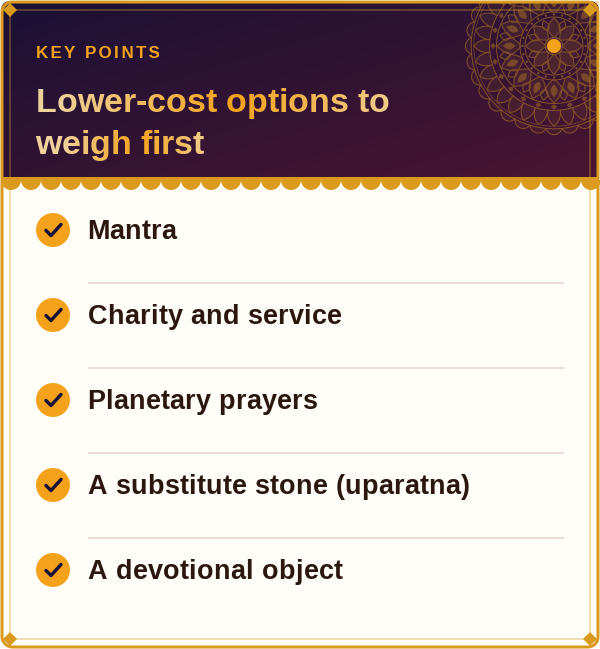
- Mantra. A short planetary mantra said daily, often on the planet's weekday.
- Charity and service. Giving linked to the planet, such as helping elders for Saturn or supporting a school for Jupiter. Our post on remedies built on seva, fasting and charity lists everyday ways to do this around Chicago.
- Planetary prayers. A graha shanti prayer at home or at a temple, which is optional and explained before anything is arranged.
- A substitute stone (uparatna). Amethyst for blue sapphire, citrine or yellow topaz for yellow sapphire, garnet for ruby. These are far cheaper and suit a cautious trial.
- A devotional object. Some people prefer a mala; see our notes on rudraksha faces, use and care.
If you still decide to buy
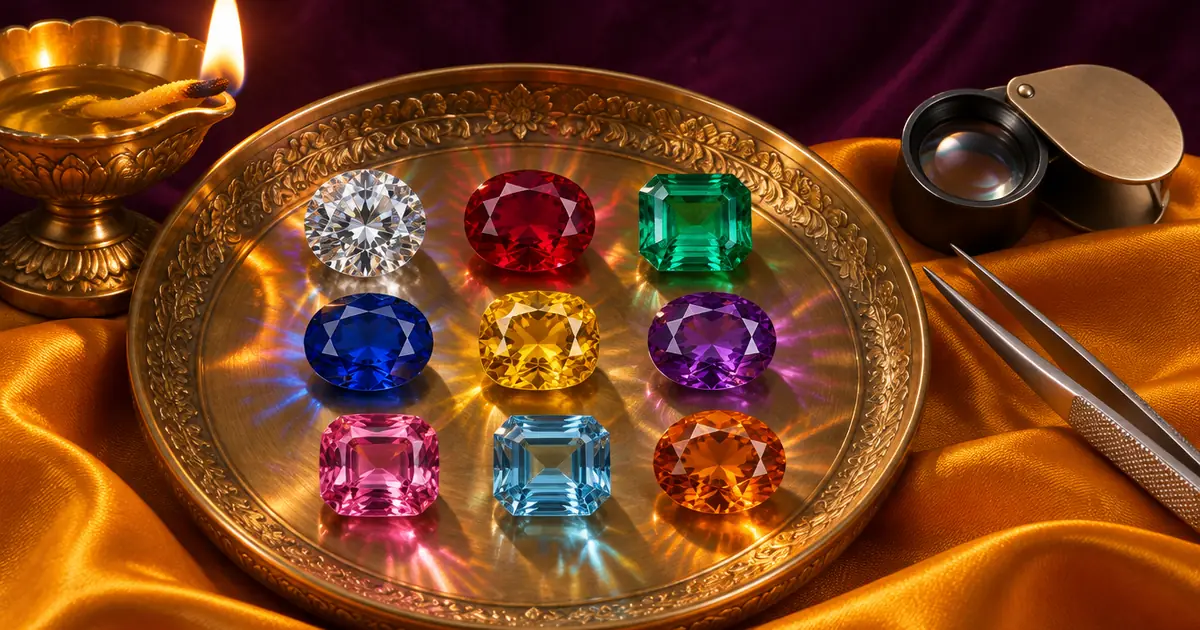
The jewelry counters along Devon Avenue and in the suburbs sell real stones alongside treated and synthetic ones, as jewelers everywhere do. Under the Federal Trade Commission's Guides for the Jewelry Industry, sellers should disclose treatments that significantly affect a stone's value or need special care, and lab-created stones must be described as such. Ask for an independent laboratory report, the weight in carats on the receipt, and the return policy in writing. Be wary when the person recommending the stone also sells it, and compare more than one shop. If you are buying gold at the same time for a festival, our piece on Akshaya Tritiya and gold on Devon Avenue covers that custom.
Getting a second look without pressure
If someone has already recommended a stone, a gemstone and remedy consultation can check the reasoning against your chart and give the cheaper options equal time. Astrologer and Psychic Vijayram works by phone, WhatsApp or video across Chicagoland, and nothing is sold during the session. The short answer on whether to wear a gemstone an astrologer suggests sums up the same approach.
One limit stands over all of this: no gemstone can change a medical result, rescue a business or make another person act differently. At most it is a reminder you wear, and a reminder is worth only what you do while wearing it.
Common questions
Can I wear yellow sapphire just because Jupiter is a good planet?
Tradition does not work that way. Jupiter is a natural benefic, but for some rising signs it rules awkward houses, and then strengthening it is not advised. The decision rests on your own chart, not on the planet's general reputation.
Is it bad luck to take off a gemstone once I have started wearing it?
No. If a stone leaves you uneasy, or the reason for wearing it has passed, you can remove it. Most astrologers would rather you stop than wear something you doubt.
Does a substitute stone work the same way as the main gem?
Tradition calls substitutes uparatna and treats them as milder versions of the main gem. Whether any stone does anything is a matter of faith. What is certain is that a substitute costs far less, so it suits a cautious trial.
Should children wear astrological gemstones?
Many astrologers avoid strong stones for young children, whose charts are still being understood. There is also a plain safety issue: small stones and loose settings are a choking risk for toddlers.
Related service
Keep reading
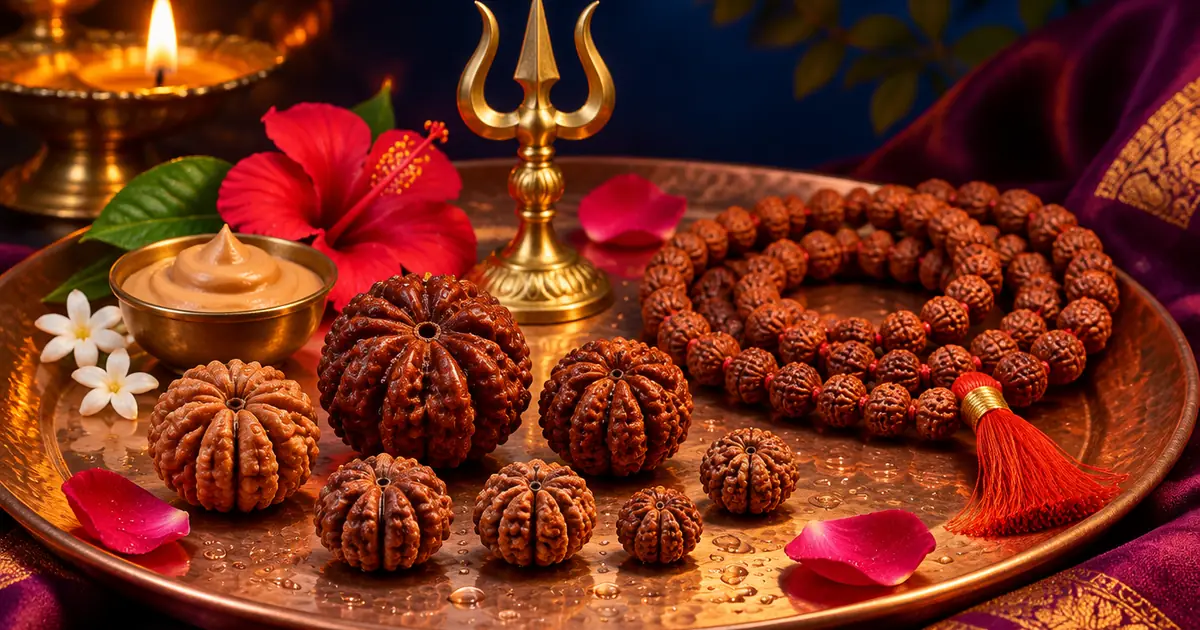
Rudraksha Basics: Faces, Use and Care
Rudraksha benefits explained as devotion, not medicine: what the faces mean, which bead people choose, how to spot fakes and how to care for a mala.
Read article →
Remedies Without a Price Tag: Seva, Fasting and Charity in Chicago
Simple Vedic remedies that ask for time, not money: charity, mantra, fasting and seva, with real ways to serve at Chicago temples, gurdwaras and food pantries.
Read article →
Rahu Kalam and Daily Timing: How Much Should You Worry?
Rahu Kalam explained: how the daily window is worked out from local sunrise, why India-based apps get Chicago wrong, and a sensible way to use it.
Read article →Quick answers
Should I wear a gemstone an astrologer suggests?
Should you wear an astrology gemstone an astrologer suggests? It is a traditional remedy, not a cure: questions to ask first, and when to wait or decline.
Read answer →Can a Western birth chart printout be turned into a kundli?
What is a kundli, and can a Western birth chart printout become one? Yes, from the same birth data. Here is what the sidereal shift and Indian layout change.
Read answer →Talk to Astrologer and Psychic Vijayram
Tell us what you are facing. If a reading is unlikely to help, you will be told that plainly.