
Square or Diamond? Converting a South Indian Chart to the North Indian Layout
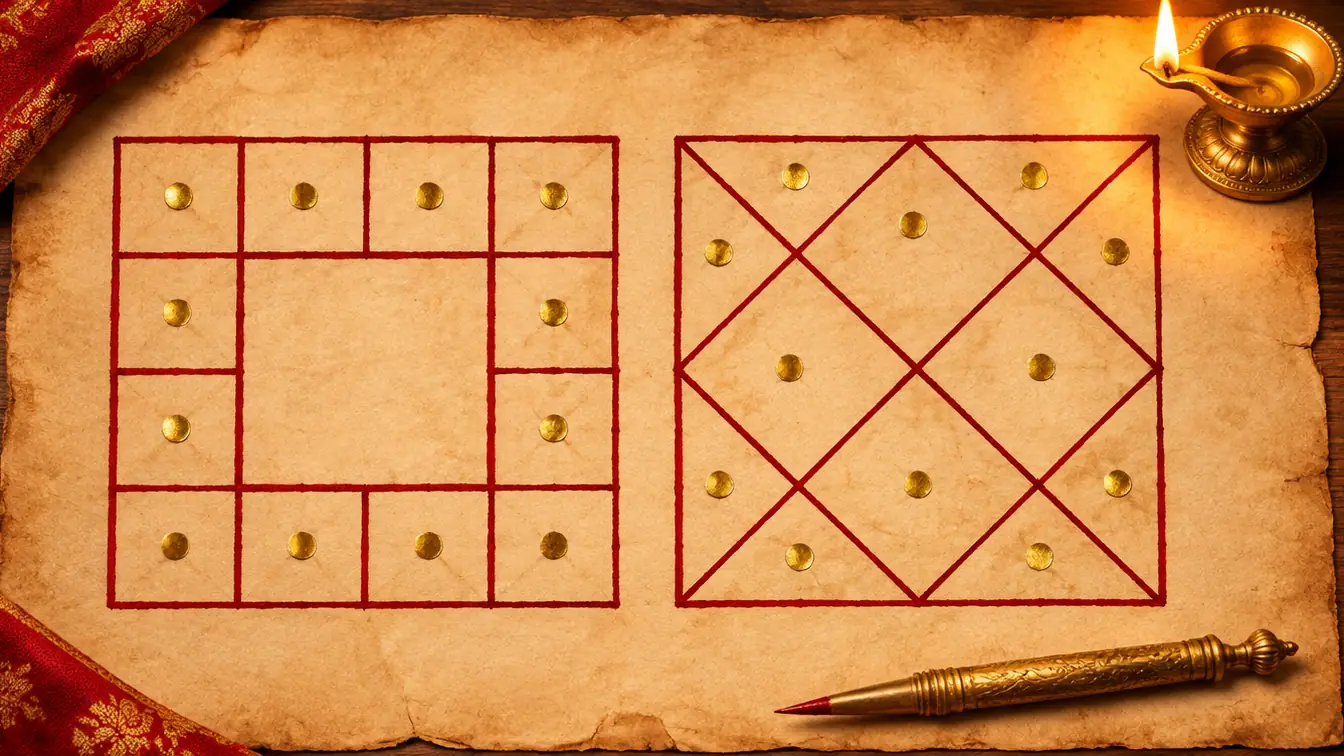
A South Indian chart fixes the signs in a square grid, with Pisces in the top left box and the others running clockwise, and marks the ascendant with a slash or 'Asc'. A North Indian chart fixes the houses instead. To convert, write the ascendant's sign number in the top diamond, count on counterclockwise, then place each planet by sign.
Key takeaways
- The South Indian chart is a four-by-four grid with the middle four boxes left empty (sometimes used for a name or the word Rasi).
- In the North Indian chart the opposite is fixed.
- Say the diagonal line sits in the box on the right side, third row down.
- To turn a diamond into a square, read the number in the top diamond, draw the slash in that sign's box on the grid, then copy each planet into the box of the sign it occupies.
- Comparisons are much easier when both charts are in one format.
A couple in the western suburbs sits down to compare horoscopes before an engagement. One family's chart, made in Chennai, is a neat square of boxes with no numbers. The other's, from Lucknow, is a diamond full of numbers. Both sides are sure the other chart is confusing. Neither is wrong; they are the same information drawn two ways, and turning one into the other takes a pencil and a few minutes.
How the South Indian square works
The South Indian chart is a four-by-four grid with the middle four boxes left empty (sometimes used for a name or the word Rasi). The twelve outer boxes each hold one sign, and the signs never move. Pisces is always top left, and the order runs clockwise:
| Pisces | Aries | Taurus | Gemini |
| Aquarius | Cancer | ||
| Capricorn | Leo | ||
| Sagittarius | Scorpio | Libra | Virgo |
Because the signs are fixed, the chart does not need numbers. What changes is where the planets are written and which box carries the ascendant mark, usually a diagonal line across one corner, or the letters Asc, La or Lagna. The general layouts are described in the overview of kundali chart styles.
How the North Indian diamond differs
In the North Indian chart the opposite is fixed. The top diamond is always the 1st house, and the houses run counterclockwise from there. The signs move, so each section carries a number from 1 (Aries) to 12 (Pisces). If you have never read one, start with the guide on reading a North Indian chart in ten minutes.
The short version: South fixes signs, North fixes houses.
Converting a South Indian chart, step by step
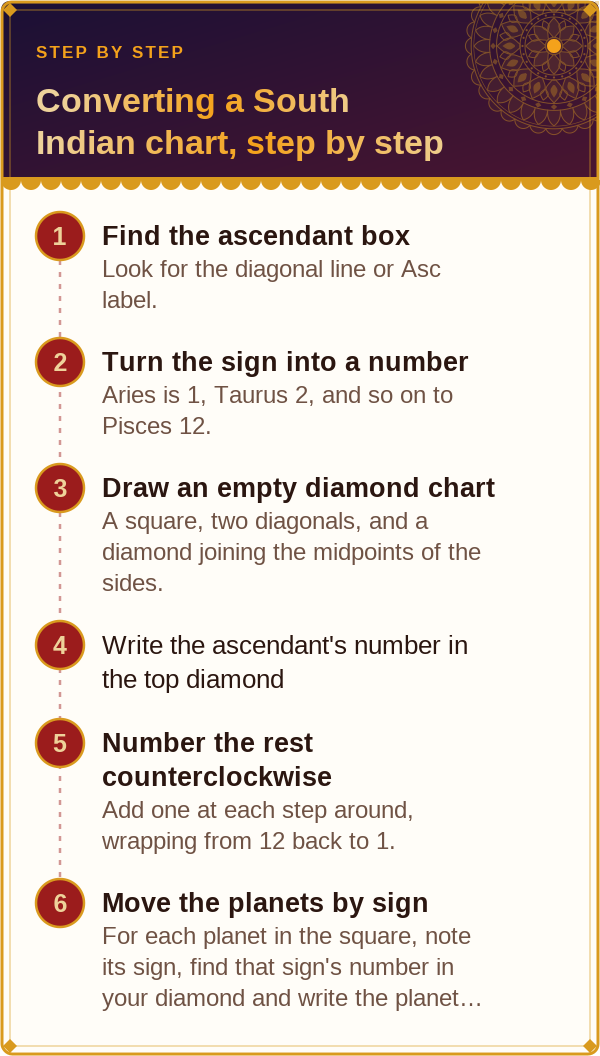
- Find the ascendant box. Look for the diagonal line or Asc label. Name the sign of that box from the grid above.
- Turn the sign into a number. Aries is 1, Taurus 2, and so on to Pisces 12.
- Draw an empty diamond chart. A square, two diagonals, and a diamond joining the midpoints of the sides.
- Write the ascendant's number in the top diamond.
- Number the rest counterclockwise. Add one at each step around, wrapping from 12 back to 1.
- Move the planets by sign. For each planet in the square, note its sign, find that sign's number in your diamond and write the planet there.
- Count to nine. Sun, Moon, Mars, Mercury, Jupiter, Venus, Saturn, Rahu and Ketu should all appear once. Rahu and Ketu should be in opposite sections, seven houses apart.
A worked example
Say the diagonal line sits in the box on the right side, third row down. That box is Leo, sign 5. Write 5 in the top diamond. Moving counterclockwise, the 2nd house gets 6, the 3rd gets 7, the 4th (left diamond) gets 8, and so on until the 12th house gets 4.
Now the planets. The Moon is in the Taurus box, top row: Taurus is 2, which sits in the 10th house of the new diamond. Saturn is in the Aquarius box, left side: Aquarius is 11, the 7th house. Mars is in the Scorpio box, bottom row: Scorpio is 8, the 4th house.
A quick formula for checking: house = (planet's sign number minus ascendant's sign number, plus 12 if the result is negative) plus 1. For the Moon, 2 minus 5 is minus 3, plus 12 is 9, plus 1 is 10. It matches.
Going the other way
To turn a diamond into a square, read the number in the top diamond, draw the slash in that sign's box on the grid, then copy each planet into the box of the sign it occupies. It is the same logic in reverse.
Little differences that trip people up
- Labels in regional scripts. Tamil, Telugu, Kannada and Malayalam charts may abbreviate planet names in their own script. A relative who reads it can call out the names while you redraw.
- Degrees in the boxes. Some South Indian printouts list degrees beside each planet. Copy them across; they matter later when strength is judged.
- A second grid. The square marked Navamsa or Amsa is a divisional chart, not a second birth chart.
- A third regional style. Charts from Bengal and Odisha use their own arrangement. The principle is the same: find the ascendant, then place every planet by sign.
- Different software settings. If two charts disagree after conversion, compare the birth time, time zone and ayanamsa before anything else.
Why it matters for families
Comparisons are much easier when both charts are in one format. That is especially true for kundli matching before an engagement, where elders on both sides want to see the charts the way they learned them. It also helps NRI families holding charts from different parts of India; the post on reading charts across two countries covers the time zone side of that. And once the drawing is settled, the next step is understanding what the rising sign does, covered in the lagna lord and its placement.
Where the drawing stops
Converting a chart is bookkeeping. It shows the same sky in a familiar shape, but it does not interpret anything, and a tidy diagram cannot predict a marriage or a career. In a birth chart reading, Astrologer and Psychic Vijayram can show your chart in either style on video and explain it in the one your family knows best.
Common questions
Will my planets change houses when the chart is redrawn?
No. Conversion only changes the drawing. Each planet stays in the same sign and the same house counted from the ascendant. If a planet seems to move, a counting step has slipped.
Can I convert the navamsa grid the same way?
Yes. South Indian printouts often show a second square labeled Navamsa or Amsa. Find its own ascendant mark and repeat the same steps to draw a navamsa diamond.
Why does my South Indian chart have no numbers in the boxes?
Because the signs never move in that style, so numbers are not needed. Each box always holds the same sign; only the planets and the ascendant mark change from one chart to the next.
Which format will the reading use?
Whichever you are used to. Many families like seeing both, especially when two sides of a match grew up with different styles.
Related service
Keep reading

Moon Sign or Sun Sign: Which One Does Vedic Astrology Use?
Moon sign in Vedic astrology: why your rashi is the Moon's sign, how it differs from a newspaper Sun sign, and how to find your own from a birth date and time.
Read article →
The 27 Nakshatras Grouped by Ruling Planet
The 27 nakshatras in nine groups of three, from Ketu's Ashwini, Magha and Mula onward, with their sign spans and how each ruler sets the dasha sequence.
Read article →
Your Lagna Lord: Where It Sits and What That Changes
What lagna means in Vedic astrology: how the rising sign fixes the twelve houses, and how the house your lagna lord sits in colors the whole chart.
Read article →Quick answers
Can a Western birth chart printout be turned into a kundli?
What is a kundli, and can a Western birth chart printout become one? Yes, from the same birth data. Here is what the sidereal shift and Indian layout change.
Read answer →How exact does my birth place need to be: city, hospital or village?
The birth chart reading details needed: date, clock time and town. Why the nearest city is usually close enough, and when a more exact birthplace helps.
Read answer →Talk to Astrologer and Psychic Vijayram
Tell us what you are facing. If a reading is unlikely to help, you will be told that plainly.