
Born in India, Raised in Chicago: Reading a Chart Across Two Countries
For NRI families in Chicago, a Vedic chart is always drawn for the place and local clock time of birth, not for where you live now. A parent born in India needs Indian Standard Time; a child born in Chicago needs Central Time, with daylight saving checked. Getting both conversions right comes before any interpretation.
Key takeaways
- A birth chart belongs to the birthplace.
- India uses a single time zone, five and a half hours ahead of universal time.
- A Chicago birth is recorded in Central Time.
- People raised in Chicago by parents from India tend to bring a recognizable set of questions.
- Families from different parts of India may hold charts in different styles.
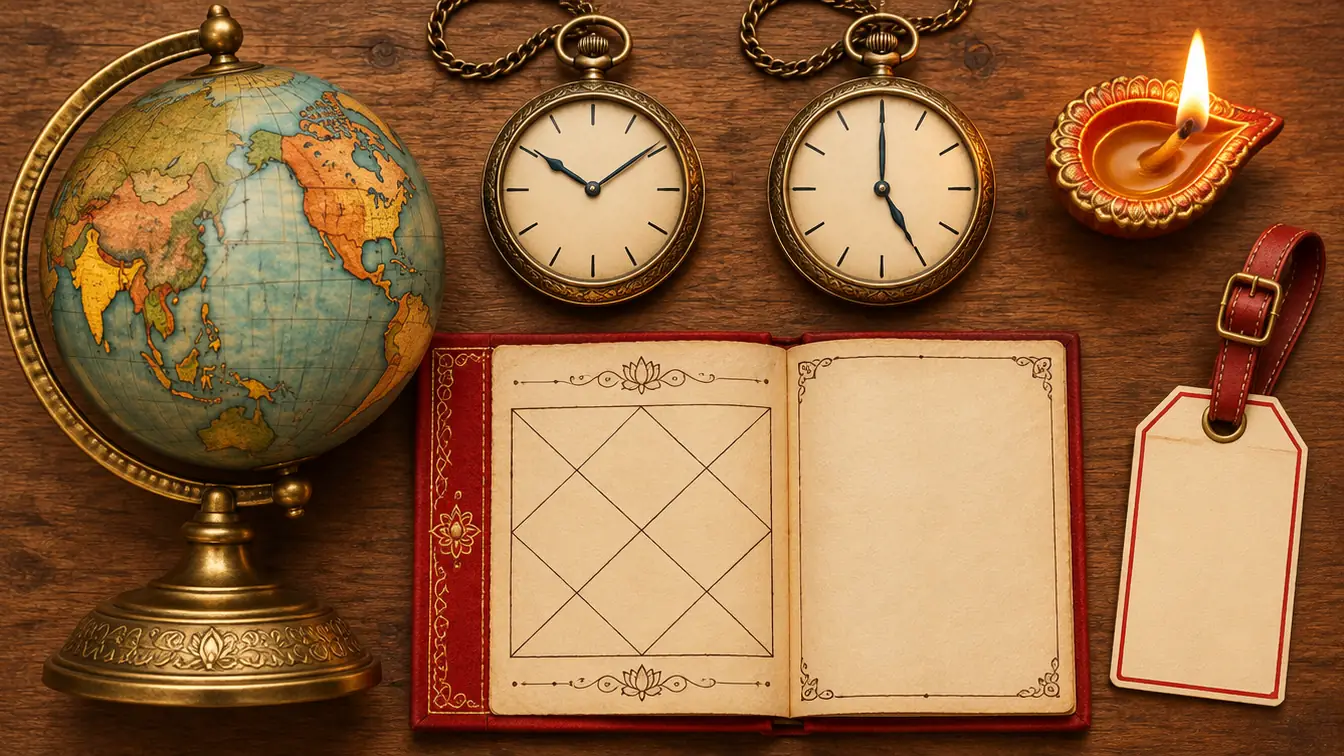
Many Chicago families keep two very different horoscopes in the same drawer. One is a parent's janam patri, handwritten in India decades ago, folded so often the creases have gone soft. The other is a crisp app printout for a child born at a Chicago hospital. They look nothing alike, and people often assume one of them must be wrong. Usually both are fine. They simply need translating into the same language before anyone compares them.
This is a common situation here. The Chicago area has one of the largest Indian American populations in the country, second only to the New York metro according to the overview of Indians in Chicago, and many of those households hold charts from both sides of the world.
The rule that settles most confusion
A birth chart belongs to the birthplace. It is calculated from the local clock time where you were born, converted to universal time, and set against the sky as seen from that spot. The city you live in today has no say in it. A woman born in Ahmedabad who has lived in Schaumburg for thirty years still has an Ahmedabad chart. Her son born at a hospital on the North Side has a Chicago chart. Neither one moves.
Most errors in NRI charts come from mixing these up: entering a Chicago birth with an Indian time zone, or an Indian birth with the time zone of the phone doing the calculating.
Charts drawn in India: what to check
India uses a single time zone, five and a half hours ahead of universal time. The history of Indian Standard Time shows that this was not always so simple. Before the late 1940s and early 1950s, cities such as Bombay and Calcutta kept their own local times, and brief wartime clock changes were used in a few years. For most births since the 1950s, IST with no daylight saving is correct. For older births in a big city, or anything during the war years, it is worth checking which clock the family was using.
Reading ghatis and palas
Many traditional patris do not give the birth time in hours at all. They give the ishta kaal: the time elapsed since local sunrise, counted in ghatis and palas. One ghati is 24 minutes and one pala is 24 seconds, so sixty ghatis make a full day.
A worked example: a patri reads 12 ghatis 30 palas. Twelve ghatis are 288 minutes, or 4 hours 48 minutes; thirty palas add another 12 minutes, for exactly 5 hours. If sunrise in that town on that date was 6:10 a.m., the birth time was 11:10 a.m. local time. The sunrise must be for the birth town and date, not a general figure for India, which is why this conversion is done carefully before a reading rather than guessed.
Charts for children born in Chicago
A Chicago birth is recorded in Central Time. From spring to autumn that means daylight time, five hours behind universal time; in winter it is standard time, six hours behind. The rules for when the clocks change have shifted over the decades, as the record of daylight saving time in the United States shows, so the date of birth decides which offset applies.
The classic mistake happens when a grandparent in India has a chart made locally. The astrologer there may enter the time as if it were IST. Since Chicago is ten and a half hours behind India during daylight time and eleven and a half in winter, the error can shift the ascendant, the Moon's nakshatra and even the date. If a child's Indian-made chart and an American app disagree completely, check this first. The post on old Chicago birth times and daylight saving covers births from before the rules settled.
What second-generation clients actually ask
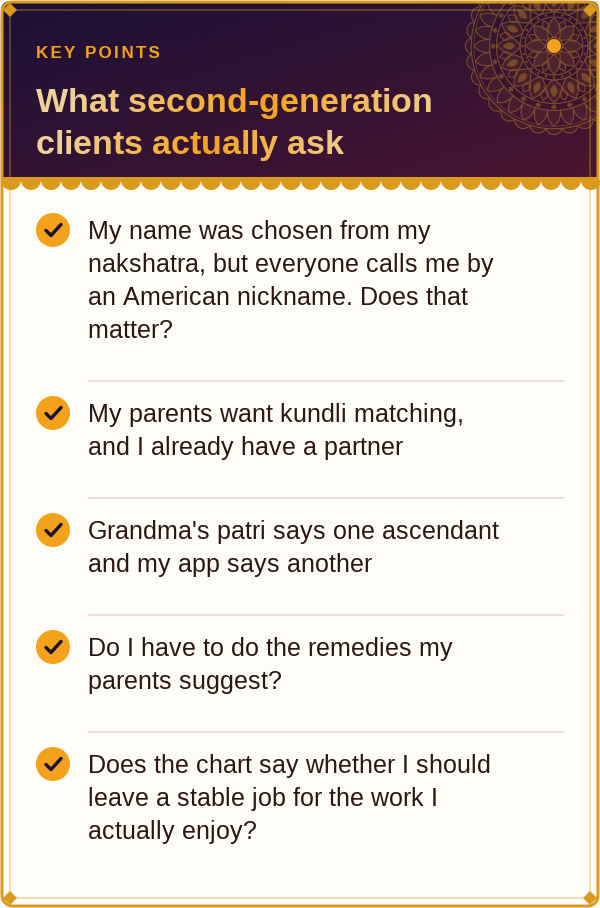
People raised in Chicago by parents from India tend to bring a recognizable set of questions. A few that come up often:
- My name was chosen from my nakshatra, but everyone calls me by an American nickname. Does that matter? Tradition attaches the syllable to the formal name; daily nicknames are not read as changing the chart. The piece on nakshatra syllables and school roll calls looks at how families balance the two.
- My parents want kundli matching, and I already have a partner. Matching can be read as information for the family conversation rather than a verdict. The kundli matching session is set up that way.
- Grandma's patri says one ascendant and my app says another. Usually a time zone slip, a different ayanamsa, or a time written in ghatis that was converted wrongly.
- Do I have to do the remedies my parents suggest? No. Any prayer or practice is optional, and it should be explained before anyone commits to it.
- Does the chart say whether I should leave a stable job for the work I actually enjoy? It can describe tendencies and timing. The decision stays yours.
Lining up two family charts
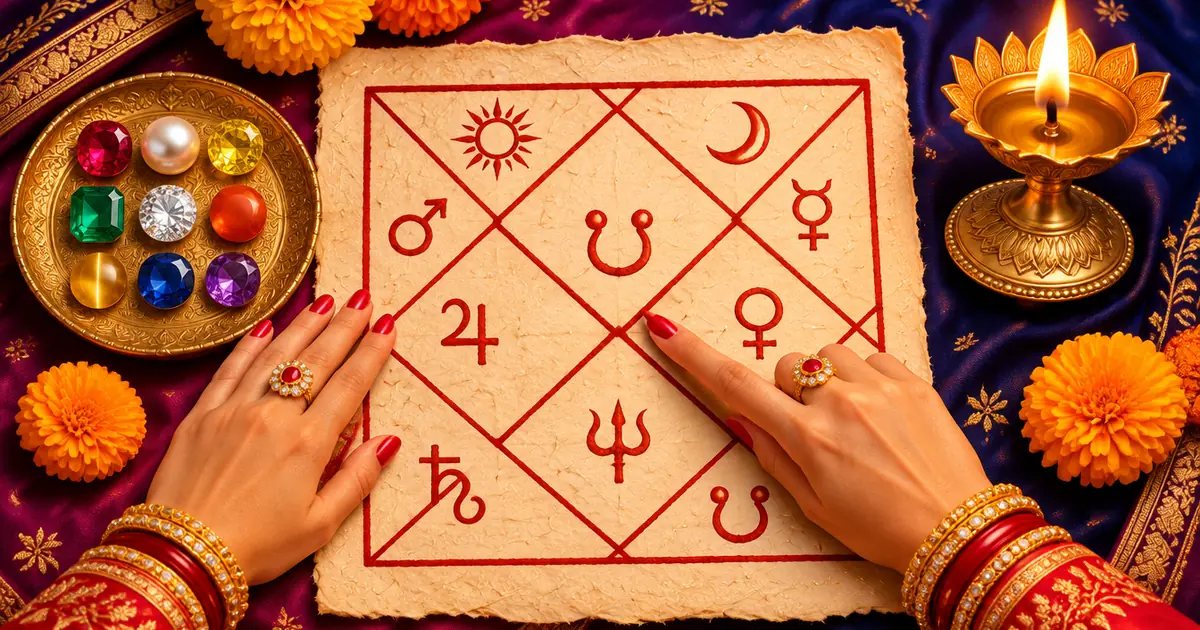
Families from different parts of India may hold charts in different styles. A Tamil or Telugu family often has the square South Indian grid; a Punjabi or Gujarati family is more likely to have the North Indian diamond. They show the same sky in different arrangements, and the post on converting a South Indian chart to the North Indian layout walks through redrawing one as the other. Older patris may also date the birth in the Vikram Samvat or Shaka calendar, which needs converting to the Gregorian date before anything else is checked.
Before you book
- Photograph every page of any handwritten patri, including the back.
- Note the town of birth, not just the state or district.
- For Chicago births, find the hospital record or the time noted on the day.
- Write down which family member remembers what, if accounts differ.
With those in hand, a Vedic birth chart reading with Astrologer and Psychic Vijayram can start from verified data. Sessions are held by phone, WhatsApp or video, arranged in advance in Central Time, which also makes it easy for a parent in India or another state to join the call.
What a chart cannot settle
A chart will not decide how much of each culture you keep, and it is no substitute for an honest conversation with your parents. It offers traditional interpretation and a structured way to reflect. The choices about family, marriage and work remain with the people living them.
Common questions
Do I need a new chart now that I live in Chicago?
No. Your birth chart is fixed to the moment and place you were born, and moving does not redraw it. Where you live does matter for local timing, such as sunrise-based muhurta windows, and some people also look at a relocation chart for a move to or from Chicago as a separate question.
My grandparents' horoscope is handwritten in Gujarati. Can it still be used?
Usually, yes. What matters is the date, the time (often written in ghatis after sunrise) and the town. If the script is hard to read, a relative can photograph the key lines and read the numbers aloud during the session.
Is NRI astrology a different system?
No. It is the same Vedic method. What differs is the paperwork: two time zones, older Indian time conventions, and charts drawn in more than one regional style that need to be lined up before comparing.
My Indian birth certificate has no time on it. What now?
Ask older relatives, check any family patri, and look for hospital papers. If nothing turns up, the post on rectifying a birth time from life events explains how a working time can be estimated, and what that method cannot prove.
Related service
Keep reading

Visa Waits and Green Card Questions: What Astrology Can and Cannot Say
Astrology for visa worries in Chicago: what the 12th, 9th and 4th houses are read for, why no chart predicts a USCIS decision, and where legal help starts.
Read article →
Tarpan in a Chicago Apartment: A Simple Pitru Paksha Practice
Pitru Paksha in the USA, kept simply: a short home tarpan for a Chicago apartment with water, sesame and names, dates by local tithi, and when to ask a priest.
Read article →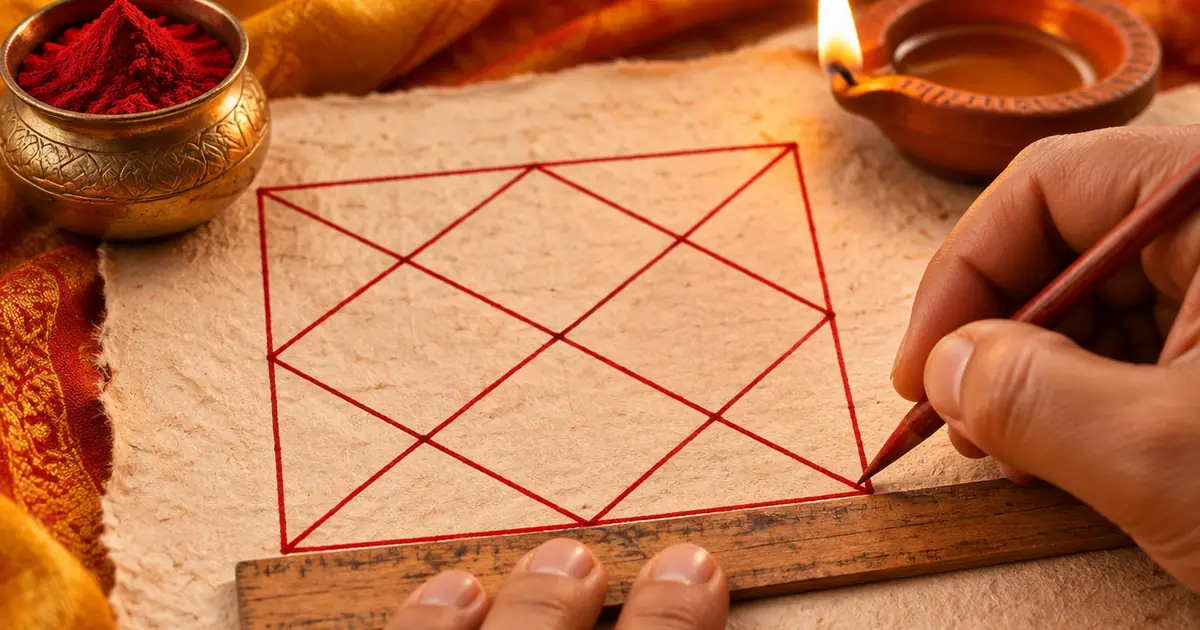
How to Read a North Indian Chart in Ten Minutes
How to read a North Indian chart: the diamond layout, why the houses stay put while sign numbers move, and where to find your ascendant and Moon in minutes.
Read article →Quick answers
Can a Western birth chart printout be turned into a kundli?
What is a kundli, and can a Western birth chart printout become one? Yes, from the same birth data. Here is what the sidereal shift and Indian layout change.
Read answer →How exact does my birth place need to be: city, hospital or village?
The birth chart reading details needed: date, clock time and town. Why the nearest city is usually close enough, and when a more exact birthplace helps.
Read answer →Talk to Astrologer and Psychic Vijayram
Tell us what you are facing. If a reading is unlikely to help, you will be told that plainly.