

A Daily Card for Reflection, Not Prediction: Five Ways to Read It
A daily tarot card is most useful as a two-minute reflection rather than a prediction. Draw one card in the morning and use a single prompt: what the figure is doing, one word to carry, its opposite, the question it asks you, or where you see it by evening. Write a line in a journal, then let the day be.
Key takeaways
- The second gives you a theme to carry, and the day stays open.
- Ignore the guidebook for a moment and describe the picture as if to a child.
- Whichever method you use in the morning, take a minute before bed:
- Once a week, on a Sunday evening perhaps, lay the seven cards from the week in a row.
- A daily card is one of the best ways to learn tarot.
The daily card is the smallest tarot habit there is: one card, drawn before the day begins. It is also easy to misuse. If you draw the Five of Pentacles and spend the day waiting for financial disaster, the card has done you no favors. Used as a short reflection, though, a daily card is a gentle way to start the morning with a question instead of a scroll through the news.
Here are five ways to read it, plus an evening check-in and a weekly habit that keep the practice grounded.
Reflection, not prediction
The shift is simple. A predictive daily card asks, "What will happen today?" A reflective one asks, "What is worth paying attention to today?" The first sets you up to notice anything that matches and ignore everything that does not. The second gives you a theme to carry, and the day stays open.
Writing is what makes it stick. The University of Rochester Medical Center's note on journaling for emotional wellness describes how writing thoughts down helps people understand them more clearly, notice what is causing stress and practice more positive self-talk. A line or two under each day's card is enough.
Five ways to read your morning card
1. What is the figure doing?
Ignore the guidebook for a moment and describe the picture as if to a child. The Eight of Pentacles: someone carefully carving coins. The Four of Swords: someone resting. Then ask: could I do some of that today? This prompt turns any card into a small, practical action.
2. One word to carry
Pick a single word from the image and take it with you: "steady" for the Chariot, "pause" for the Hanged Man, "begin" for any Ace. Write it on a sticky note or the corner of your planner. On a long commute, on the Blue Line or a Metra train, it gives your mind somewhere to rest besides worry.
3. The opposite
Ask what the opposite of the card would look like in your day, and whether you want that. The Six of Cups is nostalgia and kindness; its opposite might be rushing past people without a word. Sometimes the opposite shows you what the card is really inviting.
4. The question the card asks you
Imagine the card could ask you one question. The Fool, stepping toward a cliff edge with a small dog at his heels, might ask: "What would you try if you were not afraid of looking silly?" The Victoria and Albert Museum's print of the Fool from the Rider-Waite-Smith deck is a good one to try this with: the sun is shining, the bag is packed and the step has not yet been taken. Write the question, and answer it in one sentence.
5. Where did I see it?
Draw the card in the morning but do not interpret it at all. In the evening, look at it again and ask where it showed up in your day. A conversation that felt like the Two of Cups, a moment of overwhelm that matched the Ten of Wands. This is the most reflective method of the five, and the hardest to turn into a forecast.
The one-minute evening check-in
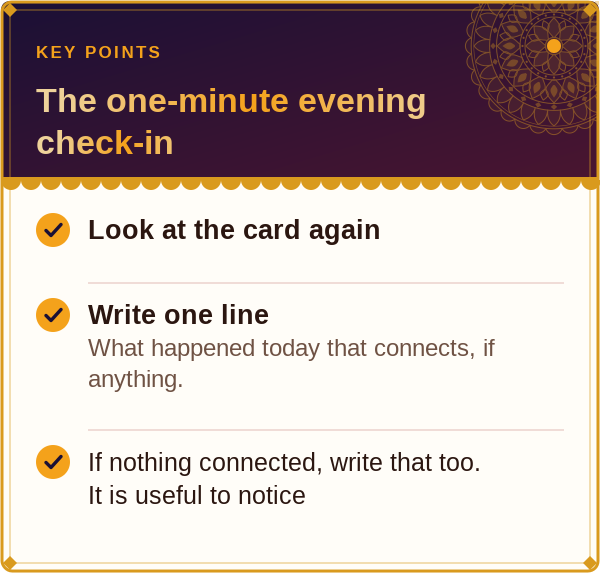
Whichever method you use in the morning, take a minute before bed:
- Look at the card again.
- Write one line: what happened today that connects, if anything.
- If nothing connected, write that too. It is useful to notice.
Over time, the "nothing connected" days are a healthy reminder that cards describe themes, not events.
A weekly review
Once a week, on a Sunday evening perhaps, lay the seven cards from the week in a row. Look for repeated suits or numbers. A week heavy in Swords may have been a week in your head; a week of Cups, a week of feelings. If a single card keeps returning, ask what it might be pointing to. If you enjoy this, the post on five ways to lay out a three-card spread gives short layouts for a weekly reflection, and in the long indoor months the spreads for a Chicago blizzard weekend offer a little more depth.
Making the deck your own
A daily card is one of the best ways to learn tarot. After a few months, you will know most cards by sight and have your own associations for each. Some people enrich this by reading the twelve zodiac trumps through their rashi, as described in the Major Arcana read through your Vedic Moon sign. Others pair the daily card with a short mantra or breathing practice, which the personal mantra and meditation guidance can help you set up.
When to stop
If the daily card starts to feel like a test you might fail, or if you find yourself drawing a second and third card to "fix" a bad one, take a break. The post on when anxiety means it is time to pause the cards explains the signs. A habit meant to steady you should never become another source of worry.
When a daily card is not enough
A single card is good for noticing, not for deciding. For a real question, such as a relationship, a job or a move, a full tarot card reading lays a proper spread and gives you time to talk. Astrologer and Psychic Vijayram reads by phone, WhatsApp or video in Central Time. The limit stays the same for one card or ten: tarot is faith-based guidance for reflection, and it cannot tell you what your day, or your life, will bring.
Common questions
What if I draw a frightening card in the morning?
Read it as a theme to notice, not an event to brace for. The Tower might prompt you to ask what feels shaky, or simply to be flexible today. If difficult cards leave you anxious for the rest of the day, try drawing in the evening instead, or take a break.
Should I draw again if I do not understand the card?
No. Sit with the picture for a minute and use one of the prompts. Not understanding a card right away is part of learning it, and it often makes sense by evening.
Do I need to know all 78 meanings to do this?
No. The prompts work from the picture itself. Over a few months of daily draws you will learn the deck naturally, which is one of the best reasons to start.
How long should the practice take?
Two to five minutes in the morning and one minute in the evening. If it is taking much longer, the practice is turning into a reading, and it is worth keeping it short.
Related service
Keep reading

Angel Card Readings: Gentle Messages, Honest Limits
What an angel card reading is, how it differs from tarot, how a session runs by phone or video, and why its messages are encouragement, not prediction.
Read article →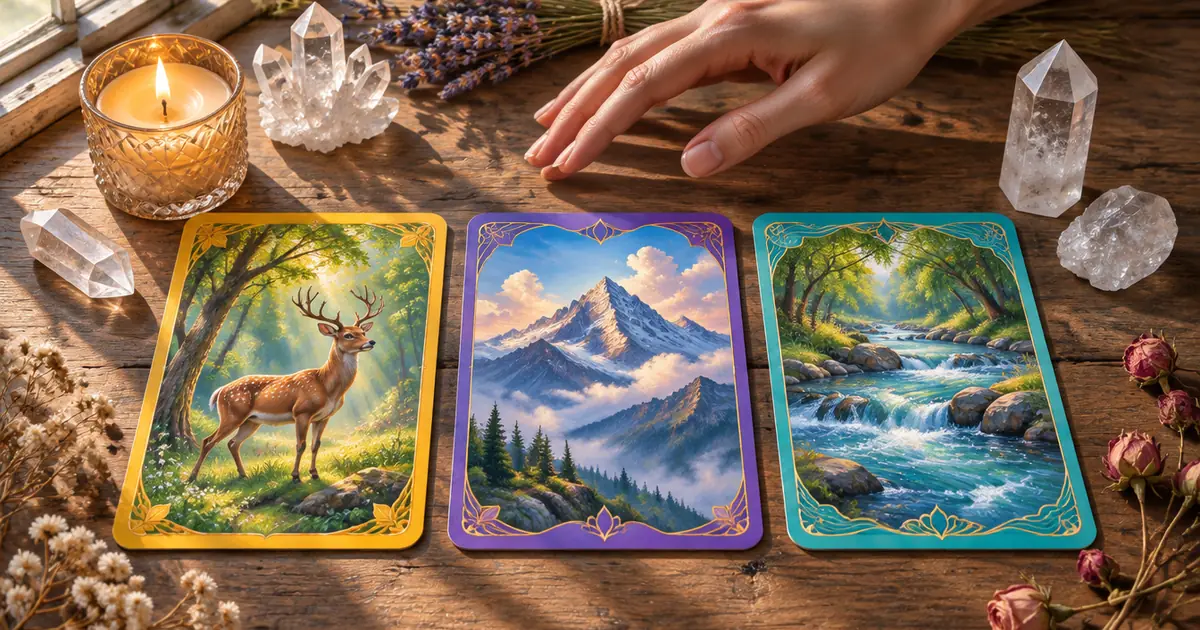
Reading an Oracle Deck Without the Guidebook
How to read oracle cards from image, color and your first response, with a simple three-card practice layout for beginners using any deck.
Read article →
Tarot Questions From Second-Generation Chicagoans: Career, Family and Identity
Tarot for career and family decisions when you grew up between two cultures in Chicago: common questions, a five-card spread, and why no card plays the villain.
Read article →Quick answers
Does it matter who shuffles the tarot deck?
How does a tarot reading work, and does it matter who shuffles the deck? Shuffling customs in person and at a distance, and what matters more than hands.
Read answer →Is a tarot reading a forecast or a mirror?
Can tarot predict the future? Why readers use tarot to reflect on a situation and its likely direction rather than to fix events, and how to use it well.
Read answer →Talk to Astrologer and Psychic Vijayram
Tell us what you are facing. If a reading is unlikely to help, you will be told that plainly.