

Tarot Questions From Second-Generation Chicagoans: Career, Family and Identity
Second-generation Chicagoans often bring tarot questions about career paths their parents did not choose, caring for aging parents, marriage expectations and which traditions to keep. A good reading keeps the focus on your own choices and next steps rather than casting parents as obstacles, and it never decides a family question for you.
Key takeaways
- Chicago has long been a city of immigrants and their children.
- A parent who left a profession behind in Hyderabad or Guadalajara to drive a cab or run a store often hopes the next generation will reclaim that status.
- Lay five cards: two on the left, two on the right, one in the middle below.
- Once a card becomes a person to blame, the reading stops being about your choices and turns into a case file.
- "Will my parents accept my choice?" asks the cards to read other people's minds.
You are thirty, a project manager in the Loop, and your mother still asks, every Sunday, when you are going to apply to medical school. Or you are the eldest daughter in a house in Skokie, and everyone assumes you will be the one who moves home when your father's health slips. Or you just do not know which Diwali traditions you will keep when you have kids of your own. None of these are questions with a right answer. That is exactly why people bring them to tarot.
Why these questions come up so often in Chicago
Chicago has long been a city of immigrants and their children. The South Asian community alone is large: the metro is home to an estimated 255,000 Indian Americans, the second-largest such population of any US metro, according to the overview of Indians in Chicago. Add the city's Mexican, Polish, Filipino, Korean and Arab families and you have hundreds of thousands of people who grew up translating, literally and otherwise, between their parents' expectations and the world outside the front door.
Those young adults are now choosing careers, partners and homes. The questions they bring are rarely "Will I get the job?" They sound more like "How do I take this job without breaking my father's heart?"
Three questions readers hear again and again
"My parents sacrificed everything for a career I do not want"
This is the most common one. A parent who left a profession behind in Hyderabad or Guadalajara to drive a cab or run a store often hopes the next generation will reclaim that status. When a child wants design, teaching or music instead, guilt arrives quickly. A career and job tarot reading can help separate two threads that get tangled: what you actually want, and what you fear your parents will feel. They need different responses.
"Who looks after Mom and Dad?"
Siblings may live in different states. One may be married, another not. Old assumptions about sons, daughters and daughters-in-law meet new realities about jobs and distance. Cards cannot divide the duty fairly, but they can surface what you are willing to give and where you need to ask for help.
"Which parts of the culture are mine?"
Identity questions are quieter but run deep. Food, language, festivals, faith, whether to have a traditional wedding or a courthouse one. The tarot has no culture of its own to impose here, which makes it a useful mirror for sorting what feels inherited and what feels chosen.
A five-card "Two Shores" spread
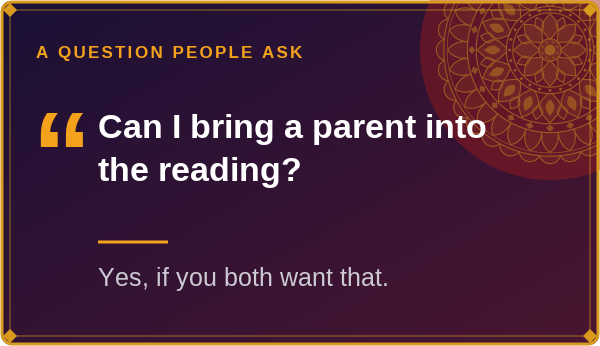
Lay five cards: two on the left, two on the right, one in the middle below.
- Left top: what I carry from home. The values, habits or strengths your family gave you.
- Left bottom: what my parents' hope is protecting. Behind most pressure is a fear: of poverty, of losing you, of losing face. This card asks what that fear is.
- Right top: what I have built here. Skills, relationships and independence you created yourself.
- Right bottom: what my own path asks of me. The cost and the commitment of the choice you are leaning toward.
- Middle: one step that honors both. A conversation, a compromise, a boundary or a small act of respect.
The second card is the one people skip, and it often changes the whole reading. Seeing a parent's demand as protection, rather than control, does not mean giving in. It makes a calmer conversation possible.
The one rule: no card plays the villain
It is tempting to read the Emperor as "my controlling father" or the Five of Swords as "my mother-in-law." Resist it. Once a card becomes a person to blame, the reading stops being about your choices and turns into a case file. A good reader will redirect: "What does the Emperor ask of you here? Structure? Firmness? A plan you can show your parents?"
This matters most for questions about marriage and partners. If your family's approval is the knot, guidance on love marriage and family approval combines the cards or chart with practical ideas for those conversations. If the friction is inside an existing marriage, the marriage and family harmony reading is built for that.
Wording your question so it helps
"Will my parents accept my choice?" asks the cards to read other people's minds. Try instead:
- "What do I need to understand before I talk to my parents about this?"
- "What would make this career change easier for my family to accept?"
- "Where am I holding myself back out of guilt rather than real duty?"
The post on how to phrase a tarot question has more examples. If your questions involve birth-time puzzles or a chart cast in India, the piece on India-born, Chicago-raised readings covers that side.
How a session works
Astrologer and Psychic Vijayram reads tarot by phone, WhatsApp or video, so you can book from an apartment in Rogers Park or a car parked outside the office. Many second-generation clients prefer a call precisely because it is private: no one at home needs to know. Sessions are arranged in advance in Central Time. You can find out more about the tarot card reading itself, or book through the contact page.
What a reading cannot do
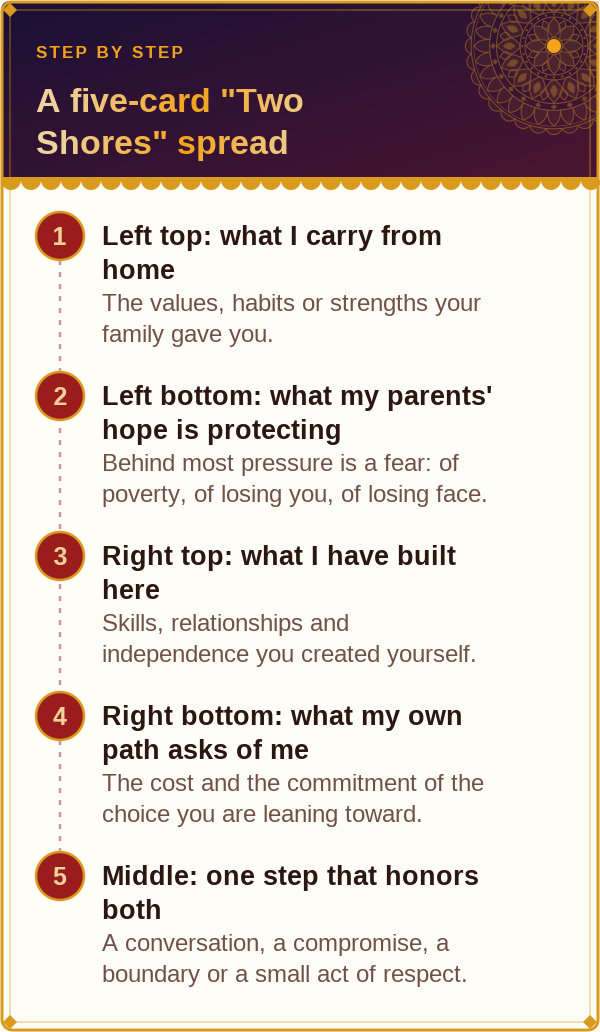
Tarot cannot make a family decision for you, predict how your parents will react, or replace a family counselor when relationships have become painful. If tension at home has turned into threats or fear, put safety first and call the National Domestic Violence Hotline. For everything else, the cards are one more way to think clearly before a hard conversation.
Common questions
Can I bring a parent into the reading?
Yes, if you both want that. Some people find it easier to talk about a hard subject with the cards as a neutral middle ground. Agree beforehand which questions are on the table, and keep the session about choices rather than who is right.
Will the reader tell me whether to follow my parents' wishes?
No. That decision belongs to you, and often to your family together. The reading can help you understand what each option means to you and what a respectful conversation might look like.
I am not Indian. Is this post still for me?
Yes. Chicago has grown up with children of immigrants from Mexico, Poland, Korea, the Philippines, Nigeria and many other places. The questions about duty, ambition and belonging are much the same, and the spread works for anyone.
Is tarot compatible with my family's religion?
Families differ on this, and it is fine to have reservations. Tarot here is used as a tool for reflection rather than worship or prediction. If it conflicts with your faith, a conversation with a counselor or a trusted elder may serve you better.
Related service
Keep reading

A Tarot Spread for Chicago Marathon Week: Focus, Nerves and the Long Run
A five-card tarot spread for focus in Chicago Marathon week, for runners and supporters. Mindset only: training and medical calls stay with experts.
Read article →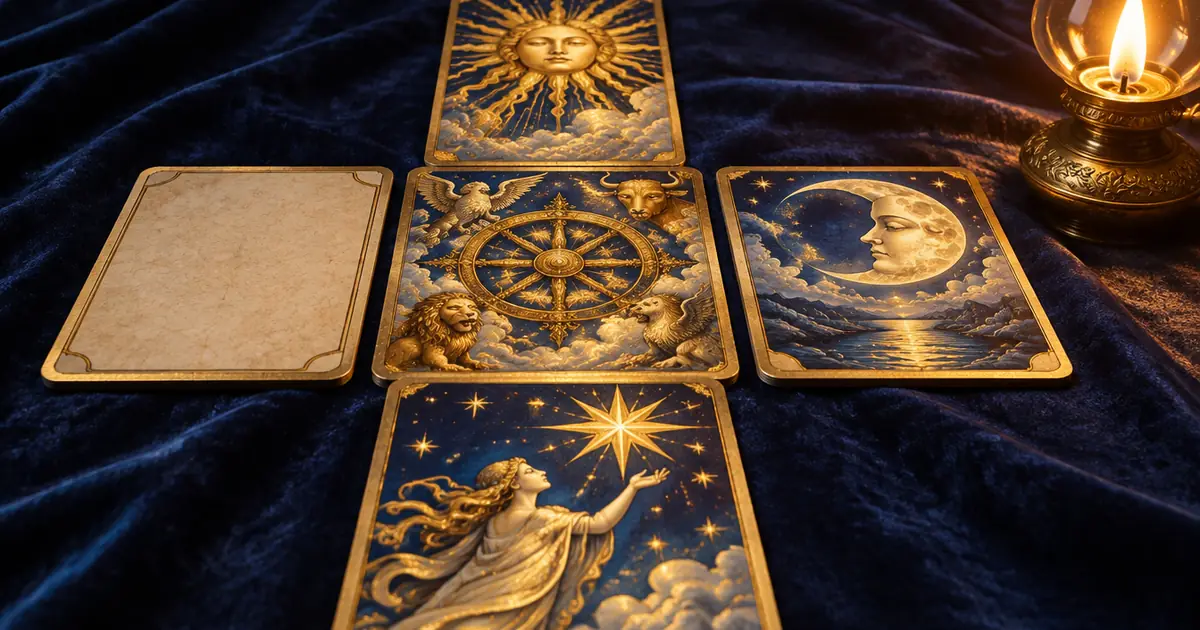
Several Major Arcana in One Spread: What Readers Make of It
Many Major Arcana in a reading usually mark a significant chapter, not a crisis. How readers interpret a trump-heavy spread, with the odds and a calm method.
Read article →
Pentacles and Paychecks: Reading the Money Suit for Career Choices
Pentacles career tarot, Ace to King: what each card suggests for job offers, raises and steady work, read beside a real budget rather than in place of one.
Read article →Quick answers
Does it matter who shuffles the tarot deck?
How does a tarot reading work, and does it matter who shuffles the deck? Shuffling customs in person and at a distance, and what matters more than hands.
Read answer →Is a tarot reading a forecast or a mirror?
Can tarot predict the future? Why readers use tarot to reflect on a situation and its likely direction rather than to fix events, and how to use it well.
Read answer →Talk to Astrologer and Psychic Vijayram
Tell us what you are facing. If a reading is unlikely to help, you will be told that plainly.