

A Tarot Spread for Chicago Marathon Week: Focus, Nerves and the Long Run
A tarot spread for focus in Chicago Marathon week uses five cards: training already banked, where the nerves sit, what to let go of on race morning, where support comes from and a message for the hardest miles. It is a mindset exercise for runners and supporters, never a substitute for a coach's or doctor's advice.
Key takeaways
- Marathon nerves are rarely about the distance.
- Shuffle while thinking about the race, then lay five cards in a row.
- A few patterns come up often in race week spreads:
- Partners, parents and friends have their own nerves, especially for a first marathon.
- Write the five cards and a one-line note for each on a small card.
For one weekend each October, the city rearranges itself around a single route. The Chicago Marathon starts and finishes in Grant Park and loops through neighborhoods on the North, West and South Sides before heading back to the Loop. By race week the training is done. What is left is waiting, carb-loading, checking the forecast for the twentieth time and lying awake doing pace arithmetic. That restless gap is where a short, quiet reflection can help.
This spread is about mindset only. It will not tell you your finishing time, and it has nothing to say about pacing, fueling or injuries. Those belong to your coach, your training plan, the official race information and, if anything hurts, a doctor.
Why a card spread can help in race week
Marathon nerves are rarely about the distance. Runners who have done the long runs know their legs can do it. The worry is usually about something vaguer: letting people down, a bad patch at mile 20, the weather, the crowd at the start corrals. Laying out a few cards turns that fog into five specific things you can look at one at a time. The tarot is good at that: its images give shape to feelings that are hard to name.
The five-card race week spread
Shuffle while thinking about the race, then lay five cards in a row.
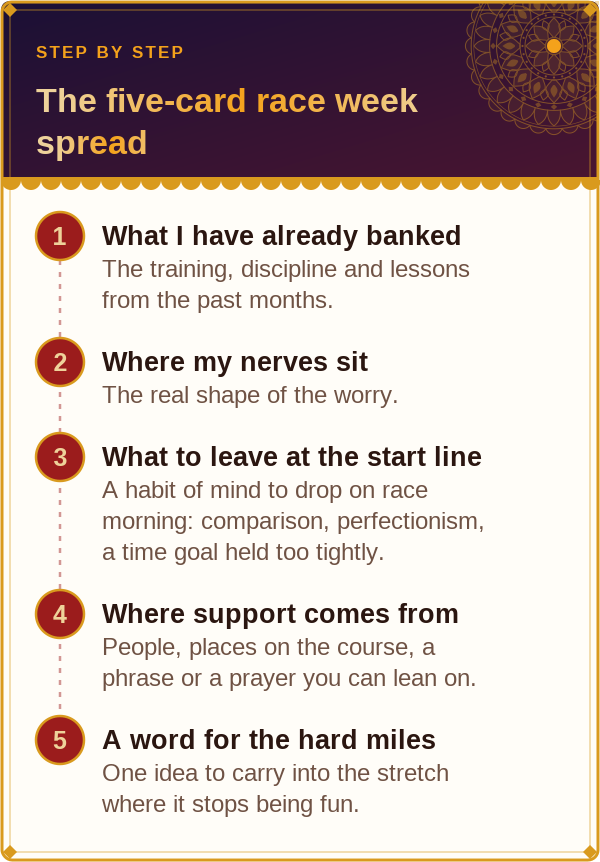
- What I have already banked. The training, discipline and lessons from the past months. This card is a reminder that most of the work is behind you.
- Where my nerves sit. The real shape of the worry. Often it is not the race at all, but someone's expectations or an old memory of failing.
- What to leave at the start line. A habit of mind to drop on race morning: comparison, perfectionism, a time goal held too tightly.
- Where support comes from. People, places on the course, a phrase or a prayer you can lean on.
- A word for the hard miles. One idea to carry into the stretch where it stops being fun. Many runners write a single word from this card on their wrist or bib.
Reading the cards without overreading them
A few patterns come up often in race week spreads:
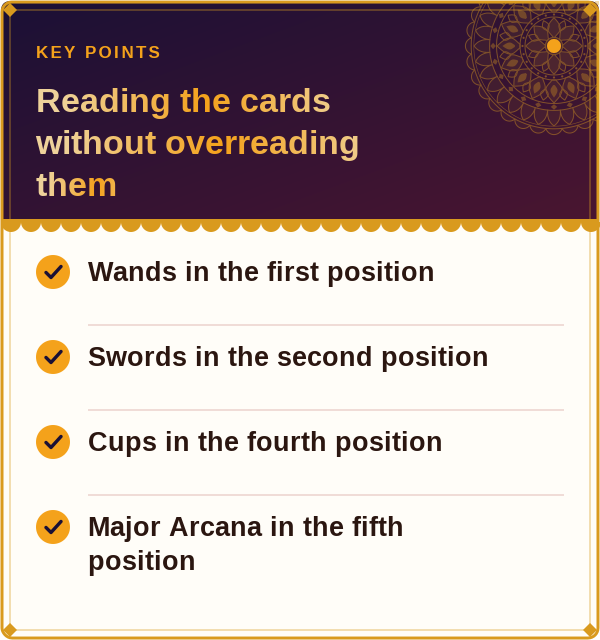
- Wands in the first position usually reflect energy and drive from training. The Eight of Wands, with its staves in flight, is a fitting picture of fitness built up and ready to move.
- Swords in the second position tend to show nerves that live in the head: overthinking, rehearsing disasters. Name them, then notice that they are thoughts, not facts.
- Cups in the fourth position often point to emotional support, such as family on the sidewalk, a running club, a friend who will text at the halfway mark.
- Major Arcana in the fifth position make strong mantras. Strength, the Chariot and the Star each sum up a whole attitude in a single image.
If a card in the fifth position feels flat, pick a word from its picture instead of its meaning. A card showing a figure walking steadily can simply become "steady."
A version for supporters
Partners, parents and friends have their own nerves, especially for a first marathon. They can use the same layout with adjusted positions:
- What my runner has already done.
- What I am worried about on their behalf.
- What I need to let go of: control, the urge to fix, my own plans for the day.
- How I can best support them.
- A word I can shout or text when they pass.
The third card often surprises supporters. It is easy to forget that hovering is not the same as helping.
Turning the spread into a race-morning routine
Write the five cards and a one-line note for each on a small card. On race morning, while you wait in the corral, read it once. Then breathe slowly for a minute: in for four counts, out for six. People who want a steadier practice for nerves before events can try personal mantra and meditation guidance, which pairs a short mantra with breath. If you would rather draw one card each morning in the weeks before a race, the daily one-card practice is a good format.
If the spread leaves you more anxious instead of calmer, stop. That happens, and it is a sign to put the cards away until after the race. The post on tarot and anxiety explains why.
Booking a reading in race week
Some runners prefer someone else to lay the cards so they are not tempted to read the result they want. Astrologer and Psychic Vijayram offers tarot card readings by phone, WhatsApp or video, arranged in advance in Central Time, so a short session can fit around a shakeout run or an evening with your feet up. For a lighter format you can do yourself, the three-card spread also works for a quick pre-race check-in. Questions are welcome through the contact page.
What this spread cannot do
No card can tell you whether you will finish, how fast you will run, or whether your body is ready. Those answers come from training, medical advice and the day itself. If you feel chest pain, dizziness or anything unusual before or during the race, stop and get medical help right away; on the course, find the nearest medical tent or call emergency services. The spread is a way to settle your mind. The running is still up to you.
Common questions
Should I use tarot to decide whether to run with an injury?
No. That is a medical question. Talk to your doctor, a physical therapist or the race medical team. A card cannot assess a tendon or a heart, and no reader should pretend otherwise.
When in race week is the best time to do the spread?
Two or three evenings before the race works well: close enough to feel real, far enough that you are not staying up late the night before. Keep it to fifteen minutes.
Can supporters use the same spread?
Yes, with small changes to the positions, described above. Family members often carry their own nerves, especially for a first marathon, and the spread gives them something calm to do.
What if I draw a card like the Tower or the Ten of Swords?
Read it as a picture of the nerves you already have, not a forecast of a bad race. Hard cards in the second position are common and usually just name the fear so you can set it aside.
Related service

Keep reading
Several Major Arcana in One Spread: What Readers Make of It
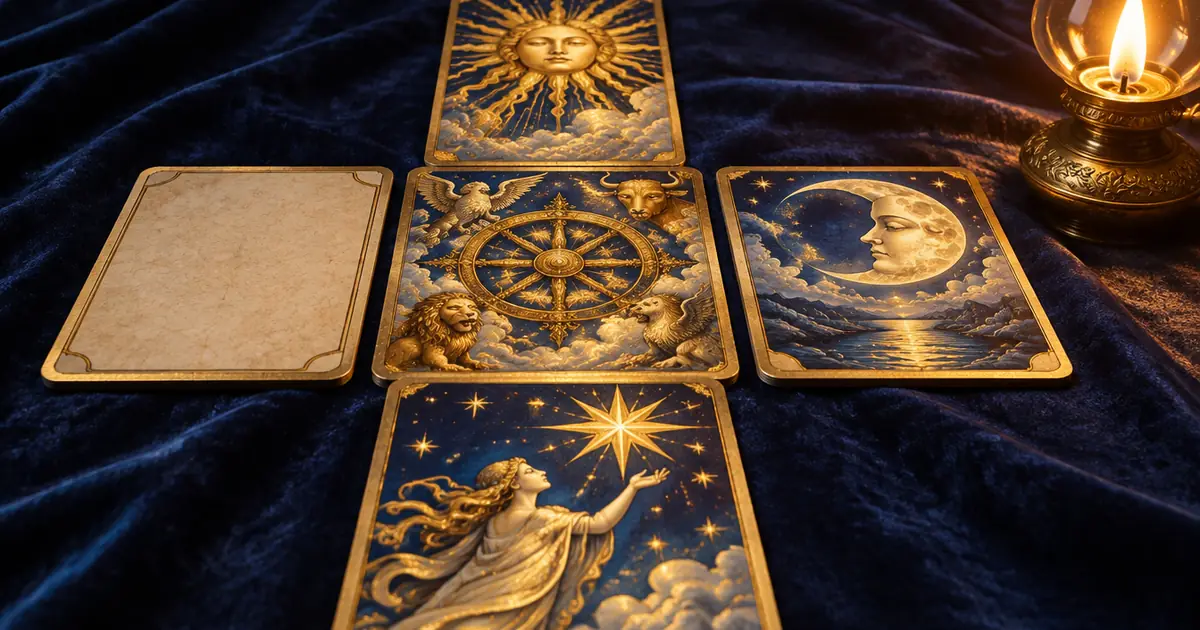
Many Major Arcana in a reading usually mark a significant chapter, not a crisis. How readers interpret a trump-heavy spread, with the odds and a calm method.
Read article →
Pentacles and Paychecks: Reading the Money Suit for Career Choices
Pentacles career tarot, Ace to King: what each card suggests for job offers, raises and steady work, read beside a real budget rather than in place of one.
Read article →
Booking a Tarot Reader in Chicago: Length, Spreads and Price Explained
Booking a tarot reading in Chicago: how long sessions run, which spreads suit which questions, how fees work, recording etiquette, and party versus private.
Read article →Quick answers
Does it matter who shuffles the tarot deck?
How does a tarot reading work, and does it matter who shuffles the deck? Shuffling customs in person and at a distance, and what matters more than hands.
Read answer →Is a tarot reading a forecast or a mirror?
Can tarot predict the future? Why readers use tarot to reflect on a situation and its likely direction rather than to fix events, and how to use it well.
Read answer →Talk to Astrologer and Psychic Vijayram
Tell us what you are facing. If a reading is unlikely to help, you will be told that plainly.