
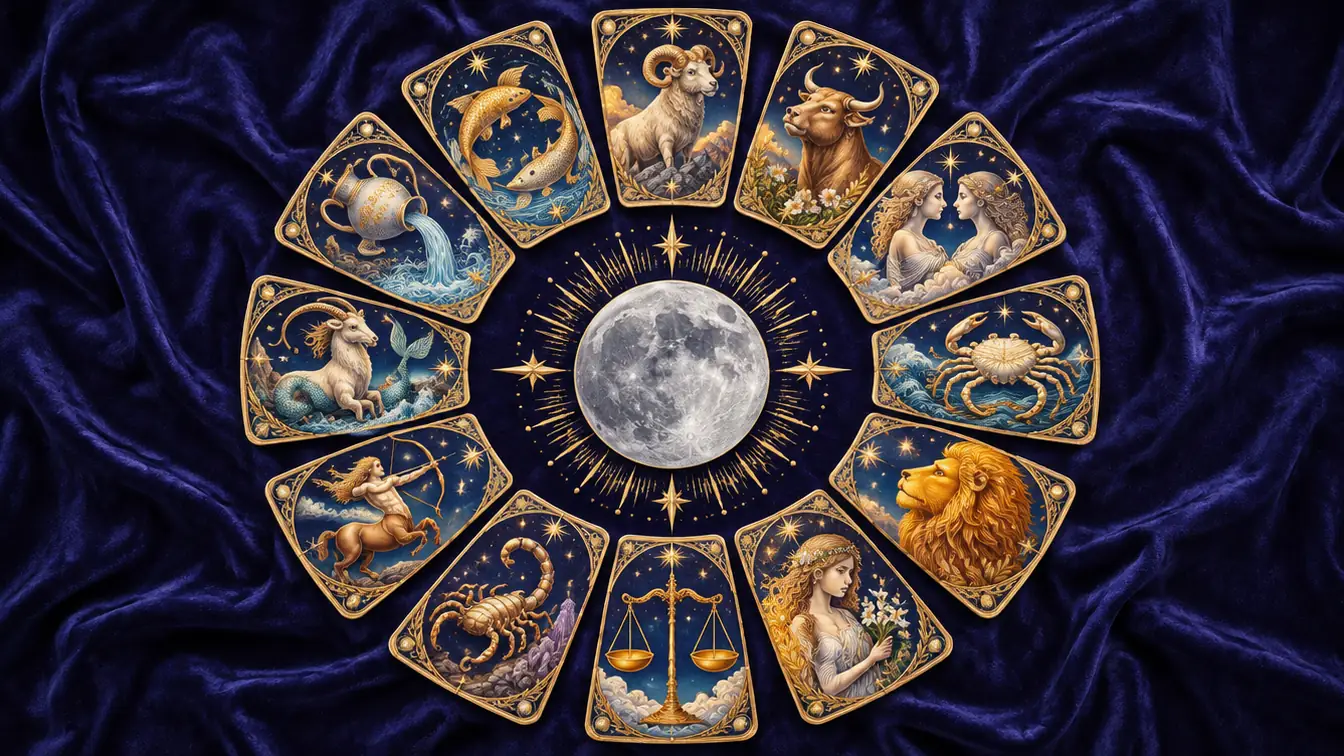
The Zodiac Cards of the Major Arcana, Read Through Your Vedic Moon Sign
Twelve Major Arcana cards carry zodiac signs in the Golden Dawn system, from the Emperor for Aries to the Moon for Pisces. If you know your Vedic Moon sign, or rashi, from your kundli, you can find its card and use its meaning as a reflective prompt. It is a modern exercise, not a classical Jyotish method or a forecast.
Key takeaways
- Tarot began as a card game in fifteenth-century Italy, with no astrology attached.
- The Golden Dawn worked with the tropical zodiac, which fixes the signs to the seasons.
- Makara and the Devil can feel unfair too, but the card is about attachment and habit, which Saturn's discipline is often called on to loosen.
- Some people go one step further and look at the card for their rashi lord too.
- To be clear about its limits: no classical Jyotish text pairs rashis with tarot cards, and the Golden Dawn never used the sidereal zodiac.
Twenty-two cards make up the Major Arcana, from the Fool to the World. Most guides list their meanings one by one, which is useful, but there is another way into them that suits anyone who grew up with a kundli in a drawer at home. Twelve of these cards carry a zodiac sign. If you know your rashi, you already have a doorway into one of them.
This post explains where those pairings come from, why a Vedic chart shifts them, and how to use the card for your Moon sign as a short reflection. It is offered as an exercise in thinking, not as a method from the classical texts of Jyotish.
Where the zodiac pairings come from
Tarot began as a card game in fifteenth-century Italy, with no astrology attached. The links between cards and signs were worked out much later, in late nineteenth-century London, by the Hermetic Order of the Golden Dawn. That group assigned each trump a Hebrew letter and a sign, planet or element: twelve cards for the twelve signs, seven for the classical planets and three for the elements. The overview of tarot card reading sets out the full table of these Golden Dawn correspondences, and the history of the Major Arcana notes that the Rider-Waite-Smith deck swapped Strength and Justice so that Strength became card eight, to sit with Leo, and Justice card eleven, to sit with Libra.
Most English-language decks still follow that order, so the pairings below match whatever deck you probably own.
Why your kundli gives a different sign
The Golden Dawn worked with the tropical zodiac, which fixes the signs to the seasons. Jyotish uses the sidereal zodiac, which fixes them to the stars. Over centuries the two have drifted apart by roughly 24 degrees, which is almost a whole sign. The astronomer James Kaler's explanation of why your zodiac sign is probably wrong sets out the precession behind this, and why astrologers who follow the stars and those who follow the seasons now name different signs for the same birth.
There is a second difference. Western horoscope columns are built on the sun sign. Indian families more often talk about the Moon sign, the sign the Moon occupied at birth. So the sign you know from your kundli may differ from the one in a magazine for two reasons at once. For this exercise, use your Vedic Moon sign.
The twelve zodiac trumps by rashi
| Rashi | Sign | Card | Rashi lord | A question to reflect on |
|---|---|---|---|---|
| Mesha | Aries | IV The Emperor | Mars (Mangal) | Where do I need firmer structure, and where am I being rigid? |
| Vrishabha | Taurus | V The Hierophant | Venus (Shukra) | Which traditions do I keep because they help me, and which out of habit? |
| Mithuna | Gemini | VI The Lovers | Mercury (Budha) | What choice am I putting off, and what do I value most in it? |
| Karka | Cancer | VII The Chariot | Moon (Chandra) | What am I steering toward, and what pulls me two ways? |
| Simha | Leo | VIII Strength | Sun (Surya) | Where would patience do more than force? |
| Kanya | Virgo | IX The Hermit | Mercury (Budha) | What would I learn from a quiet hour alone this week? |
| Tula | Libra | XI Justice | Venus (Shukra) | Where am I avoiding an honest account of my own part? |
| Vrishchika | Scorpio | XIII Death | Mars (Mangal) | What is ending naturally, and am I letting it? |
| Dhanu | Sagittarius | XIV Temperance | Jupiter (Guru) | Where would a middle path serve better than all or nothing? |
| Makara | Capricorn | XV The Devil | Saturn (Shani) | What habit or attachment has more hold on me than I admit? |
| Kumbha | Aquarius | XVII The Star | Saturn (Shani) | What hope have I set aside that deserves another look? |
| Meena | Pisces | XVIII The Moon | Jupiter (Guru) | Which of my fears are facts, and which are fog? |
A few of these surprise people. Vrishchika natives are rarely pleased to find Death beside their sign, until they learn that the card stands for endings and change, not mortality; the post on the Death card in a love reading explains why. Makara and the Devil can feel unfair too, but the card is about attachment and habit, which Saturn's discipline is often called on to loosen.
How to use your card as a reflection
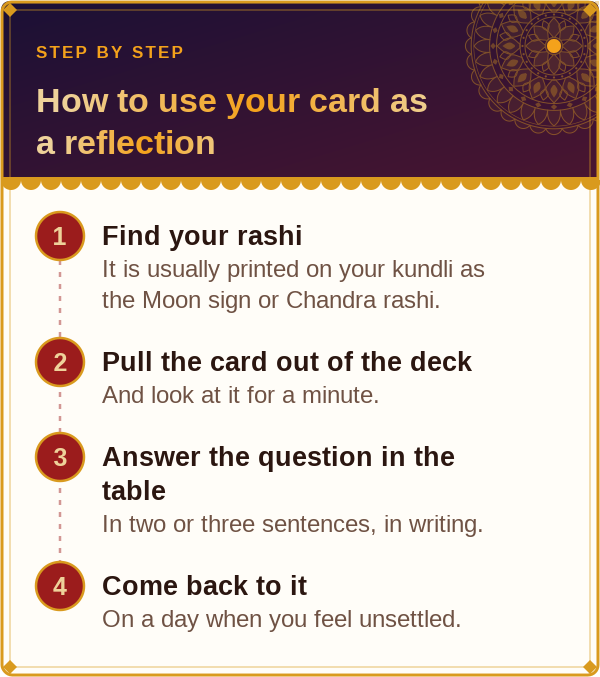
- Find your rashi. It is usually printed on your kundli as the Moon sign or Chandra rashi. If you are unsure what your chart shows, the short answer on turning a Western chart printout into a kundli helps.
- Pull the card out of the deck and look at it for a minute. Notice what the figures are doing before you think about meanings.
- Answer the question in the table in two or three sentences, in writing.
- Come back to it on a day when you feel unsettled. The same card read in a different mood often shows something new.
Some people go one step further and look at the card for their rashi lord too. The Golden Dawn gave seven trumps to the classical planets: the Magician to Mercury, the High Priestess to the Moon, the Empress to Venus, the Wheel of Fortune to Jupiter, the Tower to Mars, the Sun to the Sun and the World to Saturn. A Kanya native would then sit the Hermit beside the Magician, both under Mercury, and ask how study and skill work together in their life.
What this exercise is, and what it is not
To be clear about its limits: no classical Jyotish text pairs rashis with tarot cards, and the Golden Dawn never used the sidereal zodiac. Combining them is a modern, personal bridge between two traditions. It can be a thoughtful way to learn the trumps, and it can make a card feel less like a stranger. It is not a reading of your chart, it does not reveal your character with any authority, and it cannot predict events.
If you want your actual chart read, with your Moon sign, its nakshatra, the planets and their periods, that is the work of a Vedic birth chart reading. If you want the cards laid for a real question, a tarot card reading does that. Astrologer and Psychic Vijayram offers both by phone, WhatsApp or video, and the post comparing tarot and Vedic astrology explains which suits which kind of question. If your spreads keep filling with trumps, the guide to several Major Arcana in one spread is worth reading next.
Common questions
My Western sun sign and my Vedic Moon sign are different. Which one do I use?
For this exercise, use the Moon sign (rashi) from your kundli. It is a different placement from the sun sign in Western horoscope columns, and it is the sign Indian families usually mean when they talk about someone's rashi. You can also look at the card for your sun sign out of interest.
What if I do not know my Moon sign?
You need your birth date, time and place to calculate it. The Moon changes sign roughly every two and a half days, so the date alone is sometimes enough, but not always. A birth chart reading will confirm it.
Which cards belong to Rahu and Ketu?
None in the Golden Dawn system, which was built on the seven classical planets of Western astrology. Some modern readers make their own pairings for the lunar nodes, but there is no settled tradition behind them.
Does my rashi card mean I will draw it more often?
No. Every card has the same chance in a shuffle. The pairing is a lens for reflection, not a sign that the deck favors you.
Related service
Keep reading
Fire, Water, Air and Earth: The Elements Behind the Minor Arcana
Minor Arcana meanings through the four elements: Wands as fire, Cups as water, Swords as air, Pentacles as earth, and how element balance in a spread is read.
Read article →
The Death Card in a Love Reading: Endings, Changes and Fresh Starts
The Death tarot card meaning in a love reading: why readers see endings, change and fresh starts rather than a threat, and how position and neighbors shift it.
Read article →
The Tower Card Explained
The Tower tarot card meaning in plain terms: sudden change and shaken structures, what it suggests in love and work, the reversed card, and a calm response.
Read article →Quick answers
Does it matter who shuffles the tarot deck?
How does a tarot reading work, and does it matter who shuffles the deck? Shuffling customs in person and at a distance, and what matters more than hands.
Read answer →Is a tarot reading a forecast or a mirror?
Can tarot predict the future? Why readers use tarot to reflect on a situation and its likely direction rather than to fix events, and how to use it well.
Read answer →Talk to Astrologer and Psychic Vijayram
Tell us what you are facing. If a reading is unlikely to help, you will be told that plainly.