
Fire, Water, Air and Earth: The Elements Behind the Minor Arcana
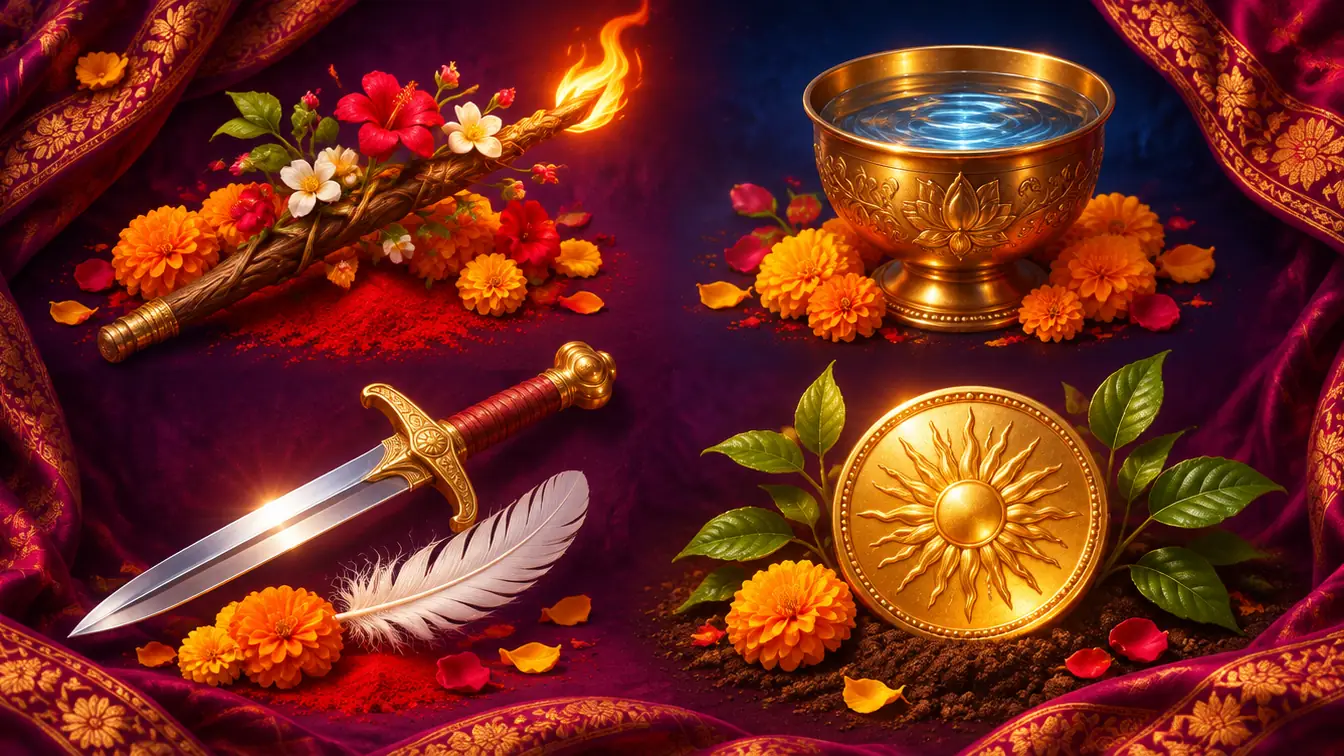
The Minor Arcana has 56 cards in four suits, each tied to an element. Wands are fire: drive and ambition. Cups are water: feelings and relationships. Swords are air: thought and conflict. Pentacles are earth: work, money and the body. Counting the suits in a spread shows which part of life is taking up the most room.
Key takeaways
- The suits descend from Italian playing cards.
- Wands are living branches, often sprouting leaves.
- Cups hold feelings, love, friendship, intuition and the inner life.
- Swords are the mind: thought, speech, decisions, conflict and truth.
- Pentacles are money, work, health, home and the material world.
Most people meet the Major Arcana first: the Fool, the Lovers, Death, the Tower. Yet in most spreads the Minor Arcana does the steady work. These 56 cards describe ordinary life, the jobs, arguments, friendships, bills and small hopes that make up a week. Learning them through their elements is the fastest way to make sense of a spread before you know every single card.
Four suits, fourteen cards each
The suits descend from Italian playing cards. As the overview of the Minor Arcana explains, each suit has ten numbered cards, Ace to Ten, and four court cards: Page, Knight, Queen and King. Most English-language decks follow the Rider-Waite-Smith designs of 1909, in which every numbered card has a full scene, not just a pattern of symbols. That is why you can often read a Minor card from its picture alone.
The element pairings below are the ones most readers use today. A few traditions swap Wands and Swords, so if you work with an unusual deck, check its booklet.
Wands: fire
Wands are living branches, often sprouting leaves. Fire is energy, desire, ambition and the urge to start something. Wands cards turn up around new projects, creative work, competition and anything that needs nerve.
- At their best: courage, momentum, enthusiasm. The Ace of Wands is a spark; the Six of Wands is public recognition.
- At their worst: burnout, impatience, scattered effort. The Ten of Wands shows a figure bent under a heavy bundle.
Cups: water
Cups hold feelings, love, friendship, intuition and the inner life. The Victoria and Albert Museum holds an early printing of the Ace of Cups from the Rider-Waite-Smith deck, a single chalice overflowing with streams of water, which captures the suit well: emotion that fills and spills.
- At their best: connection, comfort, generosity. The Two of Cups is a meeting of equals; the Ten of Cups a contented household.
- At their worst: moodiness, nostalgia, wishful thinking. The Five of Cups dwells on spilled cups and ignores the two still standing; the Seven of Cups is lost in daydreams.
Swords: air
Swords are the mind: thought, speech, decisions, conflict and truth. They carry the harshest pictures in the deck, which makes people wary of them, but air also brings clarity.
- At their best: honesty, sharp judgment, a hard decision finally made. The Ace of Swords cuts through confusion.
- At their worst: anxiety, cruelty, overthinking. The Nine of Swords sits awake at night; the Three of Swords is heartbreak.
Pentacles: earth
Pentacles are money, work, health, home and the material world. Earth is slow and practical, and the suit often answers "how" rather than "why."
- At their best: skill, steady progress, security. The Eight of Pentacles is an apprentice at the bench; the Nine of Pentacles enjoys what was earned.
- At their worst: stinginess, stagnation, worry about money. The Four of Pentacles grips its coins too tightly.
For work questions, the guide to reading Pentacles for career choices goes through the suit card by card.
Court cards: an element within an element
Court cards are hard for beginners because they can mean people, roles or attitudes. One common scheme gives each rank its own element as well: Pages earth, Knights air, Queens water and Kings fire. The Queen of Cups then reads as "water of water," deeply feeling and intuitive, while the King of Swords is "fire of air," decisive and perhaps a little cold. Systems differ, and A. E. Waite's own divinatory meanings in The Pictorial Key to the Tarot describe the court cards more as types of person than as elemental mixtures. Use whichever helps you see the card.
Reading element balance in a spread
Once you know the elements, you can read the shape of a spread before you read any single card. Count the suits.
- One suit dominates. That area of life is taking up the most room. Mostly Swords suggests the problem lives in your head; mostly Pentacles that money or work is the real subject, whatever the question said.
- An element is missing. Sometimes that is the gap. A love question with no Cups at all might suggest the feelings are not being discussed.
- Elements side by side. Some readers use elemental dignities: fire and air feed each other, as do water and earth, while fire and water, or air and earth, weaken each other. A Wands card beside a Cups card may show passion dampened by mood.
Here is a short illustration. Someone asks about a stalled friendship and draws five cards: the Five of Swords, the Two of Swords, the Page of Swords, the Three of Wands and the Six of Cups. Three Swords say the friendship has become a matter of argument and silent standoffs. One Wands card looks outward, toward moving on. A single Cups card, full of childhood memories, holds the affection that still remains. There are no Pentacles, so practical matters are not the issue. Before reading any card in detail, the reader already knows where to look: the arguing mind, and the warmth underneath.
Element balance works in any layout, and it is especially useful in larger spreads such as the ten-card Celtic Cross worked through step by step. Readers who do not use reversed cards often rely on elemental dignities instead, a choice explained in the post on why some readers never use reversals.
A note for readers who know Jyotish
Vedic astrology also groups the twelve rashis by element: fire for Mesha, Simha and Dhanu, earth for Vrishabha, Kanya and Makara, air for Mithuna, Tula and Kumbha, water for Karka, Vrishchika and Meena. If your chart is heavy in one element, you may notice yourself drawn to the matching suit. That is a fun parallel, not a rule, and the two systems grew up separately.
Reading the suits in a session
In a full tarot card reading, the element count is usually one of the first things mentioned, because it gives the whole spread a frame. Astrologer and Psychic Vijayram reads by phone, WhatsApp or video, and on video you can see the suits gather on the cloth for yourself.
The usual limit applies. The suits describe themes in your situation as you see it now. They cannot tell you what will happen, what someone else is thinking, or replace advice from a doctor, lawyer or financial professional.
Common questions
Why do some decks say Coins or Disks instead of Pentacles?
The suits come from Italian playing cards, which used coins. The Rider-Waite-Smith deck drew them as pentacles, and other decks use disks or rings. The element and meaning stay the same: earth, money, work and the body.
Are court cards always other people?
Not always. A court card can describe someone in your life, a role you are playing, or a way of handling the situation. The Queen of Swords might be a sharp-minded friend, or a reminder to speak plainly yourself.
Is one suit unlucky?
No. Swords have the most uncomfortable images, but they also stand for clear thinking and honest speech. Every suit has a helpful and an unhelpful side.
What does it mean if a spread has no Major Arcana at all?
Many readers take it as a sign that the situation sits within everyday life and your own choices, rather than a large turning point. That is often good news: it means you have room to act.
Related service
Keep reading
The Death Card in a Love Reading: Endings, Changes and Fresh Starts
The Death tarot card meaning in a love reading: why readers see endings, change and fresh starts rather than a threat, and how position and neighbors shift it.
Read article →
The Tower Card Explained
The Tower tarot card meaning in plain terms: sudden change and shaken structures, what it suggests in love and work, the reversed card, and a calm response.
Read article →
The Lovers Card Reversed: Values, Choices and Mixed Signals
The Lovers tarot card meaning when reversed: why readers see a clash of values, a decision put off or mixed signals, not a doomed romance, with spread examples.
Read article →Quick answers
Does it matter who shuffles the tarot deck?
How does a tarot reading work, and does it matter who shuffles the deck? Shuffling customs in person and at a distance, and what matters more than hands.
Read answer →Is a tarot reading a forecast or a mirror?
Can tarot predict the future? Why readers use tarot to reflect on a situation and its likely direction rather than to fix events, and how to use it well.
Read answer →Talk to Astrologer and Psychic Vijayram
Tell us what you are facing. If a reading is unlikely to help, you will be told that plainly.