
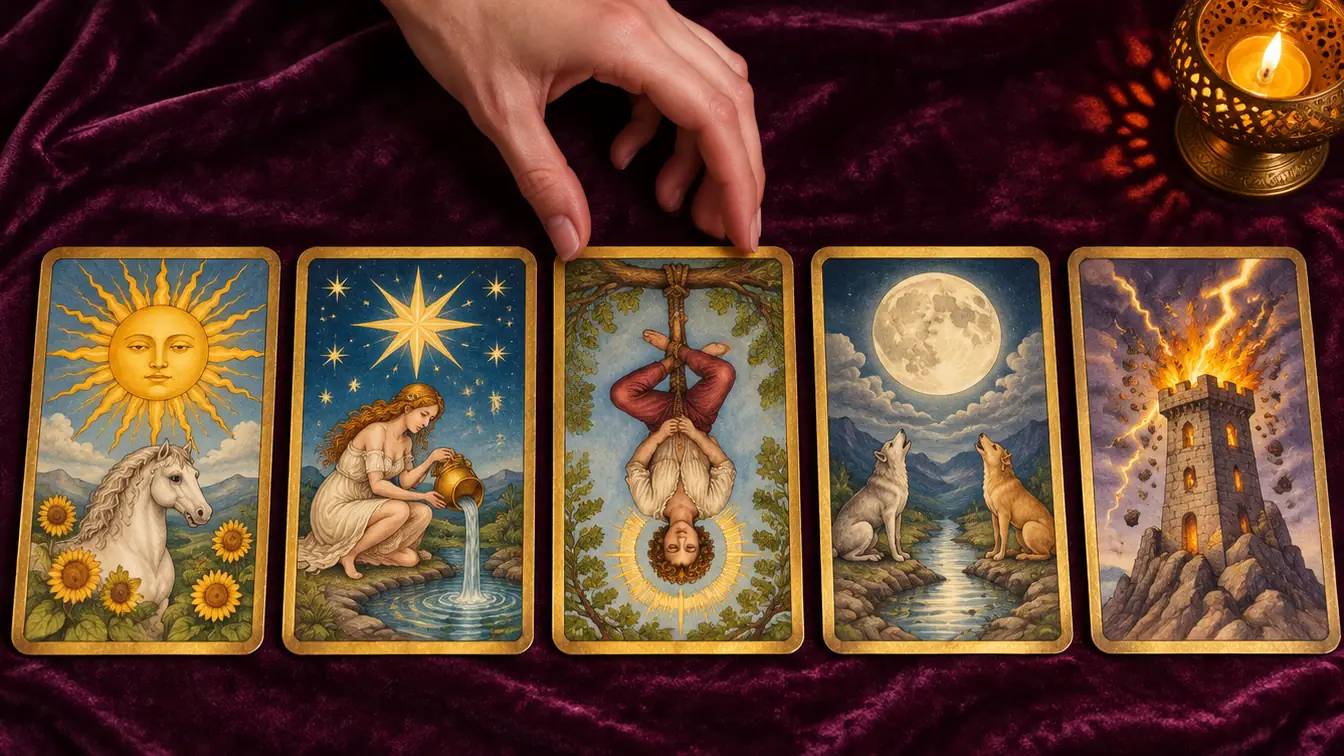
To Reverse or Not: Why Some Readers Never Use Reversals
Reversed tarot cards are cards that land upside down. Some readers give them their own meaning, often a blocked, delayed or inward version of the upright card. Others read every card upright and get the same nuance from its position and its neighbors. Neither approach is more correct; what matters is choosing one before you shuffle.
Key takeaways
- Reading meaning into upside-down cards goes back at least to eighteenth-century France.
- Take a simple three-card question: "What is happening with the job application I sent last month?"
- Readers who drop reversals often lean on the elements instead, and the guide to the elements behind the Minor Arcana explains how element balance and neighboring cards are read.
- In a tarot card reading , Astrologer and Psychic Vijayram says at the start whether reversed cards will be read and, if so, which way.
Shuffle a deck well and some cards will land upside down. What to do with them is one of the oldest disagreements among tarot readers. One reader turns them the right way up and carries on; another treats an upside-down card as a different message entirely. Both have reasons, and both can read a spread well.
This post sets out the two camps, the main ways reversals are read, and how each approach handles the thing reversals are most often used for: energy that is blocked or delayed.
Where reversals come from
Reading meaning into upside-down cards goes back at least to eighteenth-century France. The overview of tarot card reading describes how the cartomancer Etteilla, the first to assign divinatory meanings to tarot cards, inspired a dictionary that tabulated every meaning a card could carry upright and reversed. A. E. Waite kept the practice: his divinatory meanings give a reversed line for almost every card. For the Tower, for instance, he gives a grim list for the upright card and "the same in a lesser degree" for the reversal.
Other traditions went another way. Readers influenced by the Golden Dawn, the London occult order founded in 1888, often weigh a card by the elements of the cards beside it rather than by which way up it falls.
The case for reading upright only
- Every card already has a shadow. The Four of Pentacles can mean healthy saving or tight-fisted fear. The range is in the card; turning it over does not add anything new.
- Positions do the work. A card in an "obstacle" or "what is blocking me" position already shows resistance.
- Neighbors do the work. A lively card beside heavy ones reads as dampened. Fire beside water, in the elemental system, weakens.
- It avoids piling on. Clients who see three upside-down cards in a row often hear only doom, whatever the reader says.
- It is simpler to learn. Seventy-eight meanings are plenty to start with.
The case for using reversals
- More nuance from fewer cards. In a three-card spread, a reversal adds a layer without adding a card.
- It flags what is stuck. A reversal draws the eye straight to the part of the situation that is not flowing.
- Long tradition. From Etteilla to Waite to most modern guidebooks, reversed meanings are part of the inherited vocabulary.
- It suits inner questions. Many readers use reversals to show what is happening privately rather than outwardly.
Five common ways to read a reversed card
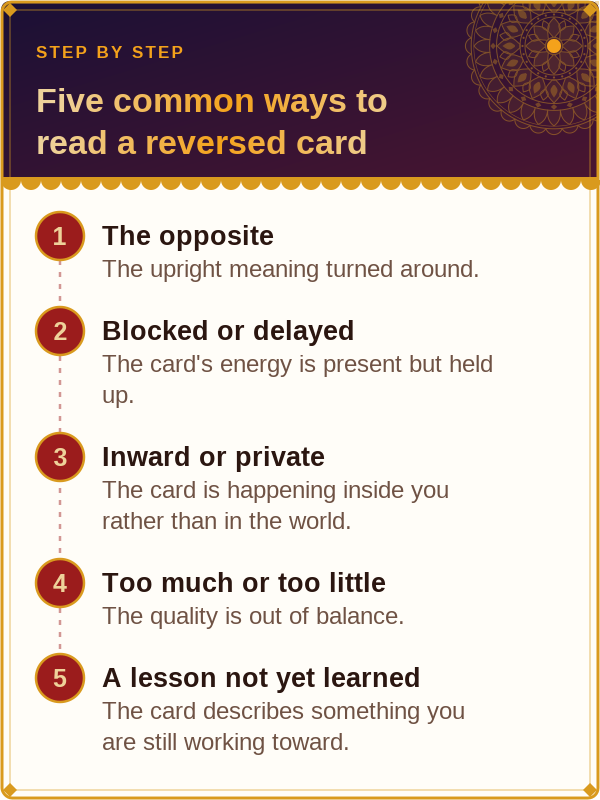
Readers who use reversals do not all read them the same way. The main approaches are:
- The opposite. The upright meaning turned around. The Sun reversed becomes gloom. This is the oldest approach and the bluntest.
- Blocked or delayed. The card's energy is present but held up. The Eight of Wands, swift movement, becomes waiting.
- Inward or private. The card is happening inside you rather than in the world. The Three of Cups reversed might be celebrating quietly, or feeling lonely at a party.
- Too much or too little. The quality is out of balance. Strength reversed might be self-doubt, or might be forcing things.
- A lesson not yet learned. The card describes something you are still working toward.
A reader should know which of these they mean, and tell you. The post on the Lovers card reversed shows how one card's reversal can be read as a values conflict or a decision postponed rather than a doomed romance.
How each approach handles delay: a worked comparison
Take a simple three-card question: "What is happening with the job application I sent last month?"
With reversals: the cards are the Page of Pentacles, the Eight of Wands reversed and the Four of Swords. The reversed Eight of Wands says plainly that movement is slowed. The Four of Swords, a figure at rest, suggests patience. The reading: progress is real but delayed; wait, and use the time.
Upright only: the same cards, all upright. The Eight of Wands alone would suggest speed, but beside the Four of Swords, a card of rest, its energy is slowed. In the position "what is happening now," the pairing reads as motion that has stalled for the moment. The reading arrives at almost the same place by a different road.
That is the honest truth about the debate: a careful reader reaches similar conclusions either way. What matters is consistency, not which method you choose.
Practical points if you read your own cards
- Decide before you shuffle and write it in your journal so you do not drift.
- Do not mix approaches mid-spread. Reading one reversed card as "blocked" and the next as "the opposite" makes a spread say anything.
- Watch your mood. If upside-down cards make you anxious, try a few weeks upright only and notice the difference.
- Use a larger spread to test yourself. The Celtic Cross worked example is a good place to practice reading neighbors and positions.
Readers who drop reversals often lean on the elements instead, and the guide to the elements behind the Minor Arcana explains how element balance and neighboring cards are read.
In a reading with this practice
In a tarot card reading, Astrologer and Psychic Vijayram says at the start whether reversed cards will be read and, if so, which way. If a card turns up that worries you, such as the Tower upside down, you are welcome to ask how it would read under the other approach. Sessions run by phone, WhatsApp or video.
The limit is the same whichever way the cards fall. An upright or reversed card reflects how a situation looks now; it cannot predict events, see into someone else's mind or replace advice from a doctor, lawyer or financial professional.
Common questions
Are reversed cards bad news?
No. A reversed card is not automatically negative. A reversed difficult card can even ease its meaning: the Ten of Swords reversed is often read as the worst being over.
How do I get reversed cards when I shuffle?
Turn part of the deck around as you shuffle, or spread the cards face down on a table and mix them with both hands. If you never rotate the deck, you will rarely see reversals at all.
I drew a reversed card. Can I just turn it the right way up?
Only if you decided before shuffling that you read every card upright. Deciding after seeing the card is a way of picking the answer you prefer.
Do most professional readers use reversals?
Practice varies widely, and there is no reliable count either way. What you should expect from any reader is a clear statement of which approach they use before the reading starts.
Related service
Keep reading
Single-Card Answers: Why Yes-or-No Tarot Struggles With 'Should' Questions
Why yes or no tarot rarely settles a 'should I' question, how single-card answers are drawn, and how to reframe it into a question the cards can help with.
Read article →
Turning 'Will He Call?' Into a Better Tarot Question
How to ask tarot questions that help: worked rewrites that turn 'will he call?' and other prediction questions into ones centered on what you can do next.
Read article →
Love Tarot Spreads for Singles, Couples and the Undecided
Love tarot questions and spreads for three situations: single, in a couple, or undecided about a relationship, each keeping the reading on your own choices.
Read article →Quick answers
Does it matter who shuffles the tarot deck?
How does a tarot reading work, and does it matter who shuffles the deck? Shuffling customs in person and at a distance, and what matters more than hands.
Read answer →Is a tarot reading a forecast or a mirror?
Can tarot predict the future? Why readers use tarot to reflect on a situation and its likely direction rather than to fix events, and how to use it well.
Read answer →Talk to Astrologer and Psychic Vijayram
Tell us what you are facing. If a reading is unlikely to help, you will be told that plainly.