
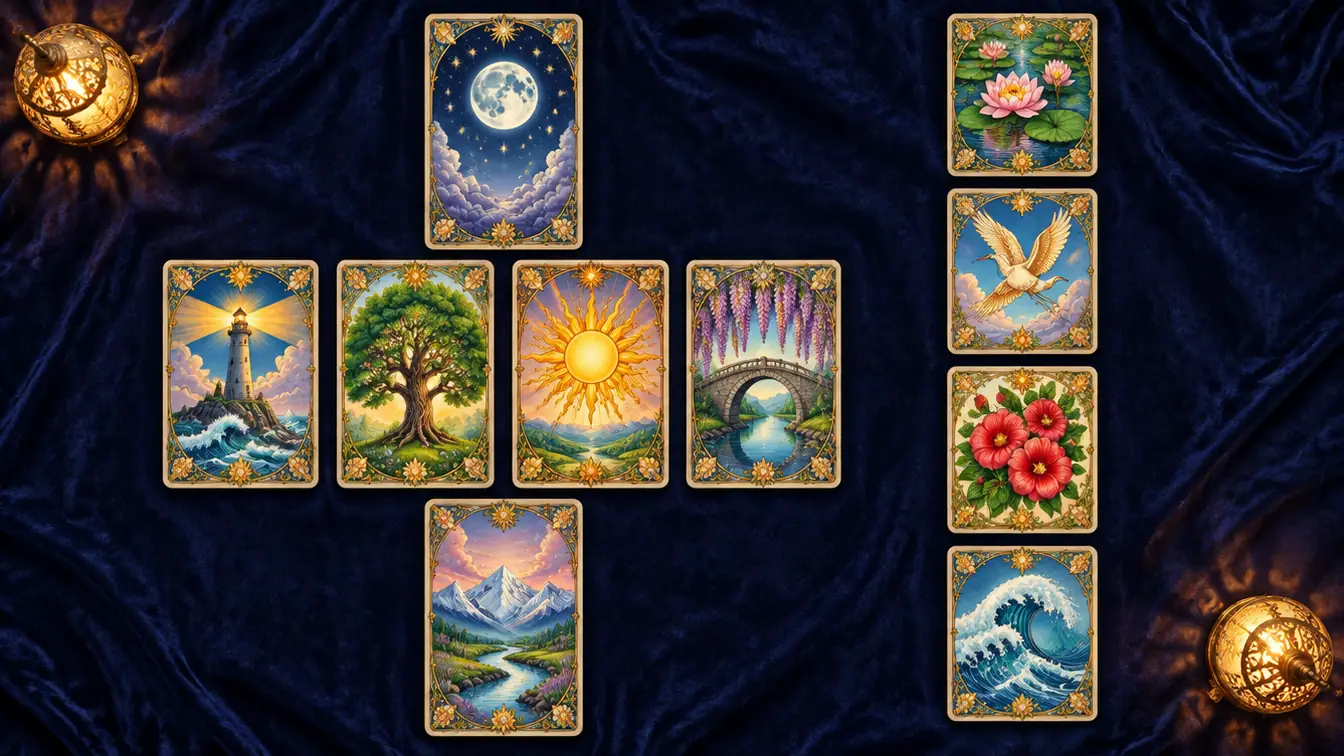
The Celtic Cross in Ten Steps: A Worked Example
The Celtic Cross tarot spread lays ten cards: six in a cross around the situation and four in a column beside it. The cross shows the present, the obstacle, the ideal, the foundation, what is passing and what is coming. The column shows your attitude, your surroundings, your hopes and fears, and where things are heading.
Key takeaways
- Waite published the method in 1910 as "An Ancient Celtic Method of Divination," in the third part of The Pictorial Key to the Tarot .
- Waite's own phrases are in quotation marks.
- Imagine someone asks: "My sister and I have barely spoken since our late father's house in Bridgeport was sold.
- The atmosphere is grief, and attention fixed on what was lost.
- The questioner's attitude is clear, logical and perhaps a little cold.
The Celtic Cross is the spread most people picture when they think of tarot: a cross of six cards with a tall column of four beside it. It looks complicated, and ten positions can be a lot to hold at once. The best way to learn it is to watch one question move through all ten cards. That is what this post does.
Where the spread comes from
A. E. Waite published the method in 1910 as "An Ancient Celtic Method of Divination," in the third part of The Pictorial Key to the Tarot. Despite the name, there is no evidence it is especially old or especially Celtic. Waite recommended it as the method most suitable for a definite question, and because it appeared in the book that accompanied the Rider-Waite-Smith deck, it spread with that deck around the English-speaking world. The overview of tarot card reading shows the layout as most people now know it.
The ten positions
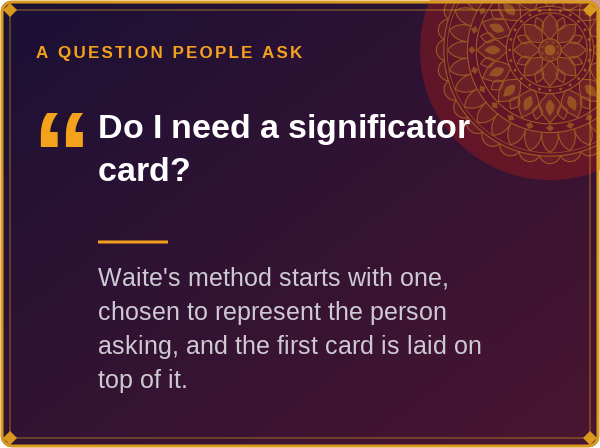
Waite's own phrases are in quotation marks.
- "This covers him." The present situation, the atmosphere of the question.
- "This crosses him." Laid sideways across card one: the obstacle, or the force working against the first card.
- "This crowns him." Above the center: the aim or ideal, the best that can be achieved but has not yet happened.
- "This is beneath him." Below the center: the foundation, what has already happened and now underlies the matter.
- "This is behind him." To one side: the influence that is passing away.
- "This is before him." To the other side: the influence coming into play soon.
- Himself. At the bottom of the column: your attitude or position.
- His house. Your surroundings: family, friends, workplace, the people whose influence bears on the matter.
- Hopes or fears. Often the same card is both.
- What will come. At the top of the column: where everything else seems to be leading.
The sample question
This is an illustration, not a real client. Imagine someone asks: "My sister and I have barely spoken since our late father's house in Bridgeport was sold. What would help me approach her?" It is a good Celtic Cross question: personal, layered, involving the past, other people and a decision about what to do next.
The cross: cards one to six
1. Covers: Five of Cups. A cloaked figure mourns three spilled cups while two remain standing behind them. The atmosphere is grief, and attention fixed on what was lost.
2. Crosses: Five of Swords. A figure gathers swords while two others walk away defeated. The obstacle is the argument itself, the kind where someone technically won and everyone lost.
Read together, the first two cards say: grief is being blocked by the memory of a fight. That pairing is the heart of the reading.
3. Crowns: Six of Cups. Children exchanging flowers in an old courtyard. The ideal is the warmth of a shared childhood, what the questioner would most like to recover.
4. Beneath: Four of Pentacles. A figure clutching coins. The foundation of the rift is money and property: the house, and who held on to what.
Now the vertical line speaks: childhood affection above, a dispute over things below. The question is which one will be allowed to define the relationship.
5. Behind: Ten of Wands. A person carrying a heavy bundle. The burden that is passing may be the years of caring for their father and handling the estate.
6. Before: Page of Cups. A young figure looking at a fish peeking out of a cup. A tentative, gentle message is coming into play, perhaps one the questioner sends.
The horizontal line moves from exhaustion to a first, tender step.
The column: cards seven to ten
7. Himself: King of Swords. The questioner's attitude is clear, logical and perhaps a little cold. They may be preparing a case rather than an apology.
8. House: the Hierophant. Family tradition and expectations: relatives with views about how siblings should behave, or the weight of religious and cultural duty around a parent's estate.
9. Hopes or fears: Three of Swords. A heart pierced by three blades. The questioner fears being hurt again, and perhaps also hopes the hurt will finally be acknowledged.
10. What will come: Temperance. An angel pouring water between two cups. Reconciliation is likely to be gradual and measured, a mixing rather than a sudden reunion.
How the cards talk to each other
Step back and look at the whole spread.
- Suits: three Cups, three Swords, one Pentacle, one Wand and two Major Arcana. Feelings and conflict dominate; the money matter is real but small. The post on the elements behind the Minor Arcana explains this kind of count.
- The King of Swords against the Page of Cups: the questioner's cool, case-building attitude clashes with the gentle message the spread suggests. That tension is the practical advice.
- The Five of Cups and Temperance: the reading begins in grief and ends in patience. Both cards involve pouring and spilling, a link a careful reader would point out.
The reading, put plainly: write a short, warm message about your father or a shared memory, not about the house. Leave the argument out of it. Expect a slow response, and let it be slow.
Notice what the spread does not say. It does not reveal what the sister thinks. It does not settle who was right about the property. If the estate dispute has legal questions in it, those belong with a lawyer, and if family tension is affecting a marriage or household, the marriage and family harmony reading looks at that side.
Tips for reading your own Celtic Cross
- Read the cross first, then the column, then the whole.
- Pair cards one and two, then three and four, then five and six, before reading anything else.
- Compare card seven with card ten: your attitude often explains where things are heading.
- Decide before you shuffle whether you are using reversed cards. The post on why some readers never use reversals sets out both approaches.
If ten positions feel like too many, start with five ways to lay a three-card spread and work up.
Booking a Celtic Cross reading
The Celtic Cross suits a full tarot card reading rather than a short session, because the links between cards take time to talk through. Astrologer and Psychic Vijayram lays it on camera for video sessions, so you can see the whole spread, or describes each card by phone. The limit holds here as everywhere: ten cards give a detailed picture of a situation as it stands, but they cannot tell you how another person will respond or fix any outcome in place.
Common questions
Do I need a significator card?
Waite's method starts with one, chosen to represent the person asking, and the first card is laid on top of it. Many modern readers skip it and let the first card stand alone. Both approaches are common.
Why do different books put cards three to six in different places?
In Waite's version, the card behind and the card before depend on which way the significator's figure is facing. Without a significator, readers settle on a fixed order, and books disagree on it. Choose one layout and keep to it.
How long does a Celtic Cross reading take?
Allow plenty of time. Reading ten positions and then the links between them is slower than a three-card spread, and it works best in a full session rather than a short one.
Is the tenth card a prediction?
No. It shows where the situation seems to be heading given everything else in the spread. Choices made after the reading can change that direction.
Related service
Keep reading
To Reverse or Not: Why Some Readers Never Use Reversals
Reversed tarot cards explained: reading upright only against using reversals, the five common ways to read an upside-down card, and how each handles delays.
Read article →
Single-Card Answers: Why Yes-or-No Tarot Struggles With 'Should' Questions
Why yes or no tarot rarely settles a 'should I' question, how single-card answers are drawn, and how to reframe it into a question the cards can help with.
Read article →
Turning 'Will He Call?' Into a Better Tarot Question
How to ask tarot questions that help: worked rewrites that turn 'will he call?' and other prediction questions into ones centered on what you can do next.
Read article →Quick answers
Does it matter who shuffles the tarot deck?
How does a tarot reading work, and does it matter who shuffles the deck? Shuffling customs in person and at a distance, and what matters more than hands.
Read answer →Is a tarot reading a forecast or a mirror?
Can tarot predict the future? Why readers use tarot to reflect on a situation and its likely direction rather than to fix events, and how to use it well.
Read answer →Talk to Astrologer and Psychic Vijayram
Tell us what you are facing. If a reading is unlikely to help, you will be told that plainly.