
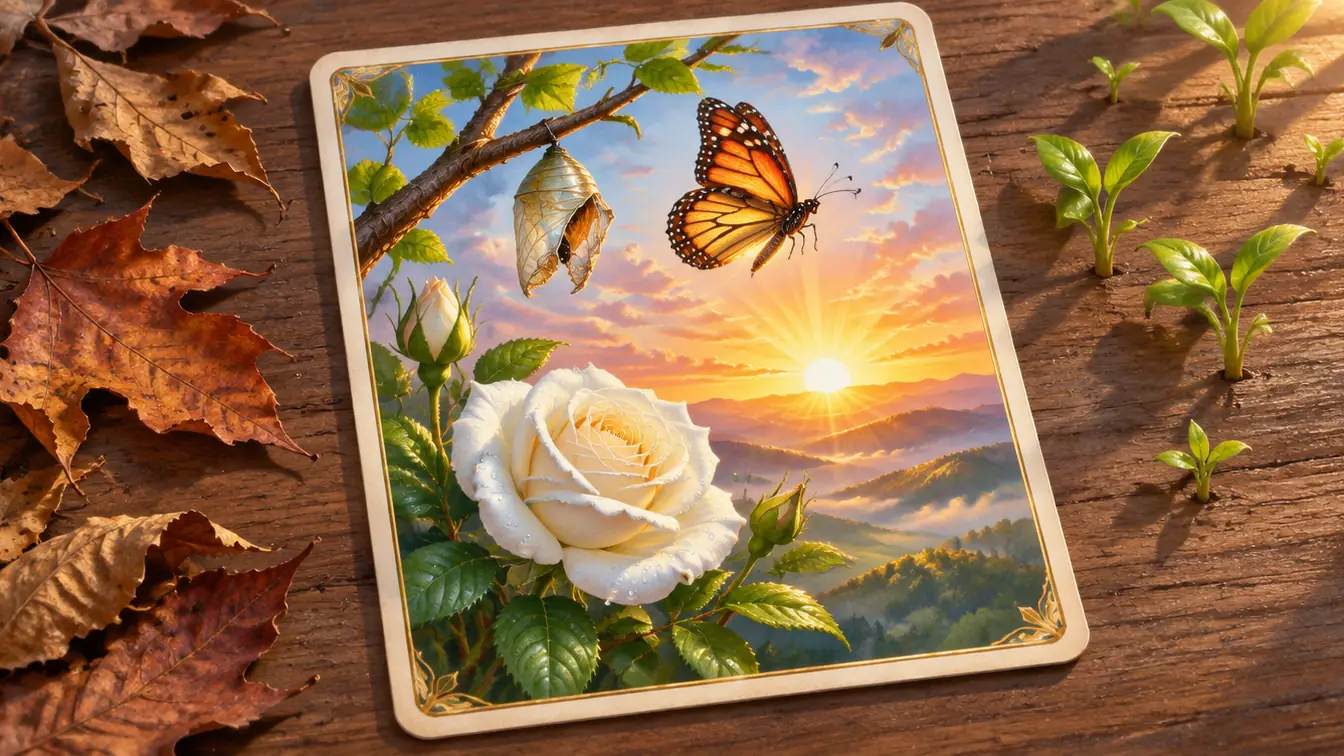
The Death Card in a Love Reading: Endings, Changes and Fresh Starts
In a love reading, the Death tarot card usually points to an ending or a change: a phase of the relationship closing, an old pattern finishing, or a breakup already under way that needs accepting. Mainstream readers do not read it as anyone dying. Its position and the cards beside it decide which kind of change it describes.
Key takeaways
- A churchman stands with hands raised, a young woman turns her face away and a child looks up without fear.
- The same card means different things depending on where it falls:
- Death beside the Ten of Cups, a happy household under a rainbow, can describe the end of one way of living together and the start of a fuller family life.
- Readers who use reversals often take an upside-down Death as change being resisted.
- A reader who uses Death to frighten you into buying a remedy is misusing the deck.
It happens in almost every love reading where the card appears. The thirteenth trump turns over, the client sees the skeleton, and the room goes quiet. If the question was about a partner, a new relationship or someone who has gone distant, the fear is immediate: something terrible is coming.
That is not how careful readers understand the card. In the tradition most decks follow, Death stands for endings and change, and in a love reading it is one of the most useful cards to see, because it names what is finishing so that something else can start. This post explains why, and how to tell which kind of change it is pointing to.
What the picture actually shows
In the Rider-Waite-Smith design, which the Victoria and Albert Museum holds as an early printing of the Death card, a skeleton in black armor rides a white horse and carries a black banner marked with a white rose. Before it lies a fallen king. A churchman stands with hands raised, a young woman turns her face away and a child looks up without fear. In the distance, a sun rises between two towers.
Each figure meets change differently: power cannot stop it, faith pleads, youth avoids it, and innocence simply accepts it. And there is a sunrise. The history of the Death card also notes that older decks such as the Tarot de Marseille left the card without a name at all, and that it came to be called the card with no name, as if it were too heavy to label. Modern readers have gone the other way, treating the card as transformation rather than an omen.
Older books were bleaker. Waite's list of divinatory meanings includes end, mortality and destruction alongside more everyday losses. Those meanings are part of the card's history, but even Waite was describing endings in general, not predicting a funeral.
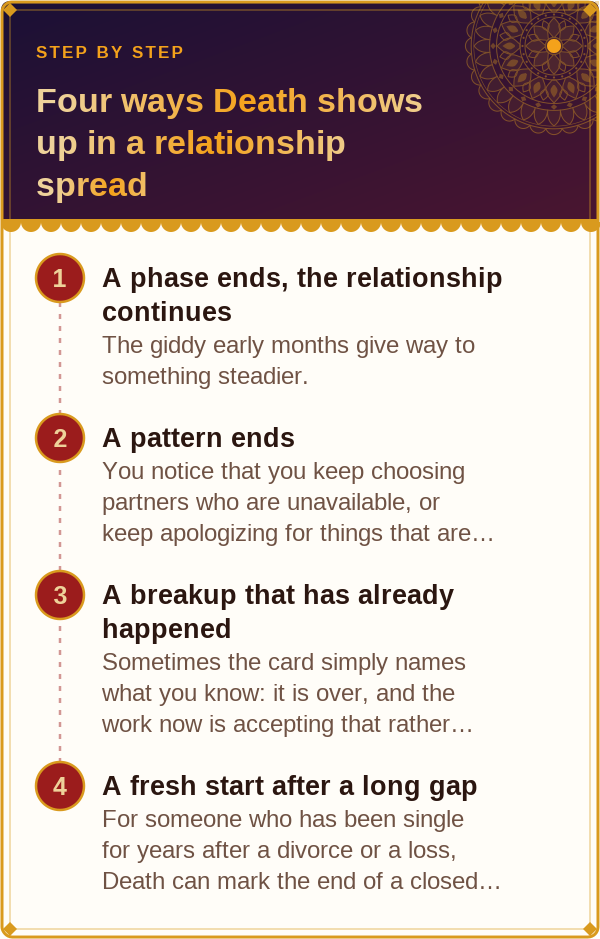
Four ways Death shows up in a relationship spread
- A phase ends, the relationship continues. The giddy early months give way to something steadier. A couple moves in together, marries, has a child or sends the last child off to college. Something is lost, and something more settled takes its place.
- A pattern ends. You notice that you keep choosing partners who are unavailable, or keep apologizing for things that are not your fault. Death in this position supports letting the habit go.
- A breakup that has already happened. Sometimes the card simply names what you know: it is over, and the work now is accepting that rather than waiting for a different ending. The post on tarot after a breakup offers a gentle spread for that stage.
- A fresh start after a long gap. For someone who has been single for years after a divorce or a loss, Death can mark the end of a closed season and the willingness to try again.
Position changes the reading
The same card means different things depending on where it falls:
- In a past position: a change that has already happened and shapes the present, such as a previous relationship whose end still colors how you trust people.
- In an obstacle position: fear of change. Something needs to end, perhaps a way of arguing, and resistance to that is the problem.
- In a "what to release" position: almost a direct instruction to let go of an expectation.
- In a future or outcome position: a likely turning point, read as a direction you are heading, never as a fixed event.
Neighbors change it too
Death beside the Ten of Cups, a happy household under a rainbow, can describe the end of one way of living together and the start of a fuller family life. Beside the Three of Swords, heartbreak, it can mean grief that needs time. Beside the Star, it reads as recovery after loss. Beside the Lovers, it might point to a decision that ends one possibility so another can grow. Reading Death on its own, without its neighbors, is how most frightening misreadings happen.
Death reversed
Readers who use reversals often take an upside-down Death as change being resisted. In love, that might be staying in a relationship that has clearly ended, checking an ex's social media every night, or refusing to let a partnership grow up. It is not a worse omen than the upright card. If anything, it is a nudge to stop holding the door shut.
What the Death card does not mean
- It does not mean anyone will die.
- It does not mean you are cursed, or that someone has done something against you.
- It does not mean your partner is about to leave, unless the rest of the spread and the facts of your life say so.
- It never means you need to pay for a ritual to "cancel" it.
That last point matters. A reader who uses Death to frighten you into buying a remedy is misusing the deck. The post on why no card requires a paid fix explains the warning signs. The sudden-upheaval card is a different one altogether, and the guide to the Tower card sets out how it differs from Death's slower kind of ending.
Bringing a love question to the cards
In a love and relationship tarot reading, Death is read the way this post describes: in its position, with its neighbors and in the light of your actual situation. If the honest question is whether a relationship that has ended might be rebuilt, the breakup and reconciliation guidance session looks at that with care and without promises. The broader tarot card reading covers any other situation. Astrologer and Psychic Vijayram reads by phone, WhatsApp or video.
The limit is simple. A tarot card cannot decide how a relationship will end or whether it will continue, and it cannot see another person's heart. It is faith-based guidance for reflection, and the choices remain yours and theirs.
Common questions
Does the Death card mean my partner will leave me?
Not by itself. It can describe a breakup that is already happening, but it just as often describes a change inside a relationship that continues, such as moving in together, a new baby or the end of the early infatuation. Look at the position and the neighboring cards before drawing any conclusion.
Can the Death card ever mean an actual death?
Readers in the mainstream tradition do not read it that way, and no card can foresee anyone's health or lifespan. If you are worried about someone's health, the right step is a doctor, not a deck.
Is Death reversed worse than upright?
Not worse, just different. Many readers take the reversed card as resistance to a change that is due: holding on to a relationship, a habit or a hope after it has run its course.
What if the Death card keeps appearing in my readings?
Take it as a theme, not a threat. Ask yourself what you already know is ending. If drawing cards is making you more anxious, stop for a while and talk to someone you trust.
Related service
Keep reading
The Tower Card Explained
The Tower tarot card meaning in plain terms: sudden change and shaken structures, what it suggests in love and work, the reversed card, and a calm response.
Read article →
The Lovers Card Reversed: Values, Choices and Mixed Signals
The Lovers tarot card meaning when reversed: why readers see a clash of values, a decision put off or mixed signals, not a doomed romance, with spread examples.
Read article →
Five Ways to Lay Out a Three-Card Spread
Five ways to lay a three card tarot spread: past-present-next, situation-action-outcome, you-them-the-bond, two options, and keep-release-try, with examples.
Read article →Quick answers
Does it matter who shuffles the tarot deck?
How does a tarot reading work, and does it matter who shuffles the deck? Shuffling customs in person and at a distance, and what matters more than hands.
Read answer →Is a tarot reading a forecast or a mirror?
Can tarot predict the future? Why readers use tarot to reflect on a situation and its likely direction rather than to fix events, and how to use it well.
Read answer →Talk to Astrologer and Psychic Vijayram
Tell us what you are facing. If a reading is unlikely to help, you will be told that plainly.