
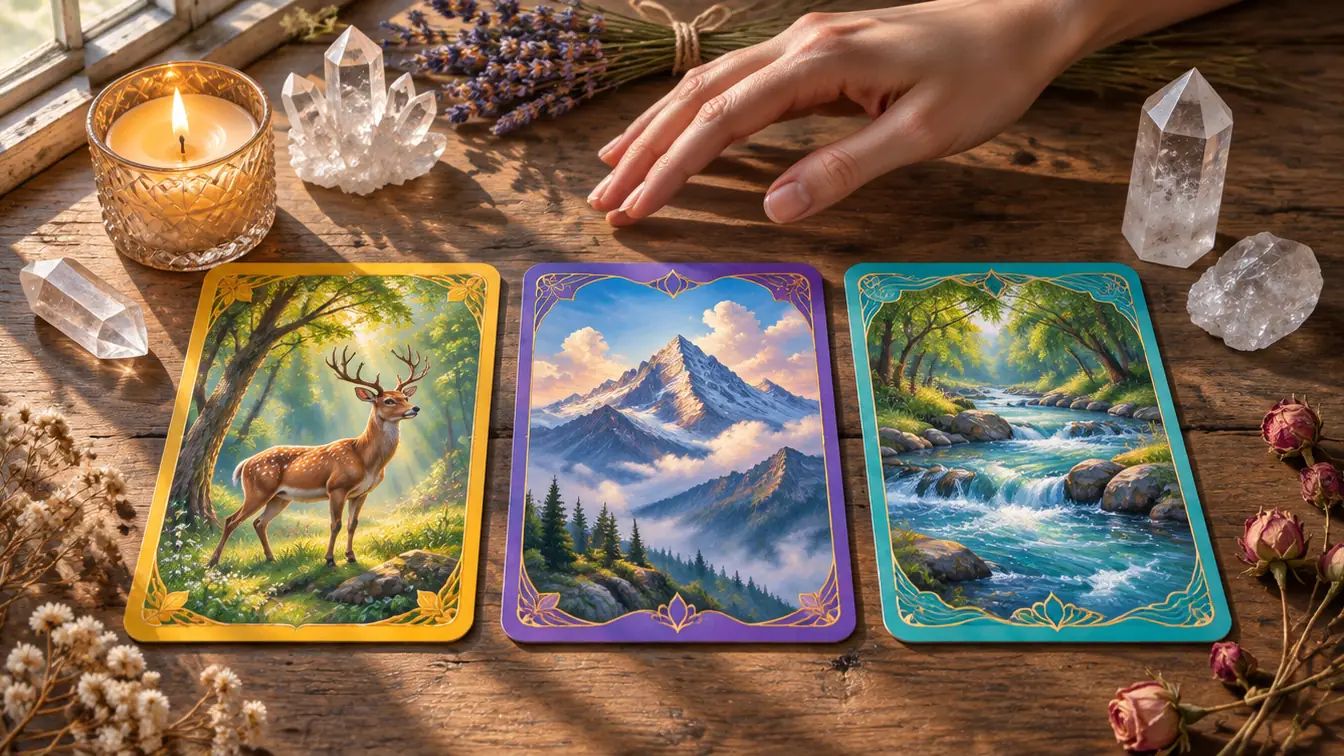
Reading an Oracle Deck Without the Guidebook
To read oracle cards without the guidebook, look at the picture before the words, notice the main colors and where your eye lands, and write down your first honest reaction. Then connect that reaction to your question. A three-card layout of what is here, what helps and what to set down is a good way to practice.
Key takeaways
- Tarot has a shared structure that readers have built on for centuries: suits, numbers, the Major Arcana.
- Cover the title or keyword with your thumb.
- Lay three cards in a row, left to right:
- Say your question is "How do I handle the next month at work?" You draw:
- Write the date, your question, the three cards and your first-response words in a notebook.
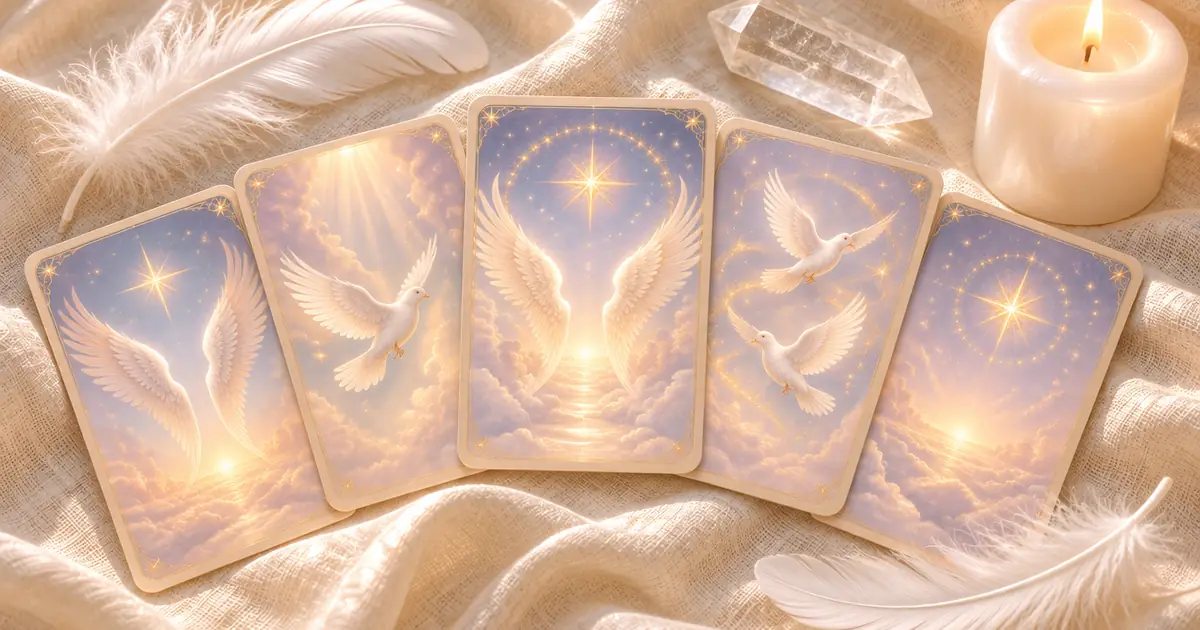
You bought an oracle deck because the art caught your eye. Then the little booklet arrived with two paragraphs per card, and suddenly the cards felt like homework. Here is the good news: oracle decks were made to be read by looking. Every deck is different, there is no fixed system to memorize, and the guidebook is optional. This post gives you a method that works with any deck, from a botanical set to an angel deck to a hand-drawn indie printing.
Why oracle decks can be read from the image alone
Tarot has a shared structure that readers have built on for centuries: suits, numbers, the Major Arcana. Oracle decks do not. Each author picks the themes and the number of cards. That makes a universal "meaning" impossible, and it puts the weight where it belongs, on what you notice. Oracle cards are a recent branch of cartomancy, the broad practice of reading cards for guidance.
It is worth being honest about how this works. People are very good at finding meaning in images, sometimes too good. Psychologists call the habit of seeing patterns in random information apophenia. A card does not know your situation. What a card can do is give your mind something concrete to react to, and that reaction can show you what you already half know. Reading this way keeps the deck in its proper role.
Four steps for reading any card
1. Look before you read
Cover the title or keyword with your thumb. Spend ten seconds on the picture. What is happening? Is there a figure, and what is it doing? Is the scene open or closed, still or moving?
2. Notice color and light
Color carries mood. A card washed in grey-blue feels different from one in warm orange, even if both show a path. Where is the light coming from? Is anything in shadow? Many people find the lightest part of the card is where the message sits.
3. Catch your first response
Before you think too hard, say or write one word for how the card makes you feel: relief, irritation, longing, calm. Irritation is useful. A card that annoys you often touches a subject you have been avoiding.
4. Only then, read the words
Now read the title or phrase printed on the card. Does it confirm your impression, add to it or contradict it? If it contradicts, trust your first look a little more than the author. You are the one with the question.
A three-card layout to practice
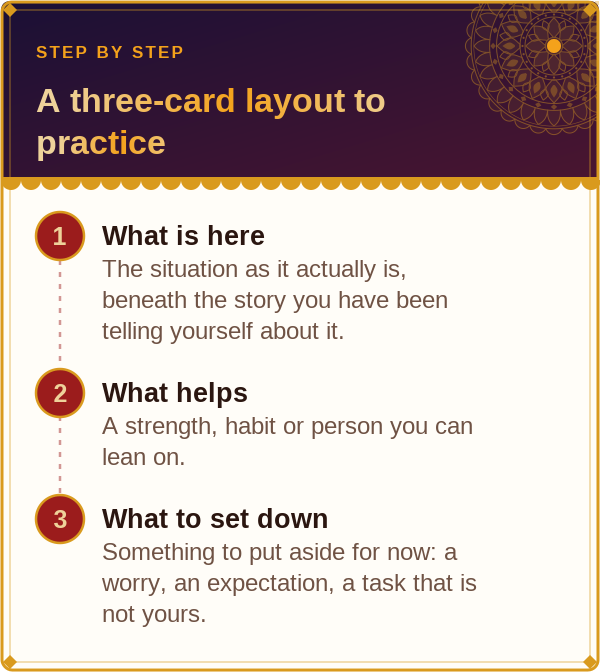
Lay three cards in a row, left to right:
- What is here. The situation as it actually is, beneath the story you have been telling yourself about it.
- What helps. A strength, habit or person you can lean on.
- What to set down. Something to put aside for now: a worry, an expectation, a task that is not yours.
Run the four steps on each card, then look at all three together. Do the colors move from dark to light, or the other way? Does one figure seem to look at another? Those small connections often give the reading its shape.
A worked example
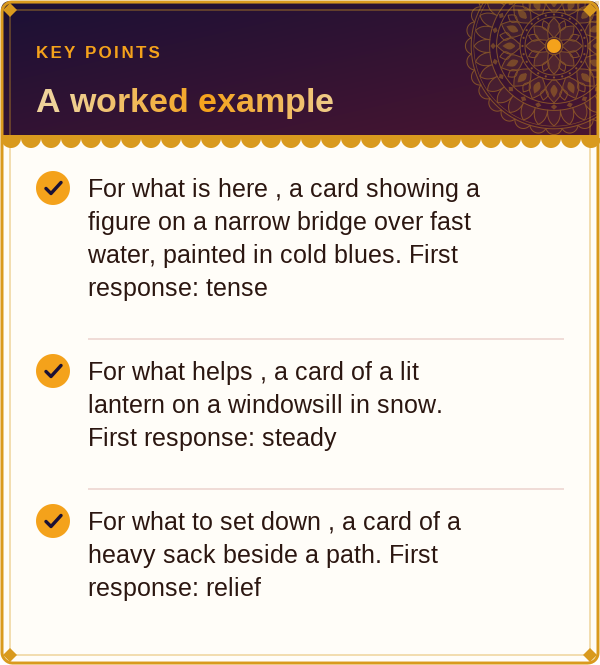
Say your question is "How do I handle the next month at work?" You draw:
- For what is here, a card showing a figure on a narrow bridge over fast water, painted in cold blues. First response: tense.
- For what helps, a card of a lit lantern on a windowsill in snow. First response: steady.
- For what to set down, a card of a heavy sack beside a path. First response: relief.
Read together, the cards suggest that the month feels precarious, that a small, reliable routine (the lantern) will carry you further than big gestures, and that something you have been hauling around, perhaps a task you agreed to out of guilt, can be put down. The printed words on the cards might say "Courage," "Hope" and "Release." Useful, but the pictures told you more.
Notice that none of this predicts what your manager will do. It gives you three things to think about and one practical step. That is the right size for an oracle reading.
Keep a short record
Write the date, your question, the three cards and your first-response words in a notebook. Writing about thoughts and feelings is a well-studied way to process stress; the University of Rochester Medical Center's note on journaling for mental health describes the benefits. After a few weeks your notes become your own guidebook, with meanings that come from your life rather than a stranger's booklet. A simple daily one-card practice works well alongside this.
When to ask a reader instead
Reading for yourself has a blind spot: it is hard to see a card clearly when you badly want a particular answer. If you notice that you keep reshuffling until you get a card you like, or the same question has been on the table for weeks, a second pair of eyes helps. Astrologer and Psychic Vijayram offers angel and oracle card readings by phone or video, where the reader describes each card and talks it through with you. For a gentler introduction to the angel decks in particular, see what angel card readings offer and where they stop. If you want more structure than an oracle deck gives, the three-card tarot spread is the natural next step.
What oracle cards cannot do
An oracle deck cannot tell you what will happen, what another person thinks, or whether a medical, legal or money decision is right. It can give you a calmer, clearer conversation with yourself. Read it that way and it will stay a helpful habit rather than a source of worry.
Common questions
Is it wrong to ignore the guidebook completely?
No. The booklet is one author's view of the card. Read it after you have formed your own impression, if at all. Over time you may find you agree with it on some cards and not others, which is normal.
Do I need to cleanse or bless a new deck first?
Some people like to hold a new deck for a moment, say a short prayer or simply shuffle it through a few times to get used to it. None of this is required. Treat the cards with the same care you would give any book you value.
What if every card seems to mean nothing?
That happens, especially when you are tired or the question is vague. Put the cards away and try again another day with a narrower question. A blank reading is not a bad sign.
Can I read oracle cards for a friend?
You can, as long as you keep it light and avoid telling them what will happen. Ask what they see in the image first. Their response will usually be more useful than yours.
Should I read reversed oracle cards?
Most oracle decks are not designed for reversals. If a card comes out upside down, many readers just turn it upright. Some treat it as a cue to slow down on that theme. Choose one approach and keep it consistent.
Related service
Keep reading

Tarot Questions From Second-Generation Chicagoans: Career, Family and Identity
Tarot for career and family decisions when you grew up between two cultures in Chicago: common questions, a five-card spread, and why no card plays the villain.
Read article →
A Tarot Spread for Chicago Marathon Week: Focus, Nerves and the Long Run
A five-card tarot spread for focus in Chicago Marathon week, for runners and supporters. Mindset only: training and medical calls stay with experts.
Read article →
Several Major Arcana in One Spread: What Readers Make of It
Many Major Arcana in a reading usually mark a significant chapter, not a crisis. How readers interpret a trump-heavy spread, with the odds and a calm method.
Read article →Quick answers
Does it matter who shuffles the tarot deck?
How does a tarot reading work, and does it matter who shuffles the deck? Shuffling customs in person and at a distance, and what matters more than hands.
Read answer →Is a tarot reading a forecast or a mirror?
Can tarot predict the future? Why readers use tarot to reflect on a situation and its likely direction rather than to fix events, and how to use it well.
Read answer →Talk to Astrologer and Psychic Vijayram
Tell us what you are facing. If a reading is unlikely to help, you will be told that plainly.