
Renew the Lease or Buy? A Two-Path Spread for Chicago Renters
A rent or buy tarot spread lays two short columns of cards, one for renewing your Chicago lease and one for buying, with a center card for what the decision is really about. It helps you notice hopes and fears around each path. It cannot judge affordability, rates or a building's condition; your numbers and your lender do that.
Key takeaways
- Before you shuffle anything, gather the facts.
- One sits in the middle, then two columns of three hang below it, left for renewing and right for buying.
- Imagine a renter in Rogers Park weighing a one-bedroom condo a few stops south on the Red Line.
- Sometimes the buy column glows and the budget says no.
- Once a decision is made, some families like to choose an auspicious day for moving in or for a griha pravesh ceremony.
The renewal letter usually arrives with a deadline and a new monthly figure. Sixty days to decide, and suddenly every open house sign on the walk to the 'L' looks like a question addressed to you. Stay another year and keep your options open? Or stop paying a landlord and start paying down a mortgage?
A tarot spread will not answer that for you, and any reader who says it can is overselling the deck. What a spread can do is slow the decision down and show you the feelings that sit underneath the spreadsheet: the pull of a place to call yours, the fear of a leaky roof you cannot hand to a landlord, the worry about tying up savings. This post sets out a two-path layout built for exactly this choice, with a worked example and clear lines about what the cards should never decide.
Numbers first, cards second
Before you shuffle anything, gather the facts. The Consumer Financial Protection Bureau's guide to buying a house walks through the questions a lender will ask, and it is worth an hour of your evening. At minimum, write down:
- Your current rent, the proposed new rent and what the lease covers (heat, parking, laundry).
- A realistic full monthly cost of owning: mortgage payment, property taxes, insurance, condo or association fees and a monthly allowance for repairs.
- How long you expect to stay. Buying tends to make more sense the longer you live in one place.
- What a down payment would leave in your emergency fund.
In a city of about 2.7 million people, as the overview of Chicago notes, housing runs from vintage courtyard buildings and two-flats to new towers downtown, and the costs vary just as widely. Older buildings can carry surprises that only an inspection reveals. If you are serious about buying, speak to a lender for preapproval, and consider a housing counselor or a real estate attorney for the contract. None of that can be read from a card.
The two-path spread
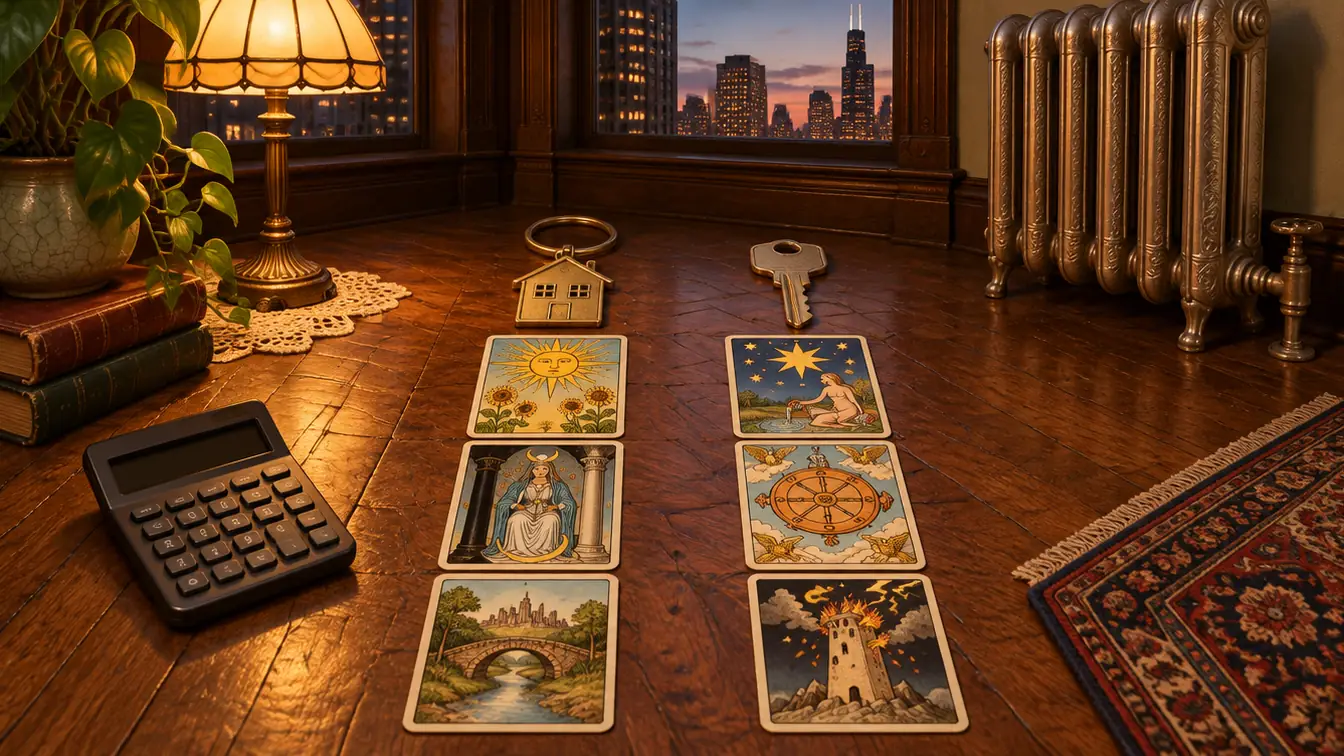
Lay seven cards. One sits in the middle, then two columns of three hang below it, left for renewing and right for buying.
| Position | Renew the lease (left) | Buy (right) |
|---|---|---|
| Center (card 1) | What this decision is really about for me | |
| Top of column | Card 2: what renewing gives me | Card 5: what buying gives me |
| Middle of column | Card 3: what renewing costs me, beyond money | Card 6: what buying costs me, beyond money |
| Bottom of column | Card 4: how I might feel a year from now on this path | Card 7: how I might feel a year from now on this path |
Card 1 often matters most. People think they are deciding about housing and discover they are deciding about security, independence, a relationship or what their parents expect of them. If a household is making the decision together, each partner can draw their own center card before the columns are laid.
A worked example
Here is an illustration, not a real client. Imagine a renter in Rogers Park weighing a one-bedroom condo a few stops south on the Red Line.
- Center: Four of Pentacles. A figure holding tightly to coins. The decision is about control and safety, and perhaps a fear of letting money go.
- Renew column: Four of Wands, Seven of Cups, the Hermit. Renewing offers a settled, sociable home (Four of Wands) but costs clarity, since keeping every option open leaves many daydreams and no plan (Seven of Cups). A year on, the Hermit suggests quiet reflection, possibly some isolation.
- Buy column: the Emperor, Ten of Wands, Six of Pentacles. Buying gives structure and authority over your own space. It costs energy: the Ten of Wands is a person carrying a heavy bundle, a fair picture of repairs and assessments. A year on, the Six of Pentacles shows give and take, money flowing in and out with some balance.
Read across the rows, not just down. The renew column feels pleasant but drifting; the buy column feels heavier but more deliberate. That contrast is the useful part. It does not say "buy." It says this person may be using the lease to avoid deciding, and that if they buy, they should budget for being tired for a while. Both observations can be tested against real numbers.
When the cards and the spreadsheet disagree
Sometimes the buy column glows and the budget says no. In that case the budget wins, every time. The cards are showing what you want, which is worth knowing, and it might shape a plan: save for another year, look at a different neighborhood, or rent somewhere that feels more like home in the meantime. Sometimes the reverse happens. The numbers work and the cards look anxious. Then the question to sit with is what the anxiety is about, and whether more information (an inspection, a talk with a lender, a frank conversation with a partner) would settle it.
A single card drawn for "should I buy?" tends to flatten all of this into a yes or no. The post on why yes-or-no tarot struggles with should questions explains the problem, and it is why this spread gives each path its own column.
If you are timing a move or a housewarming
Once a decision is made, some families like to choose an auspicious day for moving in or for a griha pravesh ceremony. That is a job for astrology rather than tarot, and the muhurta consultation for choosing dates covers it. If the bigger question is whether to leave the city altogether, the relocation astrology reading looks at moves from the chart side.
Bringing the question to a reading
If you would rather not lay the spread alone, a short one-question decision reading is built for choices like this one. You send the question in a sentence, the cards are laid on video or described by phone, and you leave with notes you can set beside your budget. Astrologer and Psychic Vijayram reads in Central Time, so an evening session after a day of viewings is easy to arrange through the booking page.
One honest limit applies. A spread reflects how the choice looks to you today; it does not forecast prices, rates or the state of a building's pipes. As the short answer on whether tarot is a forecast or a mirror puts it, the cards work best as a mirror. Use them to understand yourself, and let the lender, the inspector and your own arithmetic do the rest.
Common questions
Can the cards tell me whether mortgage rates will fall next year?
No. Rates depend on markets and policy, not on a spread. If waiting for a better rate is part of your thinking, ask a lender to show you what different rates would mean for your monthly payment, and use the cards only for how you feel about waiting.
What if both columns look discouraging?
That happens, and it usually says more about your mood than about either option. Two heavy columns often point to exhaustion with the whole subject. Take a week away from listings, then lay the spread again or talk it through in a session.
Does the spread work for other two-way choices?
Yes. Renting in the city against renting in a suburb, staying in a two-flat with family against moving out on your own, or keeping a condo against selling it all fit the same shape. Change the labels on the columns and keep the center card.
Should I lay this spread myself or book a reading?
Either works. Many people lay it at home first and book a session when the columns seem to argue with each other or when a partner sees the cards very differently.
Related service

Keep reading

Tarot Readings for Naperville and the Western Suburbs
How a tarot reading works for Naperville and western suburbs clients by phone, WhatsApp or video: what to prepare, the questions people bring, and the limits.
Read article →
Party Tarot or a Private Reading? Booking in Chicago
Hiring a tarot reader for a party in Chicago, or booking a private reading? What each format is for, how long it lasts, and which questions belong in which.
Read article →
Finals Week Tarot for Chicago Students
A short tarot spread for students in Chicago during finals week: four cards for stress and focus, plus the sleep, study and support basics that matter more.
Read article →Quick answers
Does it matter who shuffles the tarot deck?
How does a tarot reading work, and does it matter who shuffles the deck? Shuffling customs in person and at a distance, and what matters more than hands.
Read answer →Is a tarot reading a forecast or a mirror?
Can tarot predict the future? Why readers use tarot to reflect on a situation and its likely direction rather than to fix events, and how to use it well.
Read answer →Talk to Astrologer and Psychic Vijayram
Tell us what you are facing. If a reading is unlikely to help, you will be told that plainly.