

Finals Week Tarot for Chicago Students
Tarot for students during finals week works best as a short check-in, not a forecast. A four-card spread can show what is draining your focus, what steadies you and one small next step. In Chicago or anywhere else, the cards cannot sit your exams, predict grades or replace sleep, study time and campus support.
Key takeaways
- The research on exam stress is not mysterious.
- Shuffle while you think about the week ahead, not about a specific grade.
- You do not need to know all 78 meanings by heart.
- Finals land differently across the city's schools: some run on quarters and some on semesters, so exam weeks fall at different points in the year.
- Some decisions do come up during exams: whether to drop a class next term, switch majors, take a gap quarter or stay in Chicago for the summer.
It is past midnight in December. Outside the library window the sun went down before half past four, the wind off the lake is doing its best, and you have three exams in four days. Somewhere in your bag there is a tarot deck a friend gave you, and you are wondering whether it could help you think straight.
It can, a little, if you use it the right way. This post offers a four-card spread for stress and focus, written for students at Chicago's colleges and universities, from Hyde Park to Evanston and Rogers Park. First, though, the unglamorous part, because no card replaces it.
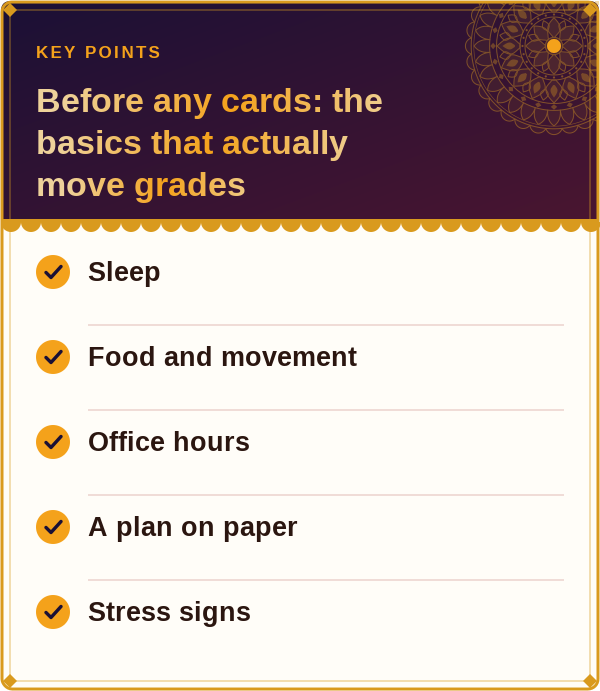
Before any cards: the basics that actually move grades
The research on exam stress is not mysterious. Sleep matters for memory and concentration, and the CDC's guidance on sleep and health is blunt that adults who regularly sleep too little pay for it in attention and mood. All-nighters feel productive and usually are not.
- Sleep. Protect at least one full night before each exam.
- Food and movement. A walk around the block or along the lakefront clears your head better than another energy drink.
- Office hours. One question answered by a teaching assistant can save an hour of rereading.
- A plan on paper. List each exam, its date and the three topics you are least sure of.
- Stress signs. MedlinePlus describes the common signs of stress, from headaches and poor sleep to irritability. If they pile up, campus health and counseling services exist for exactly this.
With those in place, a short spread can be a useful pause rather than a distraction.
A four-card spread for finals week
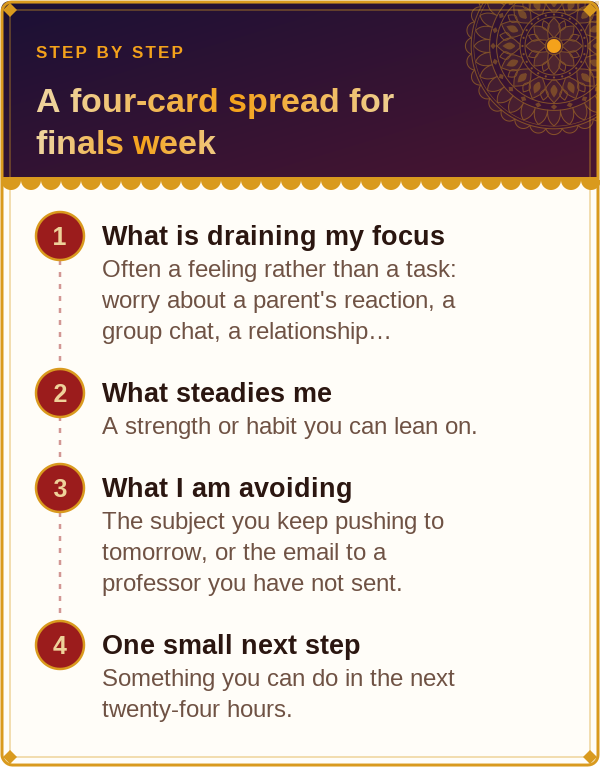
Shuffle while you think about the week ahead, not about a specific grade. Lay four cards in a row.
- What is draining my focus. Often a feeling rather than a task: worry about a parent's reaction, a group chat, a relationship, comparing yourself with classmates.
- What steadies me. A strength or habit you can lean on. It might be discipline, a study partner or simply the fact that you have done hard weeks before.
- What I am avoiding. The subject you keep pushing to tomorrow, or the email to a professor you have not sent.
- One small next step. Something you can do in the next twenty-four hours.
Read the fourth card as concrete and small. The Eight of Pentacles might mean sit down and do practice problems for an hour. The Four of Swords, a figure at rest, might mean go to bed. The Page of Swords might mean write the email you have been avoiding.
Reading it in five minutes
You do not need to know all 78 meanings by heart. Look at each picture and ask what it shows a person doing. If the first card is the Nine of Swords, someone sitting up in bed with their head in their hands, you probably already know what is draining your focus: worry at night. If the second card is the Chariot, the steadying force is your own determination. Write one line for each card in your planner, then put the deck away and start on the step from card four.
If you like the habit, the post on a daily card for reflection turns it into a two-minute morning routine that works well in a busy term.
Questions to keep away from the deck
Some questions only make finals week worse when you put them to the cards:
- "Will I pass organic chemistry?" No card can see that, and a bad draw will rattle you before the exam.
- "What grade will I get?" Same problem.
- "Is my professor going to curve it?" Ask the professor.
A better version of each is about what you control: "What would help me prepare for chemistry this week?" The guide to rewriting prediction questions into better tarot questions has more examples.
Chicago campuses, long nights
Finals land differently across the city's schools: some run on quarters and some on semesters, so exam weeks fall at different points in the year. The Hyde Park neighborhood, home to the University of Chicago, empties out after its exams, while campuses in Evanston, Rogers Park, Lincoln Park and the Near West Side keep their own calendars. Many students are also far from home. If your family is in India, remember they are ten and a half or eleven and a half hours ahead of Chicago, depending on the season, and a quick call at a sensible hour for both of you can steady you more than any card.
When a short reading helps
Some decisions do come up during exams: whether to drop a class next term, switch majors, take a gap quarter or stay in Chicago for the summer. Those suit a short one-question decision reading, where the question is worded carefully and the cards are read as prompts, never as orders. Astrologer and Psychic Vijayram reads by phone, WhatsApp or video in Central Time, so a twenty-minute call between study sessions is easy to fit in. Book through the contact page once your exam schedule is clear.
When stress becomes something more
If finals week has tipped into panic, hopelessness or not sleeping for days, put the cards down. Talk to your campus counseling center or a doctor. You can contact the Suicide and Crisis Lifeline at any hour to reach the Suicide and Crisis Lifeline, and in an emergency call emergency services. The post on when anxiety means it is time to pause the cards explains why readings and spiraling worry are a bad mix.
The plain limit: cards do not sit exams. They can help you notice what is in your way and choose one next step. The studying, the sleep and the asking for help are still yours to do, and they are what carry you through.
Common questions
Can the cards tell me if I will pass?
No. No spread can see an exam result, and a reader who claims otherwise is guessing. What the cards can do is help you notice what is getting in the way of studying, which is something you can change.
Is a reading a waste of study time?
A four-card spread takes about ten minutes, which is roughly one coffee break. If it helps you pick a plan for the evening, it has paid for itself. If you notice you are drawing cards instead of studying, put the deck in a drawer until exams are over.
Can I book a short session during exam week?
Yes. A short one-question session fits between exams, and evening slots in Central Time suit most student schedules. Keep the question about your choices, such as how to plan the week or whether to drop a class next term.
What if I feel overwhelmed, not just stressed?
Talk to someone now. Your campus counseling center, a doctor or the Suicide and Crisis Lifeline by call or text can help. If you are in danger, call emergency services. A tarot spread is not the right tool for that moment.
Related service
Keep reading
Tarot Near Me in Chicago: In Person or by Phone?
Searching for a tarot reader near me in Chicago? How readings by phone or video work, how cards are chosen at a distance, and when a table may matter to you.
Read article →
The Zodiac Cards of the Major Arcana, Read Through Your Vedic Moon Sign
Major Arcana meanings for the twelve zodiac trumps, using the Golden Dawn pairings shifted to the sidereal Moon sign in your kundli, as a reflective exercise.
Read article →
Fire, Water, Air and Earth: The Elements Behind the Minor Arcana
Minor Arcana meanings through the four elements: Wands as fire, Cups as water, Swords as air, Pentacles as earth, and how element balance in a spread is read.
Read article →Quick answers
Does it matter who shuffles the tarot deck?
How does a tarot reading work, and does it matter who shuffles the deck? Shuffling customs in person and at a distance, and what matters more than hands.
Read answer →Is a tarot reading a forecast or a mirror?
Can tarot predict the future? Why readers use tarot to reflect on a situation and its likely direction rather than to fix events, and how to use it well.
Read answer →Talk to Astrologer and Psychic Vijayram
Tell us what you are facing. If a reading is unlikely to help, you will be told that plainly.