

Ketu Mahadasha and the Pull Toward Spiritual Life
Ketu mahadasha is a seven-year period that tradition links with detachment, endings, spiritual practice and inward attention. Many people feel less interested in status and more drawn to prayer, study or pilgrimage. The practical task is to honor that pull while keeping work, money, health and relationships steady, rather than abandoning everything at once.
Key takeaways
- Ketu is the Moon's south node, the partner of Rahu.
- Not everyone feels all of these, and some feel few.
- For many families in Chicagoland, a Ketu period is when the regular temple visit becomes a commitment rather than an occasion.
- The risk in a Ketu period is not spirituality.
- Ketu's period is short, and so are its parts:
Some people describe the start of their Ketu period as a quiet loss of appetite for things that used to matter. The promotion that once felt urgent seems less important. A crowded social calendar starts to feel like noise. A trip to a temple, a meditation course or a long-postponed pilgrimage suddenly seems more real than the next quarterly target. If that sounds familiar, tradition has a name for it.
Why Ketu is linked with letting go
Ketu is the Moon's south node, the partner of Rahu. In the old story, retold in the account of Ketu, it is the headless body of the demon whose head became Rahu. Where Rahu is hunger without a stomach, Ketu is a body without a head: action without craving, knowledge without the need to display it. The Sanskrit and Jyotisha senses of the word collected by Wisdom Library include a banner or flag and a sign, which fits Ketu's role as a pointer beyond ordinary goals.
In Jyotish, Ketu is the karaka, or significator, of moksha (release), past skills, research, sudden insight, and the things we already know so well we no longer value them.
What people commonly report
- Less interest in recognition, more interest in meaning.
- A pull toward prayer, mantra, meditation or scripture.
- Endings: a job, a friendship or a role that has run its course.
- Sudden insights or changes of direction.
- Interest in research, healing traditions, languages or the occult.
- Feeling like an outsider in familiar settings.
Not everyone feels all of these, and some feel few. Ketu's sign and house, and the planet ruling that sign, shape how the period shows up.

Pilgrimage, close to home and far away
For many families in Chicagoland, a Ketu period is when the regular temple visit becomes a commitment rather than an occasion. The area has long-standing temples within a drive: the Hindu Temple of Greater Chicago in Lemont, the Sri Venkateswara (Balaji) temple in Aurora modeled on Tirupati, and the BAPS mandir in Bartlett. The post on visiting Chicago-area temples has practical notes. Others plan a trip to India for a pilgrimage long talked about, or join a retreat.
A daily practice is often the most useful step of all. A short mantra or breath routine, done consistently, gives Ketu's inward pull a shape. The personal mantra and meditation session is designed for exactly that.
Keeping practical life steady
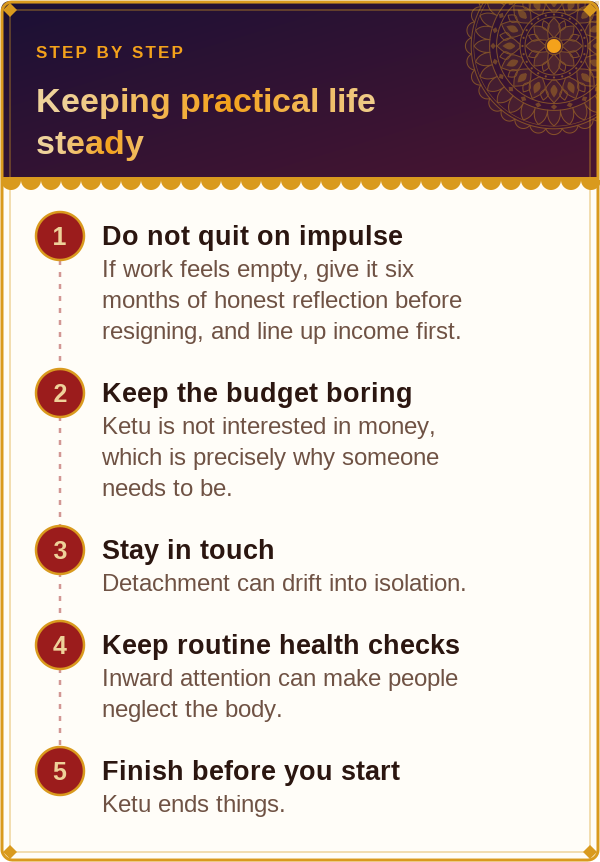
The risk in a Ketu period is not spirituality. It is dropping the practical threads all at once. A short checklist:
- Do not quit on impulse. If work feels empty, give it six months of honest reflection before resigning, and line up income first.
- Keep the budget boring. Ketu is not interested in money, which is precisely why someone needs to be.
- Stay in touch. Detachment can drift into isolation. Keep regular calls with family and a few friends on the calendar.
- Keep routine health checks. Inward attention can make people neglect the body.
- Finish before you start. Ketu ends things. Let it close what is genuinely finished, rather than everything at once.
The seven years, in sub-periods
Ketu's period is short, and so are its parts:
| Sub-period | About | Often read as |
|---|---|---|
| Ketu | 5 months | The tone is set, sometimes abruptly |
| Venus | 1 year, 2 months | Comfort and relationships return to view |
| Sun | 4 months | Questions of authority and self-respect |
| Moon | 7 months | Emotion, home, mother |
| Mars | 5 months | Energy, conflict, decisive action |
| Rahu | 1 year | The node axis activated: restless and eventful |
| Jupiter | 11 months | Teachers, learning, faith |
| Saturn | 1 year, 1 month | Duty and structure |
| Mercury | 1 year | Study, trade, communication |
The period hands over to Venus's long twenty years, often a striking change of mood. To see where you are on that line, use a hand-drawn Vimshottari timeline.
Ketu and Rahu as a pair
Ketu sits exactly opposite Rahu in every chart. The houses they occupy form an axis: what Rahu reaches for, Ketu already holds. Reading a Ketu period well usually means looking at Rahu too. The post on Rahu's period of ambition and reinvention describes the other end.
Optional remedies
Traditional practices include prayers to Ganesha, who is commonly associated with Ketu, meditation, and service without seeking credit. They are offered as choices, explained first, and never sold on fear.
A plain limit
A Ketu period does not decide whether you renounce anything, lose anything or find anything. It describes a traditional theme of inwardness for reflection. For a reading of your own Ketu, its house and its dispositor, a dasha and transit reading with Astrologer and Psychic Vijayram is the place to start.
Common questions
Does Ketu's period mean I will lose my job?
No. Ketu is linked with endings and detachment, so some people do leave roles or change direction. Others stay in the same job and simply care less about titles. Placement and sub-periods shape it.
Why is Ketu said to act like Mars?
A traditional saying holds that Ketu behaves like Mars, sharp and sudden. That is one reason astrologers check where Mars sits and how it is placed when reading a Ketu period.
Should I wear a cat's eye for Ketu?
Only after careful review, if at all. Cat's eye is one of the stones tradition treats cautiously. Prayer, meditation and simple service carry no such risk.
I feel numb and disconnected. Is that just Ketu?
Please do not assume so. Persistent numbness, low mood or withdrawal can be signs of depression and deserve a conversation with a doctor or therapist. Astrology can sit alongside that care, never in place of it.
Related service

Keep reading

Venus Mahadasha and Money: Comfort, Spending and Creative Work
Venus mahadasha read for money: Shukra's twenty years and comfort, spending, art and lifestyle, with plain budgeting habits to keep alongside the chart.
Read article →
Born With Mercury Retrograde: Reading Vakri Budh in Your Own Chart
Mercury retrograde in Vedic astrology, natal edition: why vakri Budh is read as strong and inward, not broken, and what it suggests about thinking and study.
Read article →
Jupiter Transit by Moon Sign: Twelve Short Notes for the Year
Jupiter transit by Moon sign: twelve short notes, one per rashi, on how a guru gochar is read from the Moon, written as tendencies rather than fixed outcomes.
Read article →Quick answers
How do I find which mahadasha I am in now?
What is mahadasha, and which one are you in now? Trace the Vimshottari sequence from the Moon's nakshatra at birth to today's period in a few plain steps.
Read answer →How do I know if Sade Sati has started for me?
What is Sade Sati, and has it started for you? Compare transiting Saturn with your Vedic Moon sign, then read the three phases without the scare stories.
Read answer →Talk to Astrologer and Psychic Vijayram
Tell us what you are facing. If a reading is unlikely to help, you will be told that plainly.