
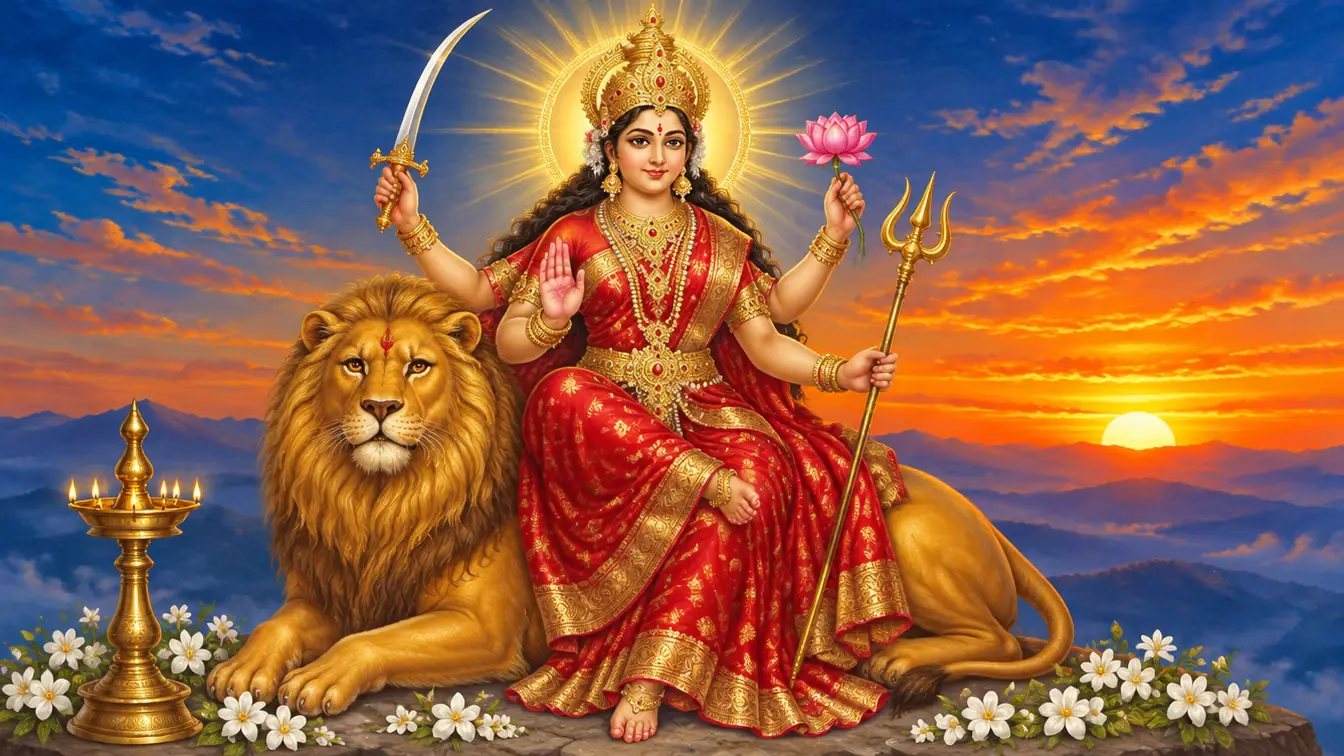
Mantra and Prayer for Your Own Love Life: A Vedic Alternative to a Spell
A mantra for your love life works on the person chanting it: a steadier mind, clearer intentions and readiness to meet someone or repair what is yours to repair. Vedic tradition offers a Friday Venus mantra, the Katyayani prayer for a good marriage and a sankalpa stating your intention. None of it should be aimed at a named person.
Key takeaways
- People who go looking for a love spell often want one thing underneath the search: to stop feeling powerless.
- A sankalpa is a spoken intention at the start of a practice.
- In Vedic astrology Venus is Shukra, the planet traditionally read for affection, attraction, comfort and partnership.
- In the Bhagavata Purana, the young women of Vraja worship the goddess Katyayani through a winter month, praying for a good husband.
- A short Sanskrit prayer often recited at the end of practice asks that all beings be happy and that no one suffer: Sarve bhavantu sukhinah .
Why a mantra, and not a spell
People who go looking for a love spell often want one thing underneath the search: to stop feeling powerless. A flyer's spell promises power over someone else by a deadline. A mantra for your love life offers steadiness in yourself, and it sits well beside the reconciliation prayer and puja offered here. A mantra and a prayer begin with your own mind, your own readiness, and your own way of loving.
A mantra is a sacred sound, word or verse repeated with attention, a practice with deep roots across Indian religions, as the overview of mantra explains. What follows are a few traditional choices for love and partnership, with honest notes on how to use them. Nothing here is required, and none of it is a substitute for living your life, meeting people and having honest conversations.
Start with a sankalpa that names only you
A sankalpa is a spoken intention at the start of a practice. Traditionally it says who is praying, where, when, and for what. Said at home in Chicago, it names this city and the day you begin. A simple version might be:
"I, [your name], here in Chicago, begin this practice today so that I may be calm, honest and ready for a loving partnership."
Notice the tone. Nothing in it asks for harm or for power over anyone. If you are in a relationship that is struggling, your sankalpa can ask for patience, clear speech and the wellbeing of both of you. If someone has left, it can ask for reconciliation, for peace and for the obstacles between you to lift. For a home practice, begin with yourself; a reconciliation puja for an ex or lost love is a separate service.
Friday and Venus
In Vedic astrology Venus is Shukra, the planet traditionally read for affection, attraction, comfort and partnership. The overview of Shukra notes that Friday, Shukravara, is named for him and gives his seed mantra as Om Draam Dreem Draum Sah Shukraya Namaha. A shorter form many people use is Om Shum Shukraya Namaha.
A common practice is one round of 108 repetitions on a mala on Friday mornings, or a shorter count on other days. In Jyotish, the first planetary hour, or hora, of each Friday belongs to Venus, and horas are counted from local sunrise. Use Chicago's sunrise, not India's: it comes close to 7:20 a.m. in early January and around 5:15 a.m. in mid-June, so a Friday practice timed to the Venus hora moves by about two hours across the year. If dawn does not suit your schedule, any quiet time on a Friday is fine. Tradition treats sincerity as more important than the minute.
If you want to know how Venus is placed in your own chart before you begin, the post on reading Venus's condition in a love reading explains what the reader looks at.
The Katyayani prayer, framed honestly
In the Bhagavata Purana, the young women of Vraja worship the goddess Katyayani through a winter month, praying for a good husband. Families still recite prayers to Katyayani, and to Parvati, when a son or daughter is hoping to marry. Said here, the prayer asks for a good and suitable partnership in general. It is not recited with a particular person in mind, and it is never used to press a reluctant partner or reluctant parents. The post on family approval for a love marriage shows how prayer can sit alongside patient conversations at home without becoming a weapon.
A prayer that includes the other person
A short Sanskrit prayer often recited at the end of practice asks that all beings be happy and that no one suffer: Sarve bhavantu sukhinah. It is useful after a breakup in particular. Saying it while thinking of someone who hurt you is hard, and that is the point. It turns a practice that could slide into obsession into one that loosens its grip. You do not have to wish them back. You only have to wish them well, and wish yourself well too.
A forty-day practice for a Chicago week
Forty days is a traditional length for a vow, long enough to form a habit and short enough to see the end. A plan that fits a working week here might look like this:
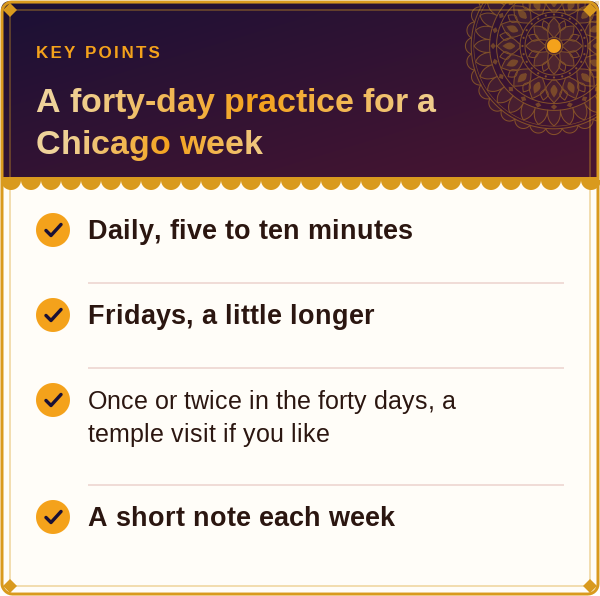
- Daily, five to ten minutes: your sankalpa, a short count of your chosen mantra, and the closing prayer for everyone's wellbeing.
- Fridays, a little longer: a full round of 108 for Venus, ideally near your local sunrise, with a lamp lit if that is part of your practice and safe where you live.
- Once or twice in the forty days, a temple visit if you like: the Sri Venkateswara (Balaji) Temple in Aurora follows the Tirupati tradition, whose stories include the marriage of Venkateswara and Padmavati, and the Hindu Temple of Greater Chicago in Lemont is another choice. Check each temple's own website for timings.
- A short note each week: how you are sleeping, what you have done for your own life, and whether the longing feels heavier or lighter.
If you are unsure which mantra to choose, the post on choosing a mantra by deity, by planet or by need compares the options, and personal mantra and meditation guidance can teach the pronunciation and fit a routine to your actual week.
When a reading helps
A mantra works best alongside some honest thinking about your situation. If you have been single longer than you hoped, a love timing reading can put the wait in perspective. If you came here after searching for a love spell, the page on love spells and getting an ex back in Chicago sets out what is offered and how it works. And if you are curious why people have trusted love charms for thousands of years, the post asking whether love spells work looks at the history.
What a mantra cannot do
A mantra cannot make anyone love you, return to you or stay. It works on the person chanting, and even then gently, over weeks. Meditation research summarized by the National Center for Complementary and Integrative Health suggests that practices like this may help some people with stress and sleep, and also notes that a few people find meditation brings up difficult feelings. If your thoughts about a person have become constant or frightening, or heartbreak is affecting your sleep, work or safety, talk to a doctor or counselor. Astrologer and Psychic Vijayram offers mantra and prayer as faith-based support, never as a replacement for that care.
Common questions
Is there a mantra to make a specific person love me?
Prayer in this tradition asks for blessing, reconciliation and the wellbeing of everyone involved. Getting an ex or lost love back is offered as a separate service of prayer, mantra and puja, with no result promised and nothing done to harm anyone.
Is there a mantra to attract love?
Tradition offers prayers for a good partnership, such as a Friday Venus mantra or the Katyayani prayer. Read honestly, they attract love by working on you: steadier moods, a clearer sense of what you want and more openness to meeting people.
Can I chant these if I am not Hindu?
Yes, if you approach them with respect. Many people from other backgrounds use a short mantra as a focus for prayer. If your own faith has prayers for love and marriage, those work just as well as a daily practice.
Do I need a priest for the sankalpa?
No. A sankalpa before a temple puja is usually spoken by the priest, but a personal sankalpa for home practice is yours to say. Keep it short and honest, and say it the same way each day.
Related service
Keep reading

Dating Through a Chicago Winter: What a Love Reading Is Good For
A love reading in Chicago during the cold months: why loneliness and commitment questions get louder in winter, and how to ask ones that actually help.
Read article →
Ten and a Half Hours Apart: Chicago-India Couples and Their Call Schedules
Long distance relationship astrology for Chicago-India couples: how the time gap shifts when clocks change, call routines that hold, and what two charts add.
Read article →
Rushing Into Love in a Lonely First Chicago Winter? A Gentle Pause
Lonely after moving to Chicago and tempted to rush into love? Moon transits, why friendships first often help, and ordinary ways newcomers find community.
Read article →Quick answers
Should I keep waiting for my ex while I get readings?
Can a psychic bring your ex back? Get-your-ex-back work is offered as prayer, mantra and puja for reconciliation, with no result promised. Waiting versus healing.
Read answer →Can I ask about someone else's feelings in a love reading?
Questions to ask in a love reading when you want to know someone else's feelings: why readings stay with your side, and how to reframe the question.
Read answer →Talk to Astrologer and Psychic Vijayram
Tell us what you are facing. If a reading is unlikely to help, you will be told that plainly.