

Telling Your Parents in the Suburbs About Your Partner
For families in the Chicago suburbs, telling Indian parents about a partner usually goes better in stages: one trusted relative first, then a calm private talk, then time before any meeting. A chart reading can give everyone shared, neutral language, but it should never be used to pressure parents or to overrule your own choice.
Key takeaways
- Many suburban parents still value horoscopes, and a reading can offer shared, neutral language.
- Sometimes the hesitation runs on both sides.
- The Forced Marriage Initiative explains what counts as forced marriage and how to get confidential help, and emergency services is the number to call if you are in danger.
- The post on patience and prayer when a family hesitates over a love marriage covers the months after that first conversation.
You have rehearsed it on the drive home from the Loop more times than you can count. Somewhere on the tollway between the city and your parents' driveway in Schaumburg or Naperville, the speech falls apart. Telling Indian parents about a boyfriend or girlfriend is rarely one conversation. It is a sequence, and it goes better when you plan it like one.
Many South Asian families now live well beyond the city. A WBEZ analysis of suburban South Asian hubs counted more than 13,000 South Asian immigrants in Naperville, with roughly 9,000 in Schaumburg and 8,000 in Aurora. Those suburbs come with their own social weather: tight circles of family friends, the same faces at the temple and at birthday parties, and news that travels fast.
Before you say anything
- Know what you are asking for. Acceptance of the relationship? Permission to marry? A first meeting? Parents can hear "I am seeing someone" very differently from "I am going to marry this person."
- Know what they fear. Usually it is some mix of community reputation, cultural loss, your future security and simply being left out of your life.
- Agree with your partner on the pace. They should know what you plan to share and when.
A conversation plan in five stages
- One ally first. An older cousin, an aunt, a sibling who has been through it. They can tell you how your parents are likely to react and may soften the ground.
- A private, unhurried talk. Not at a party, not on the phone during their commute, not during Diwali with relatives in the next room. A weekend afternoon at home works for many families.
- Lead with the person, not the label. Describe who they are: their work, their family, how they treat you. Caste, religion or nationality will come up, but it lands better after your parents have a sense of a real human being.
- Stop before it becomes a fight. Let the first conversation end with "please think about it." Most parents need time, and their first reaction is rarely their last.
- A low-pressure meeting later. Coffee or a casual meal, not a formal visit. Some families prefer the partner's parents to approach them, which takes more planning but carries traditional respect.
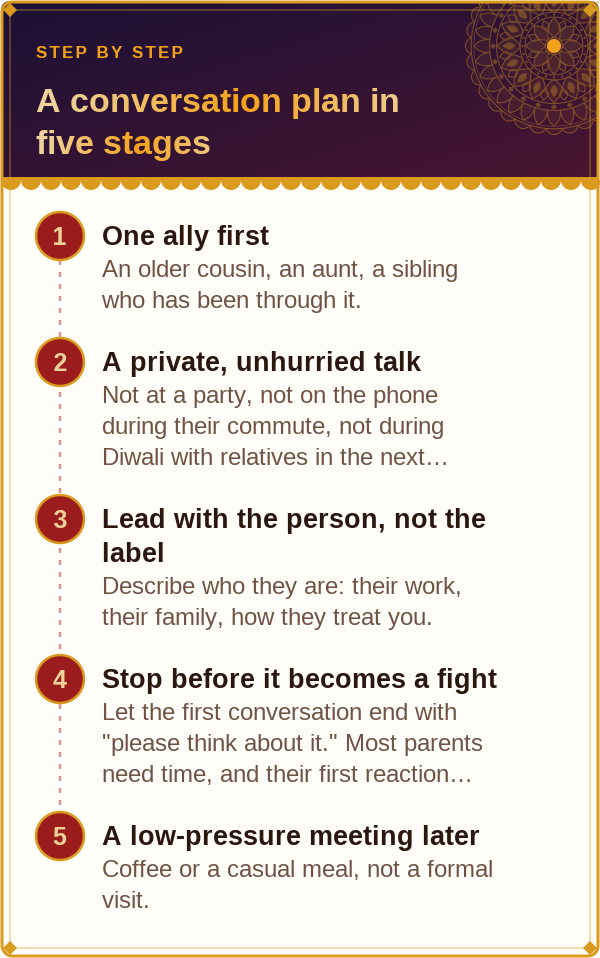
Chart insight as a bridge, not a weapon
Many suburban parents still value horoscopes, and a reading can offer shared, neutral language. Instead of a standoff about who is right, the family can talk about what the charts describe: temperaments, strengths, the periods ahead. A love marriage and family approval session with Astrologer and Psychic Vijayram is built for exactly this, with parents welcome to join by video.
The same tool can also be misused. Some ways to keep it a bridge:
- Do not use a good match score to corner your parents. "The stars agree, so you have to" turns a tradition they love into a trap.
- Do not let a weak score become a weapon against you either. One factor is never a verdict, and a full kundli matching reads the whole picture, including cancellations.
- Ask for any remedies to be explained and optional. Nobody should feel the relationship depends on a paid ritual.
Things that usually make it worse
- Ultimatums in the first conversation, from either side.
- Letting your parents find out from someone else.
- Comparing them to other families who accepted a match.
- Promising things you cannot keep, such as a partner's conversion, to win quick agreement.
When both families are traditional
Sometimes the hesitation runs on both sides. A Gujarati family in Naperville and a Tamil family in Schaumburg may each worry about language, food, rituals and which customs the wedding will follow. In that case the conversation plan doubles: each partner talks to their own parents first, and only later do the families meet.
It can help to agree in advance on the few things that matter most to each of you and the many things that can flex. Families often fight hardest over symbols, such as which ceremony comes first or whose priest officiates, and these are easier to settle once everyone feels heard. Some couples find a joint session useful, where both families hear the same explanation of the two charts at the same time, so nobody suspects the reading was arranged to favor one side.
When it is not just disapproval
Disagreement is painful but normal. Coercion is different. If you are being kept from leaving home, having your phone or passport taken, or being pushed toward a marriage you do not want, that is a safety issue. The Forced Marriage Initiative explains what counts as forced marriage and how to get confidential help, and emergency services is the number to call if you are in danger.
The long view
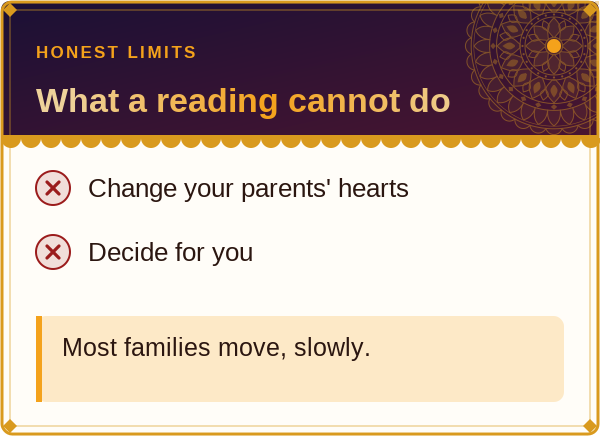
Most families move, slowly. The post on patience and prayer when a family hesitates over a love marriage covers the months after that first conversation.
A reading cannot change your parents' hearts or decide for you. It can give you steadier footing and calmer words, which is often what the first conversation needs most.
Common questions
Should I show my parents our kundli matching score?
Only if it helps the conversation and you are prepared for any result. A good score can reassure traditional parents. Waving it as proof that they must agree usually backfires, and a low score handed over without context can close the door.
My partner is not Indian. Does a chart reading still make sense?
It can, if both of you want it. The chart does not care about background. Some parents find it reassuring that the couple took the tradition seriously. The post on intercaste and interfaith marriage in the chart goes further.
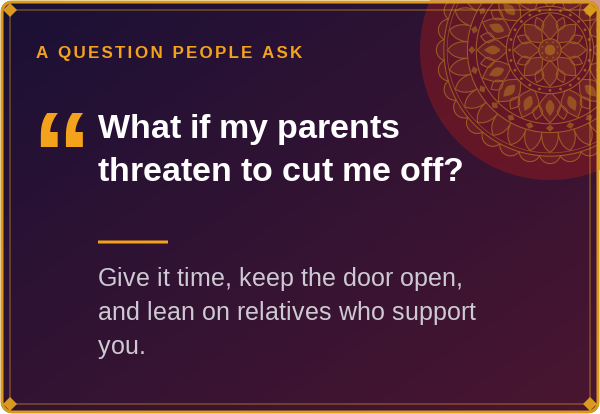
What if my parents threaten to cut me off?
Give it time, keep the door open, and lean on relatives who support you. If threats ever turn to confinement, taking your passport or forcing a marriage, contact the Forced Marriage Initiative or call emergency services.
Can a reading tell me when my parents will accept us?
It can describe periods tradition considers easier for family harmony. It cannot set a date for someone else's change of heart.
Related service

Keep reading

What Busy Chicago Professionals Ask in a Love Reading
What Chicago professionals bring to a love reading: long hours, long commutes, two careers and one apartment, and the questions underneath all of it.
Read article →
Valentine's Day in Chicago: A Reading Instead of a Reservation?
A Valentine's Day love reading in Chicago: what couples and singles ask in mid-February, a three-card spread for the week, and what tarot cannot tell you.
Read article →
Breakup Recovery When You Live Alone in the City
Getting through a breakup alone in a Chicago apartment: a steady daily routine, a short list of people to call, and where a breakup reading fits, and when not.
Read article →Quick answers
Should I keep waiting for my ex while I get readings?
Can a psychic bring your ex back? Get-your-ex-back work is offered as prayer, mantra and puja for reconciliation, with no result promised. Waiting versus healing.
Read answer →Can I ask about someone else's feelings in a love reading?
Questions to ask in a love reading when you want to know someone else's feelings: why readings stay with your side, and how to reframe the question.
Read answer →Talk to Astrologer and Psychic Vijayram
Tell us what you are facing. If a reading is unlikely to help, you will be told that plainly.